By David Vilchez, Founder & CEO, Medical Staff Talent
→ Sports Physiotherapist (Manual & Movement Therapy) — Private Family, Dubai
Ask a sports physiotherapist what a private family role involves and the first picture is often rehabilitation after an injury. In practice, the families we work with in Saudi Arabia, the UAE and Qatar are usually looking for something more continuous: a clinician who understands the sports the household actually plays, and keeps everyone playing them comfortably and safely, week after week, wherever the family happens to be.
Padel, tennis, golf and riding come up again and again in these briefs. This article looks at each sport through the eyes of a sports and manual therapy physiotherapist: the typical loading patterns, the hands-on and movement-control work a family tends to value, and how a programme can follow the family across courts, courses and stables in several countries. It is written for Western-Trained physiotherapists, particularly from the Nordic countries and Central and Eastern Europe. Where we describe a situation, it is a hypothetical example, not an account of a real person or placement.
Medical Staff Talent in one line: “Exclusively sourcing Western-Trained Private & Concierge Physicians, Physiotherapists & Osteopaths, and Private & Maternity Nurses for Private Families across the GCC.”
Why sport-specific knowledge matters in a private household
In a clinic, a physiotherapist sees a padel player for a few sessions and then the player disappears. In a private household, the same person may play four evenings a week, travel to a tournament with friends, take a golf lesson the next morning and ride at the weekend. The physiotherapist sees the whole loading picture, every day, and has the rare chance to act before small problems become injuries.
That is why the brief for these roles emphasises manual therapy and movement control over strength and conditioning, and why experience with elite athletes, professional teams or high-profile clients is a strong advantage. For a full description of the role, read our guide to sports physiotherapist jobs with private families in the Gulf, and for how elite-sport experience is weighed, our article on elite-sport physiotherapists in private family roles.
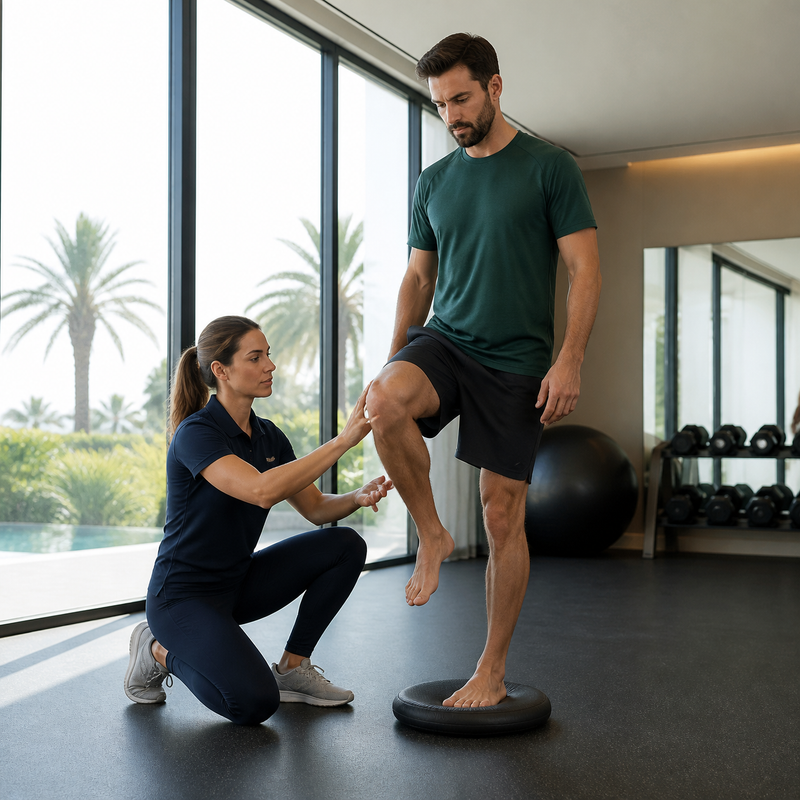
Balance and proprioception run through all four sports below; our article on balance and proprioception training, from elite athletes to older family members explains how that work is adapted across a household.
Padel
Padel has become one of the most popular sports among active families in the Gulf, and it is often played in the evening, several times a week, with friends and family. The game rewards quick lateral movement, repeated overhead shots and play close to the walls.
What a physiotherapist typically watches
- Forearm, elbow and wrist load from repeated volleys and smashes.
- Shoulder load from overhead play, especially when thoracic mobility is limited.
- Calf, Achilles and knee load from short, sharp changes of direction on artificial grass.
- Lower back stiffness after long evenings of play following a day of travel or meetings.
Where manual and movement-control work helps
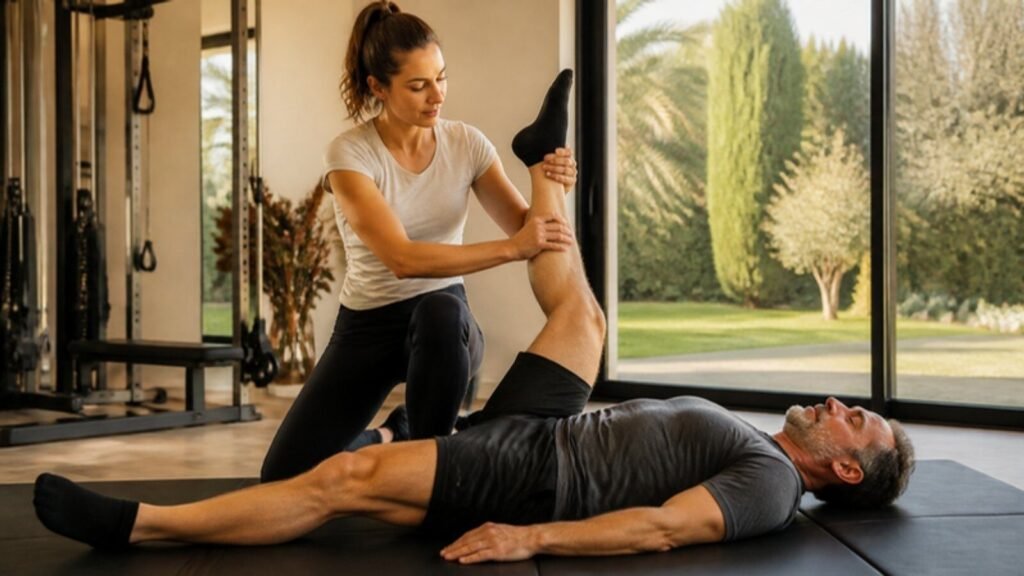
Soft tissue release for the forearm and calf, thoracic mobilisation, assisted stretching after play, and short movement-control drills for deceleration and landing are the kind of work families notice and appreciate. A ten-minute pre-match routine that a principal actually enjoys is often worth more than a long programme that is never followed.
Tennis
Tennis shares some of padel’s demands but adds longer rallies, a full serve and more running. Many principals have played since childhood, and older players often want to keep playing well into later life.
What a physiotherapist typically watches
- Serving shoulder: rotator cuff, scapular control and thoracic rotation.
- Elbow and wrist load, particularly on the backhand.
- Hip rotation and lumbar spine load on the serve and open-stance forehand.
- Knee and ankle load from hard and clay courts while travelling.
Where manual and movement-control work helps
Joint mobilisation for the thoracic spine and hips, scapular and rotator cuff control work, corrective exercise for the kinetic chain of the serve, and careful load management around travel and tournaments. For junior players in the family, the physiotherapist works within the plan agreed with the family and the child’s coach. Our article on young athletes in a private family looks at safeguarding, growth spurts and training load for children and teenagers in more detail.
Golf
Golf is played more in the cooler months in the Gulf and often on trips abroad. For how sessions are timed around the climate, see training and recovery in Gulf heat. The swing is a repeated, high-speed rotation, and many golfers combine it with long flights and long days.
What a physiotherapist typically watches
- Lower back load from rotation, especially when hip and thoracic mobility are limited.
- Lead hip and knee load through the downswing and follow-through.
- Elbow and wrist load, especially from practice sessions on mats.
- Stiffness after flights before a round the next morning.
Where manual and movement-control work helps
Hip and thoracic mobilisation, soft tissue work for the lumbar and gluteal region, rotational movement-control exercises, and a simple warm-up the golfer can use on the first tee. Working alongside a golf professional, never in place of one, keeps the advice consistent.
Riding
Many families keep horses, ride for pleasure or compete in show jumping and endurance riding, which has a long tradition in the region. Riding asks for deep core control, hip mobility, balance and the ability to absorb movement for long periods.
What a physiotherapist typically watches
- Lower back and sacroiliac load from long hours in the saddle.
- Hip adductor and flexor tightness.
- Balance, proprioception and core control, which shape the rider’s position.
- Recovery after falls, which always follows medical assessment first.
Where manual and movement-control work helps
Breathing and core control work, hip mobility, proprioception and balance training on and off unstable surfaces, and soft tissue work for the back and hips. Any fall with a suspected head injury or fracture is referred for medical assessment straight away; the physiotherapist’s role begins once the family’s doctor has cleared it.
A quick comparison
| Sport | Common loading areas | Manual therapy focus | Movement-control focus |
|---|---|---|---|
| Padel | Forearm, shoulder, calf, knee | Forearm and calf soft tissue release, thoracic mobilisation | Deceleration, landing, lateral change of direction |
| Tennis | Serving shoulder, elbow, hips, lower back | Thoracic and hip mobilisation, shoulder soft tissue work | Scapular control, kinetic chain of the serve |
| Golf | Lower back, lead hip, elbow | Hip and thoracic mobilisation, lumbar soft tissue work | Rotational control, first-tee warm-up |
| Riding | Lower back, sacroiliac region, hips | Hip and back soft tissue work, assisted stretching | Breathing, core control, balance and proprioception |
A hypothetical week across three sports
Picture a family that spends the winter in Riyadh and travels to Europe for part of the spring. On Monday evening, the principal plays padel; the physiotherapist runs a short warm-up before the match and does forearm and calf soft tissue work afterwards. On Tuesday, the principal’s spouse has a golf lesson in the morning; the physiotherapist works on hip and thoracic mobility beforehand. On Wednesday, an older relative has a balance session in the residence gym. On Friday, a teenage son rides; the physiotherapist works on core control and hip mobility within the programme agreed with the family. The following week, the whole programme moves to a hotel and a tennis club abroad, with the same routines adapted to a smaller space.
None of this is dramatic, and that is the point. The family stays active, small problems are dealt with early, and the physiotherapist becomes part of the household’s routine. For another view of how a week can unfold, read a hypothetical week as a travelling physiotherapist with a private family.
Keeping the programme going while travelling
Families in these roles travel constantly, and the physiotherapist travels with them. A sport-specific programme therefore has to work in a hotel room, on a yacht deck or at a club abroad. In practice, that means:
- A portable treatment couch and a small kit of bands, balls and mobility tools.
- Short routines that need little space and no gym.
- Clear notes so that the family’s coaches and trainers abroad can follow the same plan.
- Extra attention to recovery around long flights and time-zone changes.
What the role offers
- A permanent, live-in appointment with the family, with annual leave. Once in post, you travel continuously with the family across several countries.
- From £60,000 a year gross, depending on experience.
- Free private accommodation in the residence.
- Flights and travel always paid for by the family.
- Medical insurance covered. Professional indemnity insurance is not included.
The salary is agreed directly between the family and the clinician; each clinician should take advice from their own tax adviser on whether the income is taxable in their circumstances.
What families look for
- A physiotherapy qualification obtained in the UK, Europe, Australia, New Zealand, the USA or Canada, with current registration in the country of training. What counts is where you trained, not your nationality.
- A strong sports and manual therapy background: soft tissue release, assisted stretching, active mobility and joint mobilisation, neuromuscular and movement control, corrective exercise, movement analysis and biomechanical assessment, injury prevention, breathing and core control, proprioception and balance.
- Experience with elite athletes, professional teams or high-profile clients is a strong advantage.
- Availability to start within about six weeks and complete flexibility.
- Readiness to live with the family and travel with them. Every role is live-in and single-status: partners and children do not relocate with you.
If you are wondering how to present these skills, our article on what private families look for in a sports physiotherapist and how to show it in your CV goes into detail, and your first 90 days in a live-in role explains how the start of an appointment usually unfolds. For a closer look at the hands-on side of the role, read manual therapy jobs abroad: the hands-on skills private families ask for.
How the introduction works
Medical Staff Talent introduces and verifies clinicians. The engagement is contracted directly between the family and the clinician, and all local arrangements (visa, licensed entity, coordination with local clinics) remain with the family’s own office and advisers.
You can read more about the profession on our physiotherapists page and see the current role on our sports physiotherapist vacancy.
Frequently asked questions
Do I need to have worked in padel, tennis, golf or riding specifically?
No. A strong sports and manual therapy background is what matters. Experience in these sports helps, and so does experience with elite athletes, professional teams or high-profile clients.
Is strength and conditioning a large part of the role?
It plays a smaller part. The emphasis is on manual therapy, mobility and movement control.
Will I work with the family’s coaches and trainers?
Often, yes. The physiotherapist works alongside coaches, trainers and the family’s doctor, within their own scope of practice.
How much travel is involved?
Once in post, you travel continuously with the family across several countries, with annual leave.
Can my partner or children come with me?
No. Every role is live-in and single-status, so partners and children do not relocate with you.
How do I apply?
Send your CV in English through our confidential online form. Please do not send it as an email attachment.
Apply in confidence
If you are a Western-Trained physiotherapist with a sports and manual therapy background, can start within about six weeks and are ready to relocate alone and travel with a family, we would like to hear from you. Send us your CV in confidence.
Read next: injury prevention for active private families: skiing, sailing, riding and padel.
Send your CV in confidence