
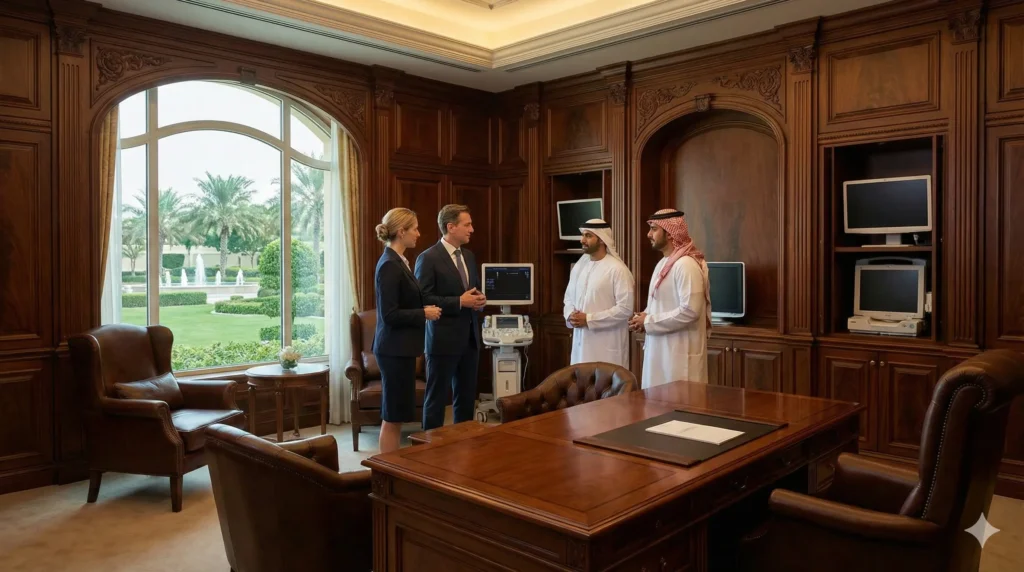
The role of a Private Physician for Royal Households in the GCC is one of the most prestigious yet demanding positions in global medicine. In cities like Riyadh, Dubai, and Doha, the demand for “concierge medicine” has evolved beyond simple house calls into a sophisticated model of clinical architecture. For the elite Western-trained consultant, this career path offers unparalleled clinical autonomy, but it requires a specific psychological profile and a mastery of professional discretion that few possess.
The Non-Negotiable Tier-1 Standard
When a Family Office or Royal estate initiates the search for a Private Physician for Royal Households, the clinical benchmarks are uncompromising. There is no room for ambiguity regarding qualifications. Only candidates with Tier-1 Western training—specifically those holding a CCT/CCST (UK), American Board (ABMS), or equivalent fellowships from Canada and Australia—are considered.
These credentials provide the “gold standard” of evidence-based medicine that elite families expect. Beyond the diploma, the candidate must demonstrate a history of practicing within high-caliber Western healthcare systems, where clinical governance and patient safety protocols are second nature. This foundation is essential because, in a private estate, the physician often operates without the immediate backup of a large hospital infrastructure, necessitating a level of decisive, autonomous expertise.
Discretion as a Clinical Competency
In the world of UHNW and Royal healthcare, clinical skill is the baseline; discretion is the differentiator. A Private Physician for Royal Households must operate with a “ghost-like” presence—visible enough to ensure absolute safety, yet invisible enough to respect the sanctity and privacy of the family’s domestic life. This requires high emotional intelligence and the ability to navigate complex social hierarchies without ego.
Confidentiality goes beyond standard HIPAA or GDPR compliance. It is a fundamental character trait. The physician is not just a medical provider but a trusted confidant. Every interaction, from routine check-ups to managing acute medical episodes, must be handled with the utmost secrecy and professional poise. This level of vetting is significantly more intense than what is found in standard hospital recruitment, as seen in our insights on Recruiting Western Trained Doctors in UAE.
Navigating the Regulatory Framework
Even in the most private settings, regulatory compliance remains mandatory. Whether practicing in a palace in Riyadh or a penthouse in Dubai, a physician must hold valid licensure. In Saudi Arabia, this means navigating the Saudi Commission for Health Specialties (SCFHS) classification process. For many Royal physicians, this involves being classified as a “Consultant,” the highest tier of professional registration.
The verification of these credentials is facilitated through the DataFlow Group, ensuring that every degree and experience letter is authenticated at the source. Understanding the specific nuances of these regional health authorities is critical for a smooth transition. For example, our guide on Saudi Medical Licensing for Consultants details the precise steps required to achieve high-level classification within the Kingdom.
Clinical Architecture vs. Traditional Practice
The scope of work for a Private Physician for Royal Households often involves “clinical architecture”—designing a 360-degree health ecosystem for the family. This includes:
-
Preventative Health Management: Designing bespoke longevity and wellness programs.
-
Emergency Planning: Establishing rapid-response protocols and “pre-planned transfer routes” to elite private hospitals.
-
Medical Coordination: Liaising with global specialists in London, New York, or Zurich for specialized second opinions.
-
Home-Based ICU Care: Coordinating with private nurses to manage complex chronic conditions within the estate.
This holistic approach requires a physician who is as much a strategist as they are a clinician. They must ensure that the family’s care follows structured processes, such as the General Medical Council (GMC) standards for documentation and consent, even in a non-traditional setting.
The Shift Toward Specialized Longevity
A growing trend in the GCC’s elite circles is the focus on longevity and executive wellness. Family offices are increasingly seeking physicians with backgrounds in Internal Medicine, Family Medicine, or Geriatrics who also possess expertise in regenerative medicine and advanced diagnostics.
The goal is no longer just treating illness but optimizing performance and extending healthspan. For clinicians, this represents a shift from reactive medicine to a proactive, high-engagement model. Regulatory bodies like the Ministry of Health and Prevention (MOHAP) in the UAE are continuously updating guidelines to accommodate these innovative healthcare models, ensuring that private practice remains aligned with national safety standards.
The Strategic ROI of Elite Placement
For the Royal Household, the “ROI” of hiring a Tier-1 Western-trained physician is measured in stability and peace of mind. For the physician, the rewards include a tax-free compensation package that reflects their elite status, often including premium housing and global travel.
However, the real value lies in the professional relationship. A successful placement is one where the physician becomes a permanent fixture of the household’s leadership team, providing a clinical anchor in an often-complex environment. This alignment of values, culture, and clinical excellence is what we specialize in at Medical Staff Talent.
Contact David for a confidential discussion on securing your next elite hire or role.