
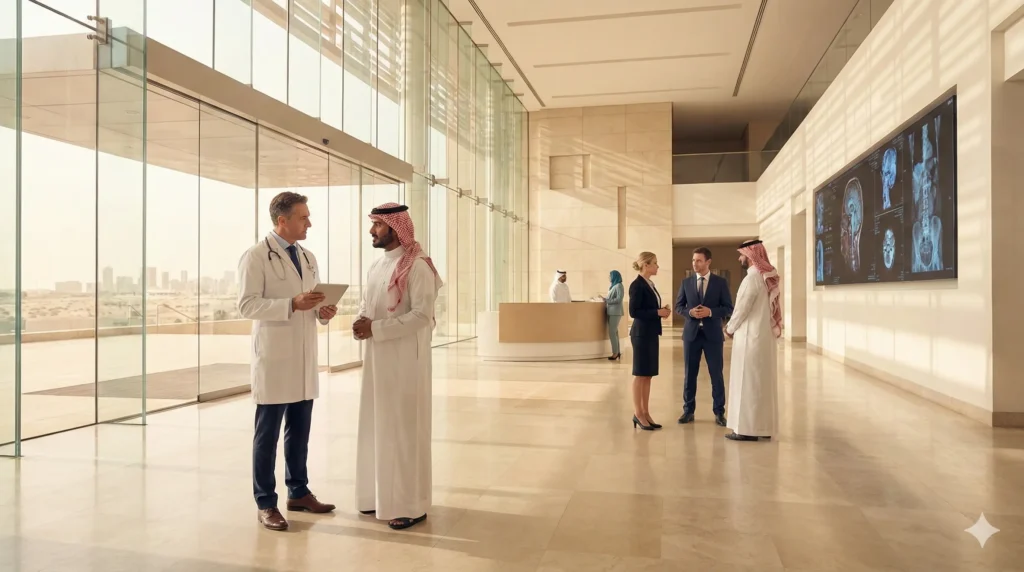
Why Dubai, Abu Dhabi, Riyadh, and Doha are rewarding reconstructive depth, discreet aesthetic judgement, and licence-ready Western-trained consultants
Plastic Surgery Recruitment in the GCC is no longer a simple search for cosmetic volume. In 2026, the stronger mandates are shaped by a more demanding brief: natural outcomes, reconstructive breadth, licensing precision, and premium patient trust. Global aesthetic activity remains high, but the market signal is changing. The International Society of Aesthetic Plastic Surgery reported nearly 38 million aesthetic procedures in 2024, with facial surgery rising in importance and facial fat grafting increasing notably. At the same time, BAPRAS continues to define reconstructive surgery around restoring function and repairing structures affected by trauma, congenital conditions, tumours, and disease. For GCC employers, that combination matters. The premium surgeon is no longer judged on aesthetics alone.
Saudi Arabia’s healthcare direction reinforces this shift. The Kingdom’s Health Sector Transformation Program is explicitly focused on quality, prevention, ambulatory care, and digital transformation. NEOM describes a health and wellbeing ecosystem built around personalized care, health tourism, and centres of excellence, while AMAALA is being positioned as a luxury wellness destination. In practical hiring terms, this favours consultants who can operate inside high-trust, brand-sensitive clinical environments rather than commodity aesthetic lists.
1. Reconstructive depth is now a premium hiring filter
The first elite standard in Plastic Surgery Recruitment in the GCC is reconstructive credibility. Private hospitals and serious surgical groups do not just want a surgeon who photographs well on social media. They want a consultant who can move confidently across scar revision, soft-tissue reconstruction, revision surgery, congenital work, trauma-related planning, and function-preserving decision-making.
That matters commercially as much as clinically. A surgeon with genuine reconstructive range gives the employer broader case resilience, stronger MDT credibility, and a safer foundation for premium brand positioning. It also aligns far better with the service-line logic described in Clinical Service Line Recruitment GCC: 2026 Playbook.
2. Natural-led aesthetics now outrank dramatic transformation
The second standard is judgement. The GCC aesthetic market remains sophisticated, but elite patients and high-end employers are increasingly drawn to surgeons who deliver refined, anatomy-respecting outcomes rather than obvious overcorrection. That is one reason the market language has shifted toward subtle facial surgery, tissue quality, scar quality, and longer-term structural thinking.
ISAPS data supports this broader direction. Facial procedures remain strong globally, eyelid surgery became the most common surgical procedure in 2024, and facial fat grafting rose sharply. In the Gulf, that does not mean employers should chase buzzwords. It means they should favour surgeons whose results look calm, durable, and proportionate. For the adjacent non-surgical market context, see Aesthetic Medicine in the GCC for Western Consultants.
3. Licence readiness must exist before the offer closes
The third standard is dossier readiness before momentum builds. This is where many plastic surgery searches still lose time. Dubai Health Authority states that applicants for DHA review must provide a valid passport copy, a Good Standing Certificate not older than six months, the last two years’ logbook for surgical specialties, and verification results aligned to PQR requirements. DHA also distinguishes registration from licence activation: registration confirms eligibility, but a hiring facility must activate it into a licence before the clinician can practise.
This is why serious employers now pre-audit documents before closing the hire. DataFlow explains that its Primary Source Verification process checks credentials directly with the issuing authority, usually across degrees, qualifications, employment, licences, and good standing, and notes a standard timeframe of roughly 15 to 25 working days when the submission is complete. That is exactly why GCC Licensing Strategy for Tier-1 Consultants, DHA Registration vs License: Dubai Hiring Guide, and Good Standing Certificates GCC: Quiet Licensing Edge should sit upstream of the offer, not after it.
4. Consultant title integrity matters more than brand language
The fourth standard is title accuracy. The UAE’s 2025 PQR lists recognized Tier 1 specialty certificates from countries including the UK, Ireland, USA, Canada, Australia, New Zealand, Singapore, South Africa, and multiple Western and Northern European jurisdictions for consultant and specialist physician exam equivalency. In Saudi Arabia, SCFHS requires official qualifications, approved verification, a valid professional registration certificate with verification support, and experience documentation for classification.
That is why premium employers should be cautious about beautifully presented CVs with weak title logic. In plastic surgery, the gap between marketed reputation and regulator-recognized status can be costly. The safest mandates still favour clearly evidenced Tier-1 Western-trained consultants whose dossier tells one coherent story across title, specialty, experience, and scope. Medical Licensing in Saudi Arabia: A Tier-1 Guide is useful here for Saudi-specific context.
5. Privileging must match the real case mix
The fifth standard is often missed: a licence is not the same thing as a safe procedural scope. Elite employers should not assume that a plastic surgery title automatically justifies every aesthetic or reconstructive privilege being marketed at interview stage. Revision experience, complication management, scar pathways, logbook depth, photographic governance, and peer confidence all matter.
This is where Credentialing and Privileging GCC: 4 Critical Rules for Elite Hiring becomes operationally important. Premium healthcare environments do not protect trust by hiring a surgeon. They protect trust by matching evidence to real privileges, committee confidence, and the actual case mix the institution intends to deliver.
6. Royal and UHNW mandates require discretion, not theatre bravado
The sixth standard is discretion under pressure. Royal clinics, private suites, and UHNW family structures do not usually want a theatrical operator. They want a calm consultant who can manage follow-up, privacy, bedside manners, and multidisciplinary coordination without destabilizing the wider care environment.
That is why Plastic Surgery Recruitment in the GCC increasingly overlaps with private medicine architecture. In these settings, a plastic surgeon may work alongside private physicians, specialist nurses, physiotherapists, and longevity-facing clinicians. The right candidate understands that trust, continuity, and professional boundaries are part of the clinical brief. That is also why Recruiting for Royal Clinics in Saudi Arabia: Elite Talent and Private Physician for Royal Households: The Elite Standard are relevant reading even for surgical searches.
7. Retention depends on operating conditions, not salary headline alone
The seventh standard is retention by design. Senior plastic surgeons do not assess a GCC move on salary alone. They look at theatre access, anaesthesia and scrub support, device ecosystem, call structure, assistant quality, case-build runway, branding constraints, relocation logistics, and whether the employer truly understands how premium surgery is delivered.
This is where many searches are won or lost. A surgeon may accept a strong package on paper, then walk away when the operating model feels thin. The employers who secure better long-term outcomes usually connect sourcing, licensing, onboarding, and family transition into one sequence. That is precisely where Medical Staff Talent’s Full-Cycle Recruiting Service and Relocating to the GCC as a Western Consultant: 2026 Guide become commercially useful.
Conclusion
Plastic Surgery Recruitment in the GCC is becoming more exacting because the market itself is becoming more exacting. In 2026, the strongest hires are not defined by cosmetic popularity alone. They are defined by reconstructive depth, natural-led judgement, title integrity, licence readiness, committee-safe privileging, discretion, and retention logic.
For private hospitals, private clinics, royal programmes, and UHNW medical environments across Dubai, Abu Dhabi, Riyadh, and Doha, that changes the search brief completely. This is no longer generic recruitment. It is clinical architecture, quietly built.
Incoming links
- Clinical Service Line Recruitment GCC: 2026 Playbook
URL: https://medicalstafftalent.com/clinical-service-line-recruitment-gcc/ - GCC Licensing Strategy for Tier-1 Consultants
URL: https://medicalstafftalent.com/gcc-licensing-strategy-tier-1-consultants/ - DHA Registration vs License: Dubai Hiring Guide
URL: https://medicalstafftalent.com/dha-registration-vs-license-dubai/ - Credentialing and Privileging GCC: 4 Critical Rules for Elite Hiring
URL: https://medicalstafftalent.com/credentialing-and-privileging-gcc-4-critical-rules/ - Executive Search in the Gulf: When Private Hospitals Need More Than Standard Recruitment
URL: https://medicalstafftalent.com/executive-search-in-the-gulf-when-private-hospitals-need-more-than-standard-recruitment/ - Recruiting for Royal Clinics in Saudi Arabia: Elite Talent
URL: https://medicalstafftalent.com/recruiting-royal-clinics-saudi-arabia/ - Medical Licensing in Saudi Arabia: A Tier-1 Guide
URL: https://medicalstafftalent.com/medical-licensing-saudi-arabia-tier-1-guide/
Final CTA
For a discreet discussion about recruiting Western-trained plastic surgeons for private hospitals, private clinics, royal clinics, and UHNW care models in the Gulf, Contact Us.