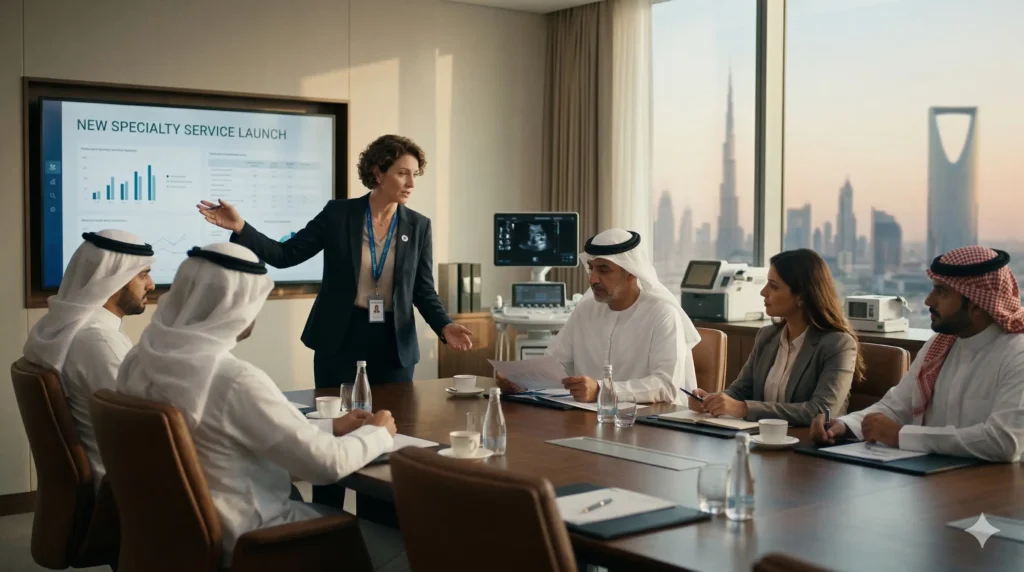
Women’s Health Recruitment in the Gulf is no longer a niche staffing issue. It is becoming a board-level priority for private hospitals, specialist clinics, and discreet UHNWI care environments across Dubai, Abu Dhabi, Riyadh, and Doha.
In these markets, women’s health is not judged only by clinical credentials. It is judged by privacy, continuity, communication, cultural intelligence, and the patient’s confidence in the full care pathway.
That is why Women’s Health Recruitment in the Gulf should not be treated as a simple vacancy-filling exercise. In premium healthcare, a women’s health service line succeeds when recruitment, licensing, onboarding, leadership, and patient experience are aligned from the beginning.
The strongest employers in the region are no longer asking only, “Can we hire quickly?” They are asking a more important question: “Can we build a women’s health model that patients trust, clinicians respect, and the organisation can sustain?”
1. Why Women’s Health Recruitment in the Gulf now matters at board level
Women’s Health Recruitment in the Gulf now carries strategic weight because women’s health is one of the clearest areas where clinical quality and cultural expectations meet.
Patients and families often place exceptional value on dignity, discretion, and a calm environment, especially in obstetrics, gynaecology, fertility, breast health, endocrinology, and selected aesthetic services.
For private hospitals and premium clinics, that changes the commercial logic. The goal is not simply to appoint a consultant. The goal is to create a women’s health pathway that patients return to, recommend privately, and trust over time.
In elite healthcare, trust is not a soft concept. It affects retention, referral behaviour, patient loyalty, and institutional positioning.
2. Women’s Health Recruitment in the Gulf is about pathway design, not one star hire
A common mistake in Women’s Health Recruitment in the Gulf is over-investing in one high-profile clinician while underbuilding the surrounding pathway.
A recognised consultant may help launch a department, but one name does not create a stable service line. Premium women’s health requires alignment across consultants, specialist nurses, diagnostics, administration, scheduling, leadership, and follow-up systems.
That is especially important in the Gulf private sector, where premium patients expect consistency. A department can look impressive in a brochure and still underperform if appointment flow feels fragmented, if nursing support is weak, or if continuity breaks down after the initial launch phase.
The strongest operators recruit around the pathway, not only around the headline profile. They define the experience first, then build the team structure needed to protect it.
3. Women’s Health Recruitment in the Gulf is heavily shaped by licensing reality
Women’s Health Recruitment in the Gulf is also shaped by regulatory detail. Employers often lose time and credibility when they treat recruitment and licensing as separate conversations.
They are not separate.
A candidate may look ideal at interview stage, yet deployment still depends on title alignment, regulator recognition, evidence quality, and facility readiness. In Dubai, registration and licence activation are not the same step. In Abu Dhabi and Saudi Arabia, classification, qualification alignment, and supporting documentation can determine whether the role works as planned.
This matters even more in women’s health, because service-line credibility can be damaged quickly if an employer announces a launch before the regulatory pathway is truly secure.
The strongest employers therefore connect search, compliance, onboarding, and mobilisation strategy from the start.
For a deeper view of licensing sequence, see GCC Licensing Strategy for Tier-1 Consultants and DHA Registration vs License: Dubai Hiring Guide.
4. Women’s Health Recruitment in the Gulf must be positioned as a life decision, not only a job move
Many of the strongest Western-trained clinicians do not view relocation as a simple employment decision. They view it as a life decision involving family, safety, schooling, infrastructure, and long-term stability.
That is why Women’s Health Recruitment in the Gulf requires a mature relocation narrative.
Compensation matters, but it is rarely enough on its own. Senior clinicians want to understand the practice environment, the quality of leadership, the reality of the patient base, the level of operational support, and the sustainability of the move for their family.
In premium women’s health, this matters even more because continuity and trust are tightly linked. A rushed hire who exits early does not just create an HR problem. It creates a patient confidence problem.
5. Women’s Health Recruitment in the Gulf must balance lawful staffing with patient trust
The right answer is not to reduce hiring to simplistic assumptions. The stronger answer is to build lawful, culturally intelligent staffing models around privacy, service need, communication style, consent standards, and continuity of care.
That distinction matters.
Elite employers should respect patient comfort and local expectations while remaining compliant, clinically rigorous, and retention-focused. In practice, that means designing a department carefully, not reactively. It means thinking about team composition, leadership visibility, privacy processes, and how trust is built at every clinical touchpoint.
In other words, Women’s Health Recruitment in the Gulf is strongest when it is framed as service design rather than stereotype.
6. Why Women’s Health Recruitment in the Gulf often requires executive search logic
Standard advertising logic often fails in premium women’s health hiring. High-trust roles require more than volume recruitment.
They require disciplined assessment of title credibility, relocation readiness, discretion, pathway fit, leadership maturity, and long-term retention probability.
That is why executive search logic is often necessary. A women’s health department serving private hospitals, specialist clinics, or discreet family-office environments cannot absorb repeated mis-hires without operational and reputational cost.
In this segment, the real expense is rarely the salary. The real expense is disruption, delay, and loss of patient confidence.
For a broader view, see Executive Search in the Gulf: When Private Hospitals Need More Than Standard Recruitment.
7. Women’s Health Recruitment in the Gulf performs best with full-cycle recruitment
At Medical Staff Talent, we repeatedly see that the strongest departments are not the ones that hire fastest. They are the ones that align role design, licensing sequence, relocation logic, onboarding, and retention planning before the clinician arrives.
That is why Women’s Health Recruitment in the Gulf performs best under a full-cycle model.
Search alone is not enough. Licensing alone is not enough. Onboarding alone is not enough. The value sits in the continuity between them.
For employers, that means fewer false starts, cleaner deployment, stronger retention, and a women’s health offer that feels coherent to patients and to the wider clinical team.
For Western-trained clinicians, it means entering a system where standards, dignity, and operational clarity are visible from the beginning.
Women’s Health Recruitment in the Gulf is not about filling a symbolic role. It is about building a trusted clinical environment that patients choose, leaders can scale, and excellent clinicians will stay in.
If your organisation is building a premium women’s health pathway in Dubai, Abu Dhabi, Riyadh, or Doha, a structured Full-Cycle Recruiting Service will usually outperform disconnected hiring, licensing, and onboarding workflows.
Official external references
For teams managing regulatory planning, these official pages are more reliable than summaries or forum advice.
- Dubai Health Sheryan – Get Registered
- Dubai Health Sheryan – Activate Professional License
- Department of Health Abu Dhabi – Professional Qualification Requirements (PQR)
- Saudi Commission for Health Specialties – Professional Classification Requirements