
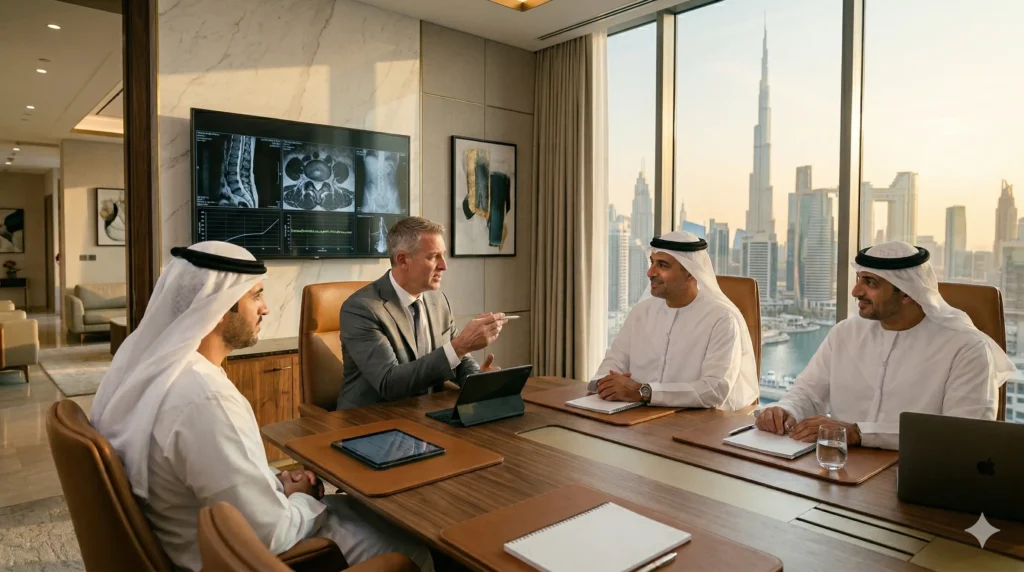
Robotic Surgery Recruitment GCC is now the decisive factor behind whether a private hospital in Dubai, Abu Dhabi, Riyadh, or Doha builds a true surgical center of excellence or simply owns expensive equipment. Across the Gulf, hospital groups are investing heavily in robotic platforms, premium operating theatres, and precision-led surgical branding. However, the hardware alone does not create clinical authority, commercial return, or patient trust. Those outcomes come from the team, the governance model, and the surgical leadership behind the platform.
That is why Robotic Surgery Recruitment GCC should be treated as a strategic service-line decision, not a conventional hiring exercise. The hospitals that outperform in robotic surgery are not merely the ones that purchase advanced technology first. They are the ones that recruit the right operator, structure the right bedside support, activate privileges correctly, and convert robotics into a repeatable premium product.
In elite Gulf healthcare, that distinction matters. A robotic system can strengthen prestige, attract referrals, shorten recovery pathways, and elevate the hospital’s market position. But without the right recruitment architecture, it can just as easily become an underused capital asset with weak clinical momentum.
Why Robotic Surgery Recruitment GCC is now a board-level priority
The Gulf private sector is becoming more sophisticated in how it evaluates surgical investment. Boards increasingly understand that a robotic programme does not fail because the machine is weak. It fails because the surrounding clinical system is incomplete. A hospital may have a qualified surgeon on paper, yet still struggle if case volume is low, bedside support is thin, proctoring is undefined, or privileging moves slower than the commercial plan.
This is why FPPE in Gulf Private Hospitals: The Hidden Second Gate
https://medicalstafftalent.com/fppe-in-gulf-private-hospitals/
and 7 Critical Reprivileging Rules in Gulf Private Hospitals
https://medicalstafftalent.com/reprivileging-in-gulf-private-hospitals/
are so relevant to robotic expansion. The objective is not only to recruit a robotic surgeon. The objective is to activate a safe, scalable, defensible programme.
A mature Robotic Surgery Recruitment GCC strategy also has to respect regulator logic. Licensing, primary source verification, surgical logbooks, internal privileging, and evidence of competence all shape how quickly a robotic hire becomes operational. In practice, robotics in the Gulf is not just a technology story. It is a recruitment, governance, and deployment story.
7 essential moves in Robotic Surgery Recruitment GCC
1. Robotic Surgery Recruitment GCC must start with independent case volume
The first filter should never be prestige alone. A famous training institution, a respected Western background, or strong laparoscopic exposure does not automatically create a credible robotic leader. The real question is whether the surgeon has meaningful independent robotic case volume in the exact specialty the hospital wants to grow.
For this reason, Robotic Surgery Recruitment GCC should begin with a forensic review of logbooks, case mix, procedural independence, console maturity, complication awareness, and real exposure to high-acuity work. In robotic urology, gynaecology, colorectal surgery, and selected oncological pathways, the difference between exposure and mastery is commercially and clinically significant.
2. Define the robotic programme before defining the shortlist
Some hospitals buy the robot first and then try to decide what the programme should become. That sequence often weakens results. A stronger model is to define the exact specialty ambition first. A provider building robotic prostatectomy capacity needs a very different search strategy from one focused on robotic hysterectomy, bariatrics, colorectal work, or pelvic oncology.
The right Robotic Surgery Recruitment GCC brief should therefore be tied to service-line priorities, referral strategy, patient demographics, payer mix, and prestige positioning. The surgeon is not just a technical hire. In many Gulf private hospitals, that person becomes the visible face of the entire programme.
3. Hire the pod, not only the console surgeon
One of the biggest operational mistakes in Robotic Surgery Recruitment GCC is hiring the lead surgeon in isolation. Robotic surgery is not a solo performance. It depends on bedside coordination, scrub familiarity, anaesthetic stability, and theatre flow that can sustain precision under pressure.
When those relationships are weak, cases are slower, team confidence drops, and the early programme becomes fragile. That is why many strong mandates are built around a pod model: lead surgeon, bedside support logic, scrub readiness, and theatre governance. Even when the full team cannot relocate together, the hospital should recruit and onboard with the pod in mind.
4. Build privileging and proctoring before arrival
Licensing is not the end of the process. It is only one part of safe activation. A consultant may hold the correct professional title and still face internal restrictions around procedure scope, supervised cases, proctor sign-off, and committee approval before being fully operational. That delay can damage the launch of a new robotic programme.
Hospitals should therefore connect Robotic Surgery Recruitment GCC with a clear privileging pathway from the beginning. That means defining documentation standards, robotic procedure thresholds, internal review steps, and proctoring requirements before the contract is finalized. This also aligns naturally with GCC Licensing Strategy for Tier-1 Consultants:
https://medicalstafftalent.com/gcc-licensing-strategy-tier-1-consultants/
5. Benchmark compensation against platform value
The compensation discussion should not be framed as if the hospital is hiring a generic consultant. A high-performing robotic leader influences throughput, length of stay, market perception, patient conversion, and referral growth. In other words, the economics of Robotic Surgery Recruitment GCC are linked to platform value, not only to salary tables.
That is why hospitals should benchmark against GCC Physician Salary Trends: 2026 Executive Report
https://medicalstafftalent.com/gcc-physician-salary-trends-2026-report/
and then adjust for leadership burden, relocation complexity, and programme-building expectations. The real question is not whether the candidate costs more. The real question is whether the candidate can make the robotics investment perform.
6. Protect documentation quality early
A robotic mandate becomes unstable when the dossier is weak. Surgical logbooks, chronology, references, good standing evidence, source verification, and specialty alignment must be clean from the start. Weak paperwork delays momentum and creates avoidable friction at the exact moment the hospital wants speed.
This is why Robotic Surgery Recruitment GCC should always run in parallel with disciplined documentation control and with related processes such as Good Standing Certificates GCC: Quiet Licensing Edge
https://medicalstafftalent.com/good-standing-certificates-gcc/
In premium Gulf recruitment, poor document preparation is not a minor issue. It is a deployment risk.
7. Turn the recruit into a teaching and brand asset
The strongest robotic hires do more than operate. They teach, standardize, and help shape the clinical identity of the programme. A surgeon who can proctor, support protocol development, mentor colleagues, and strengthen quality culture gives the hospital far more value than a technically capable but institutionally narrow operator.
In this sense, Robotic Surgery Recruitment GCC is also a branding exercise. Patients and referring physicians do not simply ask whether a hospital owns robotic technology. They ask who is leading the programme, how established the team is, and whether the service feels credible, mature, and safe.
How Medical Staff Talent supports Robotic Surgery Recruitment GCC
At Medical Staff Talent, we help recruit Western-trained Doctors, Physiotherapists, and Nurses for private hospitals, private clinics, Royal Households, and UHNW environments across Dubai, Abu Dhabi, Riyadh, and Doha. In robotic surgery mandates, that work becomes even more exacting. We do not simply identify a surgeon. We assess volume, verify documentation, evaluate deployment readiness, benchmark the offer, and help structure the move from shortlist to safe activation.
That matters because Robotic Surgery Recruitment GCC is never just about filling a vacancy. It is about building a stable surgical programme that patients trust, boards can defend, and clinical teams can scale.
Conclusion
Robotic Surgery Recruitment GCC is the real difference between owning advanced equipment and operating a respected center of excellence. The hospitals that win in Dubai, Abu Dhabi, Riyadh, and Doha will not be the ones that buy hardware fastest. They will be the ones that recruit the right high-volume surgical leadership, align privileges properly, build the right theatre pod, and turn robotics into a profitable, trusted, premium clinical service.
If your institution is planning to build or reset a robotic programme, a confidential discussion should start with recruitment architecture, not only with technology selection. You can continue that conversation here:
https://medicalstafftalent.com/contact-us/
For official regulatory context, you can review:
DHA Get Registered service
https://services.dha.gov.ae/sheryan/wps/portal/home/services-professional/service-description?CATALOGUE_TYPE=PROFESSIONAL&scode=NRG
DoH Abu Dhabi Professional Qualification Requirement (PQR)
https://www.doh.gov.ae/en/pqr
SCFHS professional classification requirements
https://scfhs.org.sa/en/professional-classification-requirements
Qatar DHP Registration & Licensing
https://dhp.moph.gov.qa/en/Pages/Registration.aspx
Incoming links
FPPE in Gulf Private Hospitals: The Hidden Second Gate
https://medicalstafftalent.com/fppe-in-gulf-private-hospitals/
7 Critical Reprivileging Rules in Gulf Private Hospitals
https://medicalstafftalent.com/reprivileging-in-gulf-private-hospitals/
GCC Licensing Strategy for Tier-1 Consultants
https://medicalstafftalent.com/gcc-licensing-strategy-tier-1-consultants/
GCC Physician Salary Trends: 2026 Executive Report
https://medicalstafftalent.com/gcc-physician-salary-trends-2026-report/
Good Standing Certificates GCC: Quiet Licensing Edge
https://medicalstafftalent.com/good-standing-certificates-gcc/
Western Medical Consultants GCC: 2026 Recruitment Strategy
https://medicalstafftalent.com/western-medical-consultants-gcc-2026/
Chief Medical Officer Recruitment in the GCC: Executive Leadership
https://medicalstafftalent.com/chief-medical-officer-recruitment-gcc-leade/
Private Medical Suite Recruitment GCC
https://medicalstafftalent.com/private-medical-suite-recruitment-gcc/