Credentialing Differences in the Gulf matter more than many employers realise.
A clinician can be fully licensable and still be wrong for the setting in which they are meant to practise.
That is why a private hospital, a private clinic, and a Royal household should never use the same credentialing model.
In Dubai, Abu Dhabi, Riyadh, and Doha, strong employers do not treat credentialing as paperwork.
They treat it as operating design.
Credentialing Differences in the Gulf decide whether a Western-trained Doctor, Nurse, or Physiotherapist can go live safely and credibly.
The regulatory floor is already clear through the DoH Abu Dhabi PQR, the SCFHS professional classification requirements, and wider hospital standards shaped by Joint Commission International.
That is the baseline.
But baseline licensability is not the same as setting readiness.
Most employers should begin with Credentialing and Privileging GCC: 4 Critical Rules for Elite Hiring.
The more important question comes next.
What should change when the setting changes?
Why Credentialing Differences in the Gulf matter by setting
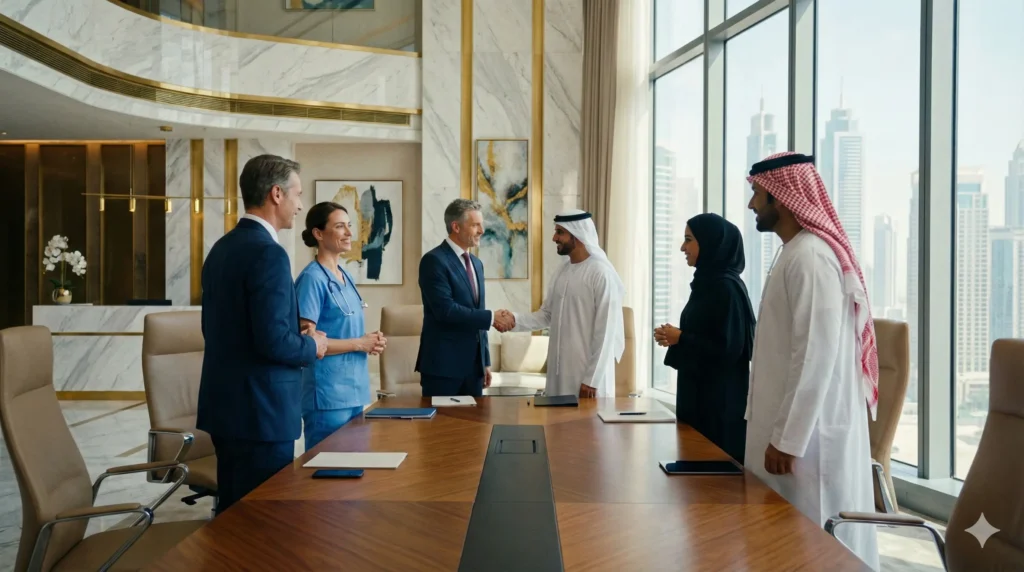
Credentialing Differences in the Gulf exist because private hospitals, private clinics, and Royal households do not carry the same risks.
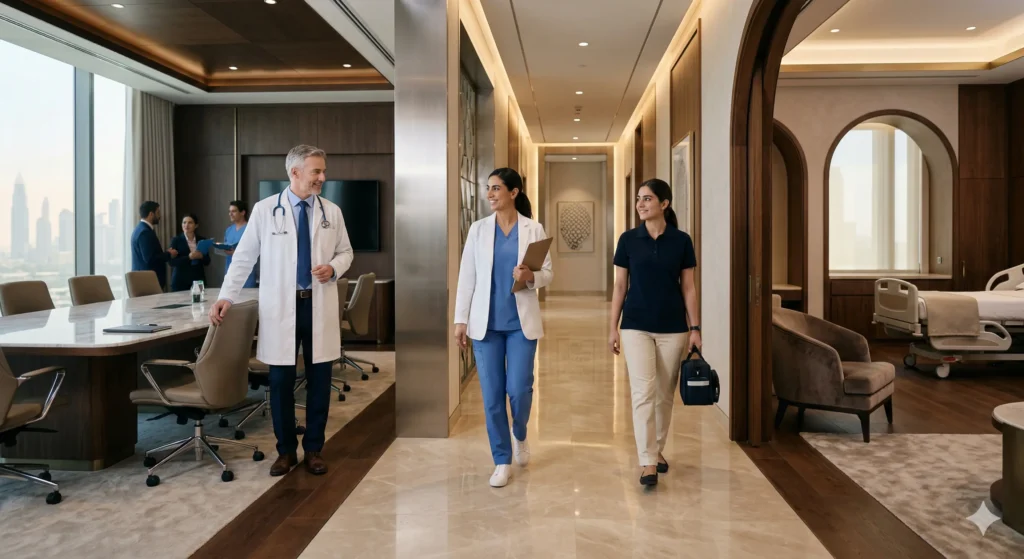
A private hospital must defend scope through committees, peer review, and later reappointment.
A private clinic needs tighter scope definition and faster activation.
A Royal household needs discretion, trust architecture, and disciplined boundaries.
When employers ignore Credentialing Differences in the Gulf, the hire may still happen.
The instability usually appears later.
1. Treating the regulator as the full operating model
The first mistake is assuming the regulator defines the whole deployment model.
It does not.
Licensing frameworks confirm title, training, standing, and experience.
They do not define how a private clinic should escalate risk.
They do not define how a Royal household should manage documentation inside a residence.
They do not define how a hospital should defend privileges six months after go-live.
This is where Credentialing Differences in the Gulf become commercially important.
Employers who stop at licensability usually build a licensable file, not a setting-ready one.
2. Using clinic-style speed for private hospital hiring
Private hospitals need deeper credentialing.
The file must survive committee scrutiny, privilege design, onboarding control, and later review.
That means evidence quality matters.
The hospital should understand not only what the clinician has done.
It should also understand what level of autonomy, procedural exposure, documentation discipline, and multidisciplinary behaviour can be defended.
That is why Medical Staff Bylaws GCC: Elite Governance Guide matters so much.
A strong file is not enough if the organisation cannot show where authority sits after arrival.
In hospital hiring, Credentialing Differences in the Gulf are not only regulatory.
They are governance decisions.
3. Making private clinic credentialing too generic
Private clinics often make the opposite mistake.
They assume a smaller environment allows lighter credentialing.
In reality, clinic credentialing should be narrower and sharper.
A clinic needs clear scope, clear referral thresholds, and clean escalation routes.
That matters in women’s health, rehabilitation, sports medicine, aesthetics, executive check-ups, and premium family practice.
In those settings, scope drift is often the real risk.
A Doctor hired for premium outpatient care can be pushed into semi-hospital work.
A Nurse can be moved into broader operational cover.
A Physiotherapist can enter a service with unclear referral boundaries.
These failures show practical Credentialing Differences in the Gulf, not abstract ones.
4. Failing to define the clinic’s true clinical boundary
The safest clinics are explicit about four things.
They define the service promise.
They define the clinical boundary.
They define the referral architecture.
They define the patient experience model.
If a clinic sells precision, continuity, discretion, or premium access, the file should prove relevant prior exposure.
That exposure should come from settings where those standards were genuinely operational.
If the clinic cannot state clearly what stays in-clinic and what moves outward, the model is exposed.
Here, Credentialing Differences in the Gulf become highly operational.
A clinic does not need slower credentialing.
It needs more exact credentialing.
5. Using hospital paperwork for Royal household medicine
Royal household and UHNW medical hiring requires a third model.
These settings still need clean regulatory logic.
But they also need much more than that.
The file must show that the clinician can work safely around privacy, family proximity, travel, irregular hours, and informal access.
That is why Royal mandates should not copy hospital credentialing or clinic credentialing.
They require trust architecture.
A Royal household Doctor, Nurse, or Physiotherapist may be clinically strong and still be the wrong appointment.
That happens when the file proves too little about discretion, self-management, escalation judgement, and household professionalism.
That is why Private Medical Suite Recruitment GCC matters operationally.
Royal roles expose some of the sharpest Credentialing Differences in the Gulf.
6. Separating credentialing from revenue readiness
Another expensive mistake is separating credentialing from activation.
In hospitals and many clinics, a clinician is not fully live just because the licence is approved.
They also need to be commercially usable.
If insurer setup or internal activation is delayed, salary cost starts before true deployment.
That is why mature employers connect hiring to Insurer Credentialing GCC: The Quiet Revenue Gate.
The strongest operators do not discover too late that the clinician is legally present but commercially under-activated.
This is another place where Credentialing Differences in the Gulf matter.
In a hospital or clinic, revenue readiness matters.
In a Royal household, trust readiness matters more.
7. Letting search, confidentiality, and onboarding run on separate tracks
When a mandate is complex, fragmented hiring becomes expensive.
The search strategy must match the licensing logic.
The confidentiality filter must match the credentialing model.
The onboarding pathway must match all three.
If they do not align, the employer creates speed in one place and instability in another.
This is why sophisticated employers often perform better with a structured Full-Cycle Recruiting Service.
Senior mandates also benefit from disciplined search methodology such as Executive Search in the Gulf: When Private Hospitals Need More Than Standard Recruitment.
Strong execution begins with understanding Credentialing Differences in the Gulf before the offer is signed.
What serious Gulf employers should do instead
The strongest employers ask one early question.
What kind of environment are we actually asking this clinician to enter?
If the answer is private hospital, build for committees, privileges, review, and retention.
If the answer is private clinic, build for scope precision, escalation design, and disciplined activation.
If the answer is Royal household or UHNW care, build for discretion, transfer logic, and household-safe behaviour.
That is when Credentialing Differences in the Gulf become a real hiring advantage.
How Medical Staff Talent applies this in practice
For Medical Staff Talent, this is not a theoretical distinction.
It is part of how we help recruit Western-trained Doctors, Physiotherapists, and Nurses for Private Hospitals, Private Clinics, Royal Households, and UHNW Families across Dubai, Abu Dhabi, Riyadh, and Doha.
We align profile selection, credentialing depth, confidentiality filtering, onboarding design, and activation logic from the start.
That makes the search process more credible because it reflects the real operating environment before the clinician arrives.
Conclusion
Credentialing Differences in the Gulf should never be treated as a technical afterthought.
They determine whether a Western-trained hire becomes a stable clinical asset or an expensive retention problem.
Private hospitals, private clinics, and Royal households all need strong clinicians.
They do not need the same credentialing model.
Employers that understand Credentialing Differences in the Gulf earlier usually build safer teams, cleaner activation, and better long-term retention.
Incoming links
- Credentialing and Privileging GCC: 4 Critical Rules for Elite Hiring — closest governance match.
- Medical Staff Bylaws GCC: Elite Governance Guide — supports the hospital section.
- Private Medical Suite Recruitment GCC — supports the Royal household section.
- Insurer Credentialing GCC: The Quiet Revenue Gate — supports the activation section.
- Full-Cycle Recruiting Service — links governance to service delivery.
- Executive Search in the Gulf: When Private Hospitals Need More Than Standard Recruitment — supports employer-side search strategy.
For employers building a safer activation pathway for Western-trained Doctors, Nurses, or Physiotherapists across Dubai, Abu Dhabi, Riyadh, and Doha, Contact Us.