

-
Not every Gulf medical hire requires a retained executive search. However, when a clinical role becomes too sensitive, too scarce, or too commercially vital, relying on a standard recruitment agency model introduces structural vulnerability.
For Private Hospitals, premium clinics, and UHNW medical employers across Dubai, Abu Dhabi, Riyadh, and Doha, choosing the wrong hiring model can directly stall licensing, weaken clinical governance, and trigger incredibly expensive replacement cycles.
When attracting elite, Western-trained clinicians, this choice shifts from a routine procurement detail to a definitive leadership decision.
Sourcing vs. Strategy: The Fundamental Differences
To protect clinical delivery and revenue timelines, healthcare executives must understand exactly what each model is engineered to deliver.
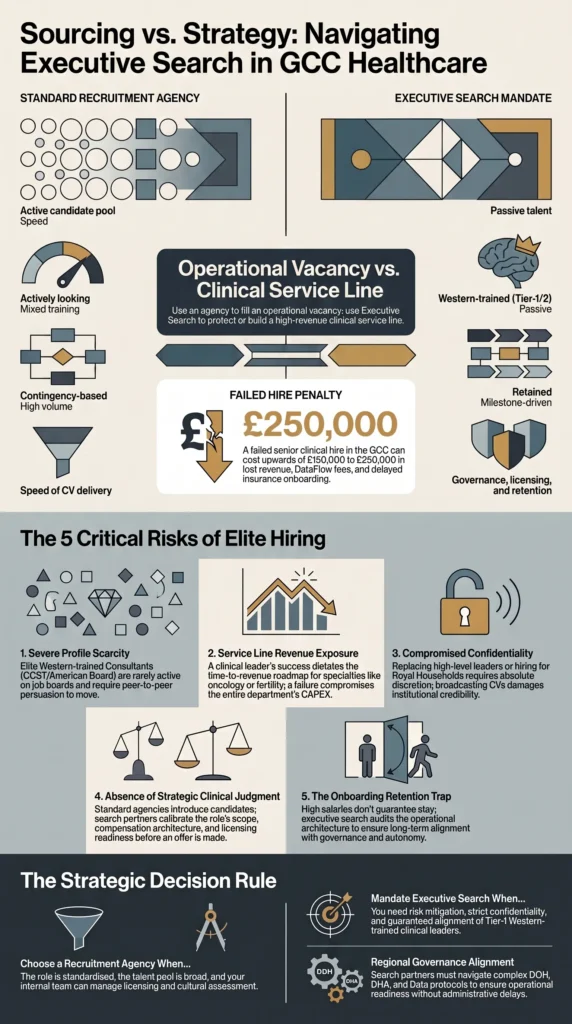
Feature Standard Recruitment Agency Executive Search Mandate Primary Focus Active candidate pool and market speed Passive talent acquisition and strategic alignment Candidate Demographic Actively looking, mixed global training Exclusively Western-trained (Tier-1 and Tier-2) passive talent Process Model Contingency-based, high volume Retained, exhaustive, milestone-driven Risk Mitigation Speed of CV delivery Governance, licensing, and long-term retention Commercial Impact Fills an operational vacancy Protects or builds a clinical service line When a Recruitment Agency Model is Sufficient
A contingent agency model works effectively when the role is highly standardized, the local talent pool is reasonably broad, and your internal clinical leadership has the internal bandwidth to rigorously assess cultural and governance fit.
This is typically true when:
-
The role is well-defined and proven within your current framework.
-
The clinical reporting lines and department structures are entirely stable.
-
The service line is mature, rather than a newly launched specialty.
-
Your internal teams can independently manage licensing readiness, communication standards, and onboarding workflows.
In these specific scenarios, volume and localized market visibility matter most. To evaluate these options, reviewing a resource like the Dubai Healthcare Recruitment Agencies: Elite Guide can help you navigate localized contingency databases effectively.
Where Contingency Sourcing Begins to Fail
The standard agency model weakens when a vacancy carries significant revenue risk, reputational exposure, complex licensing requirements, or strict confidentiality pressures.
Commercial Reality: A failed senior consultant or medical director hire in the GCC routinely costs healthcare employers upwards of £150,000 to £250,000 when accounting for lost service-line revenue, wasted DataFlow PSV fees, delayed insurance onboarding, and secondary recruitment costs.
When the stakes are this high, the process is no longer about simple sourcing—it is a strategic intervention. For a deeper breakdown of this operational pivot, see Executive Search in the Gulf: When Private Hospitals Need More Than Standard Recruitment.
The 5 Critical Hiring Risks for Private GCC Healthcare Employers
1. Severe Profile Scarcity (The Western-Trained Premium)
When your clinical model depends strictly on Western-trained Consultants (holding CCST, American Board, or equivalent European certifications) with rare sub-specialty profiles, you are not operating in an active market. You are targeting passive, highly settled individuals who require precise, peer-to-peer persuasion to move. Contingency models reward rapid database broadcasting, whereas executive search relies on discreet, targeted mapping and elite network access.
2. Service Line Revenue Exposure
Hiring a clinical leader for oncology, fertility, longevity, or sports medicine dictates your entire time-to-revenue roadmap. The first major clinical appointment defines your referral networks, institutional reputation, and payer confidence. If this individual fails to integrate, the entire capital expenditure of the new department is compromised. Managing this dynamic requires a specialized approach, as outlined in the Clinical Service Line Recruitment GCC: 2026 Playbook.
3. Compromised Confidentiality and Discretion
Replacing an underperforming Medical Director, upgrading clinical leadership ahead of a major market expansion, or hiring a private physician for a Royal Household requires absolute data security. Broadly broadcasting CVs or posting on open job boards damages institutional credibility and triggers internal instability. For private suites and high-net-worth employers, maintaining absolute discretion is paramount—a concept detailed further in Private Medical Suite Recruitment GCC: 7 Critical Rules to Avoid Costly Mistakes in 2026.
4. Absence of Strategic Clinical Judgment
A standard recruitment agency focuses on introduction; an executive search partner focuses on calibration. Elite hiring requires a partner who can critically evaluate whether your compensation architecture is retention-safe, challenge the operational scope of the role, and identify exactly where licensing, privileging, or clinical governance structures might break down prior to making an offer. This comprehensive approach is central to executing a successful Full-Cycle Recruitment for GCC Private Healthcare strategy.
5. False Onboarding Success (The Retention Trap)
An elite Western candidate may accept an offer based on a premium salary package, only to resign within nine months due to misaligned governance expectations, lack of clinical autonomy, or poorly managed relocation logistics. Executive search directly mitigates this risk by auditing the operational architecture surrounding the role before the candidate ever arrives in the region.
Aligning Search Methodology with Regional Governance
The GCC private healthcare landscape features regulatory complexities that amplify the consequences of an incorrect hire.
A misplaced appointment frequently results in extensive licensing delays, unapproved clinical privileges, and stalled insurance credentialing. To ensure compliance and clinical safety, your chosen search model must align perfectly with your institutional frameworks, including:
Furthermore, navigating regulatory parameters—such as the Abu Dhabi Department of Health (DOH) Professional Qualification Requirements, the Dubai Health Authority (DHA) registration protocols, and DataFlow Primary Source Verification—demands a dedicated strategy. For highly specialized clinical personnel, utilizing a dedicated GCC Licensing Strategy for Tier-1 Consultants ensures your candidates achieve operational readiness without costly administrative delays, while aligning directly with Joint Commission International hospital accreditation standards.
The Strategic Decision Rule
-
Choose a recruitment agency when your primary operational bottleneck is candidate volume and market reach for standardized positions.
-
Mandate an executive search firm when your primary business need is risk mitigation, strict confidentiality, and the guaranteed alignment of Western-trained clinical leaders.
In the high-trust world of premium Gulf healthcare, this structural decision must be made before market outreach begins—well before shortlist pressures begin to influence the original brief.
Partner with Medical Staff Talent
Medical Staff Talent operates exclusively within the premium tiers of the GCC healthcare market. We support Private Hospitals, elite clinics, and UHNW families in Dubai, Abu Dhabi, Riyadh, and Doha to secure exceptional Western-trained Doctors, Physiotherapists, and healthcare executives.
Whether your objective requires targeted, high-efficiency market mapping or a highly discreet, retained executive search mandate, we construct the exact hiring architecture your governance requires.
Contact Us today for a confidential evaluation of your upcoming senior clinical mandates.
-