
Rehabilitation recruitment in the GCC is no longer a side conversation in premium Gulf healthcare.
Across Dubai, Abu Dhabi, Riyadh, and Doha, private hospitals, specialist clinics, and discreet executive-care platforms are moving away from hiring a single physiotherapist simply to “cover rehab.” Instead, forward-thinking operators are building comprehensive rehabilitation pathways that seamlessly support orthopaedics, sports medicine, pain management, post-operative recovery, women’s health, executive health, and bespoke one-to-one care.
This tactical shift changes the hiring brief completely.
The real question is no longer whether a clinician can deliver an isolated, high-quality treatment session. The real question is whether an employer can build a Western-trained rehabilitation service line that is licensable, referable, operationally calm, and credible enough to retain both patients and medical staff.
Why Rehabilitation Recruitment in the GCC is a Service-Line Decision
Weak rehabilitation hiring usually begins with a flawed assumption: a private healthcare facility opens a rehab function, hires one strong physiotherapist, purchases high-end equipment, and expects the service to mature naturally.
In practice, that model rarely holds. Referral flows remain vague, clinical boundaries blur, documentation quality varies, and the rehab team becomes entirely reactive rather than strategically useful.
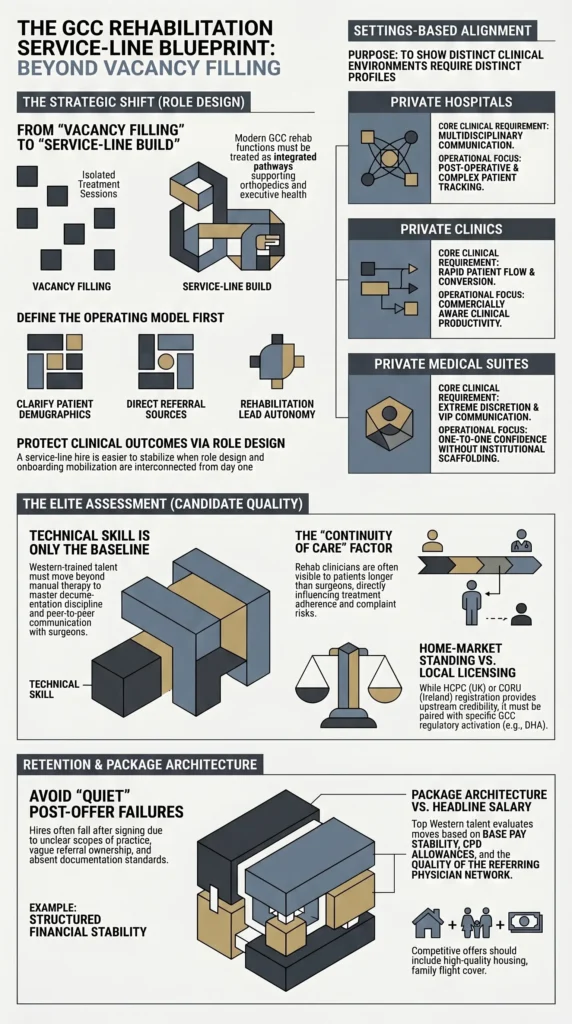
To prevent this, Rehabilitation Recruitment GCC must be treated as a comprehensive service-line build rather than an isolated vacancy.
The strongest employers define their operating model first. They clarify:
-
Which patient demographics matter most to the clinic’s growth.
-
Which medical consultants will refer directly into the service.
-
How inpatient and outpatient rehabilitation pathways connect.
-
What clinical outcomes need to be protected.
-
What level of autonomy the rehabilitation lead will actually hold.
Strategic Insight: A service-line hire is significantly easier to stabilise when role design, shortlist quality, and onboarding mobilisation are interconnected from day one. This unified approach is precisely the logic behind utilizing a comprehensive Full-Cycle Recruiting Service.
Elite Rehabilitation Hires Exhibit More Than Technical Skill
In premium Gulf healthcare, technical treatment skill is merely the baseline.
A Western-trained physiotherapist may possess exceptional clinical hands-on skills and still underperform in a private hospital or specialist clinic if they cannot document consistently, communicate effectively with surgeons, manage complex family expectations, and maintain a calm, authoritative presence in a premium patient environment.
This matters immensely in rehabilitation because physical therapies sit exceptionally close to the continuity of care. The clinician is frequently visible to the patient for much longer than the operating surgeon. They shape patient confidence long after discharge, directly influencing treatment adherence, complaints risk, and the emotional quality of recovery.
For this reason, elite employers must interview rehabilitation talent for traits beyond manual therapy, exercise prescription, or an impressive sports background. Interviews should rigorously test:
-
Referral handling: How the clinician manages cross-departmental patient transitions.
-
Documentation discipline: Adherence to international clinical governance standards.
-
Consultant communication: The ability to speak as a peer with top-tier physicians.
-
Premium patient expectations: Comfort dealing with high-net-worth individuals and VIP families.
-
Case-mix realism: Experience handling complex, multi-system recovery plans.
Adopting a broader, more sophisticated assessment approach aligns naturally with executing the right Interview Design for Western-Trained Hires: 7 Quiet Rules for Gulf Private Hospitals.
Upstream Credibility Precedes Local Gulf Paperwork
A common error in GCC healthcare recruitment is assuming that local licensing acts as the ultimate quality filter. It does not.
For UK-trained physiotherapists, employers often verify early credibility and clinical standing through the official HCPC Register. For Irish-trained physiotherapists, the primary home-market validation sits with the CORU Physiotherapists Registration Board.
[Home-Market Registration (HCPC/CORU)] ➔ [Gulf Eligibility Verification] ➔ [Local License Activation (DHA/DOH/MOH)]
While home-market standing improves shortlist confidence and ensures the clinician’s documentary story travels well, it does not replace active Gulf onboarding. In Dubai, seamless activation depends entirely on navigating the DHA Physiotherapist Licensing: 2026 Elite Path. Meanwhile, employers tracking UK talent can fast-track their validation processes by understanding the 5 Proven Benefits of HCPC Registration GCC for Western-Trained Physiotherapists.
Settings-Based Hiring: Hospitals, Clinics, and Private Suites
One of the most expensive mistakes an executive team can make is treating every rehabilitation setting as though it requires the exact same professional profile.
| Healthcare Setting | Core Clinical Requirement | Operational Focus |
| Private Hospitals | Multidisciplinary communication & tight inpatient-to-outpatient governance. | Post-operative and medically complex patient tracking. |
| Private Clinics | Rapid patient flow and strong conversion from referral to long-term treatment plan. | Commercially aware balance between clinical autonomy and daily productivity. |
| Private Medical Suites / UHNW | Extreme discretion, mobility, and high-level family communication. | One-to-one clinical confidence without immediate institutional scaffolding. |
Because clinical settings, local regulators, and practical scopes of practice do not align uniformly across the region, understanding the Credentialing Differences in the Gulf: 7 Costly Mistakes to Avoid is vital before finalizing an offer. Furthermore, for organisations expanding into hyper-discreet, premium care models, reviewing the protocols of Private Medical Suite Recruitment GCC helps frame a highly secure operating model.
For instance, an employer looking to integrate an Irish Physiotherapist in an Abu Dhabi Private Clinic must ensure the candidate’s background matches the specific, fast-paced commercial realities of private outpatient practice rather than broad inpatient wards.
Why Rehabilitation Hires Fail After the Offer is Signed
An accepted offer letter frequently creates false confidence. The hospital feels relieved, the candidate feels committed, and leadership assumes the complex work is finished. In reality, this is precisely where fragile rehabilitation hiring begins to unravel.
The most common post-offer failures are quiet, operational ones:
-
Unclear Scope of Practice: Overlap or friction with existing medical staff.
-
Vague Referral Ownership: No structured pipeline from consultants to the rehab team.
-
Weak Onboarding: Failure to integrate the new clinician into existing consultant networks.
-
Absent Documentation Standards: Lack of clear, written expectations from day one.
-
Retention Blindspots: No realistic 6-to-12-month plan to keep Western talent engaged.
Before an employment contract becomes emotionally binding, premium operators must ask one calm question: Can this clinician go live usefully and autonomously within our exact organizational infrastructure? If the answer is vague, the hire remains high-risk.
Package Architecture Over Headline Compensation
In the competitive GCC landscape, employers often overestimate the persuasive power of headline salaries alone. High-caliber, Western-trained rehabilitation professionals do not assess a relocation move on base pay alone; they evaluate the comprehensive structure of the financial package.
A truly competitive offer must be articulated clearly and balance several key elements:
-
Financial Stability: Base salary and performance incentives denominated or discussed clearly in stable benchmarks like pounds sterling (£).
-
Logistical Support: High-quality housing allowances, comprehensive family flight cover, and robust medical insurance.
-
Professional Continuity: Dedicated CPD (Continuing Professional Development) allowances and clear reporting lines.
-
Operational Infrastructure: Quality of clinic equipment and the clinical credibility of the referring physician network.
A premium financial package attached to a poorly defined role rarely retains top talent. Conversely, a beautifully structured package featuring clear clinical boundaries and visible referral logic positions an employer as a highly credible destination.
Partnering with Medical Staff Talent
This is where specialist healthcare recruitment becomes a measurable commercial asset.
Medical Staff Talent operates exclusively within the premium segment of Gulf healthcare. We do not merely fill vacant slots; we build trusted, long-term clinical teams of Western-trained Doctors, Physiotherapists, and Specialist Nurses for Private Hospitals, Boutique Clinics, Royal Households, and UHNW/UHNWI families across Dubai, Abu Dhabi, Riyadh, and Doha.
In the rehabilitation sector, our search methodology maps directly to your operational reality:
-
What specific rehabilitation pathway are you building?
-
Which clinical setting will they operate within?
-
Which internal or external referrals will feed the service line?
-
Which regional regulator governs their onboarding path?
-
Which specific profile will remain an asset to your platform twelve months from now?
This deliberate, rigorous process protects your operational stability, secures patient trust, and drives long-term staff retention.
Conclusion
Rehabilitation recruitment across the GCC is becoming increasingly exacting because the region’s premium healthcare market demands perfection. Private hospitals and elite clinics are no longer purchasing simple treatment capacity—they are investing in clinical continuity, strict documentation discipline, referral confidence, and seamless recovery journeys for highly discerning patients.
The strongest rehabilitation hires are rarely just the most impressive names on paper. They are the professionals whose training, home-market licensing path, communication style, and structural fit align perfectly with the long-term vision of your service line.
Secure Your Next Clinical Leader
For healthcare employers building a rehabilitation pathway that must feel clinically serious, discreet, and commercially stable from the outset, the most effective first step is a confidential consultation.
Contact Us today to define your strategic hiring brief.