
Hiring Western-Trained Physiotherapists in Dubai: The Employer Playbook
The Core Problem in Gulf Allied Health Recruitment
Most Dubai private clinics do not lose strong physiotherapist candidates because the market is empty. They lose them because the role is not operationally “true” at the offer stage.
A Western-trained physiotherapist will usually accept a relocation move to Dubai when four core elements are perfectly transparent:
-
Clear licensability pathways.
-
Defined scope boundaries.
-
Referral and Multi-Disciplinary Team (MDT) integration.
-
A realistic preview of what the first 90 days look like in daily clinic life.
Why This Matters in Dubai’s Private Clinic Market
In Dubai’s competitive healthcare landscape, physiotherapy is rarely a standalone vacancy. It functions as a critical component within a broader commercial system that includes orthopaedics, sports medicine, pain management, post-operative pathways, and concierge or VIP services. A clinic’s referral reputation can be damaged quickly if clinical standards are allowed to drift.
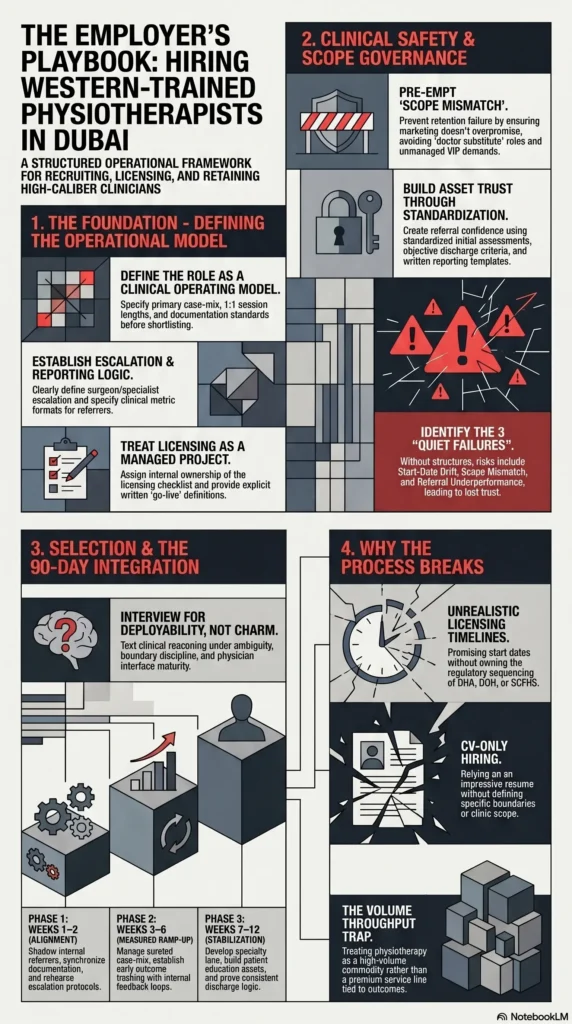
If you hire a Western-trained physiotherapist without defining exactly how they will practise—and how the clinic will support that practice—you risk three quiet operational failures:
-
Start-Date Drift: Occurs when licensing sequencing and documentation ownership remain vague.
-
Scope Mismatch: The clinic expects the clinician to “cover everything,” while the clinician expects a structured Musculoskeletal (MSK) or neurological model.
-
Referral Underperformance: Medical doctors and specialists do not trust the clinical pathway because reporting, escalation protocols, and outcome tracking are poorly designed.
How to Hire a Western-Trained Physiotherapist in Dubai: Step-by-Step
Step 1: Define the Role as a Clinical Operating Model
Before shortlisting candidates, define exactly what “good” looks like within your clinic’s operational framework:
-
Primary Case-Mix: Specify the focus area (e.g., MSK, sports, post-op, neuro, women’s health, paediatrics, chronic pain, or mixed).
-
Session Structure: Establish 1:1 appointment lengths, re-assessment cadences, documentation standards, and utilized outcome measures.
-
Escalation Logic: Define when the physiotherapist escalates cases to your orthopaedic surgeons, sports physicians, imaging partners, or emergency care.
-
Reporting Rhythm: Clarify what clinical metrics are sent to referrers, when they are sent, and in what format.
-
Equipment and Infrastructure: Clearly state what specialized tools exist on day one versus what is promised for the future.
Operational Insight: If your clinic cannot articulate these operational parameters clearly, your strongest candidate may quickly become your fastest attrition statistic.
Step 2: Treat Licensing as a Managed Sequencing Project
In Dubai, employers frequently treat licensing as if it is merely the clinician’s private administrative task. For high-calibre Western-trained candidates, this is an immediate credibility test.
To secure top talent, make the following operational points explicit in writing:
-
Which specific internal team member owns the licensing pathway and document checklist.
-
Whether you are hiring for a specific title or specialty alignment (and how you will evidence it during the application).
-
What “go-live” actually means in your clinic (what they can do immediately versus what requires internal governance sign-off).
Always benchmark your timeline against official regulator guidance. You can track the primary requirements directly via the DHA Get Registered Portal. To ensure your onboarding workflow accounts for internal compliance checkpoints before clinical practice begins, align your process with our strategic guide on Committee Approval in Gulf Private Hospitals.
Step 3: Pre-empt Scope Mismatch
Scope mismatch is the single most common reason for private-clinic retention failure in physiotherapy hiring. Common operational friction points include:
-
Marketing Overpromising: Booking the clinician as a “pain fixer” for conditions outside their defined area of competence.
-
Doctor Substitution: Expecting the physiotherapist to function as a substitute for a medical doctor (e.g., making unsanctioned diagnosis claims or mimicking prescribing behaviour).
-
Unmanaged VIP Demands: Pushing clinicians into high-risk environments (unstructured home visits, hotel care, or international travel) without an operational safety net.
To prevent early resignations, explicitly define scope boundaries within the formal job offer and reinforce them across reception scripts, booking rules, and physician expectations.
Step 4: Build Asset Trust and Referral Confidence
Western-trained physiotherapists perform at their highest level when clinical referrers feel safe. Build visible safety structures into your practice through:
-
Standardised initial assessments and clear re-assessment structures.
-
Transparent discharge criteria alongside objective return-to-sport or return-to-work pathways.
-
Consistent, written reporting templates designed specifically for internal and external referrers.
-
Agreed-upon escalation triggers covering red flags, imaging thresholds, and “not improving” clinical logic.
If you require an objective compliance filter to verify that your candidates understand regulated documentation standards and professional discipline, review our detailed breakdown on HCPC Registration for Western-Trained Physiotherapists.
Step 5: Design the Interview to Test Deployability, Not Charm
Many private clinics interview physiotherapists as if they are customer-service hires. Experienced Western-trained clinicians view a lack of clinical depth in interviews as an operational risk.
Shift your evaluation strategy to test:
-
Clinical Reasoning Under Ambiguity: How they navigate complex cases where the primary diagnosis is not immediately obvious.
-
Boundary Discipline: Which requests they will refuse, and how they communicate those clinical boundaries calmly to patients and management.
-
Documentation and Outcome Literacy: How they objectively measure and prove patient clinical value without relying on marketing hype.
-
Physician Interface Maturity: How they manage professional disagreements and structure clinical escalation pathways with medical specialists.
For a highly objective evaluation framework, utilize our comprehensive guide on Interview Design for Western-Trained Hires.
Step 6: Protect the First 90 Days
Once your selected clinician arrives in the UAE, your operational priority is to remove avoidable onboarding friction. A high-retention 90-day plan requires structural phases:
-
Weeks 1–2 (Alignment): Shadowing key internal referrers, synchronizing documentation standards, master clinical booking rules, and running through escalation rehearsals.
-
Weeks 3–6 (Measured Ramp-up): Managing a curated, selected case-mix, establishing early outcome tracking, and initiating a feedback loop with internal referrers.
-
Weeks 7–12 (Stabilization): Maintaining a stable clinic list, developing a defined specialty lane (e.g., sports rehab, post-op knee pathways, or chronic pain management), building patient education assets, and proving discharge consistency.
In premium healthcare environments, “going live” goes far beyond basic registration—it requires governance, clinical trust, and operational calm.
Where the Process Usually Breaks
Dubai private clinics typically experience recruitment failures in one of five distinct areas:
-
Promising unrealistic start dates without owning or understanding the regulatory licensing sequence.
-
Hiring based on an impressive CV alone without defining specific clinic scope boundaries.
-
Treating clinical physiotherapy as a pure volume throughput model rather than a premium service line tied directly to patient outcomes.
-
Failing to actively integrate the newly hired physiotherapist into internal physician and referrer networks.
-
Improvising the first 90 days of onboarding, then misattributing the unavoidable operational friction to “cultural fit.”
Case Study: Operational Restructuring in a Dubai Clinic
A boutique sports and orthopaedic clinic in Dubai sought to expand its post-operative rehabilitation referral stream. They shortlisted a highly qualified Western-trained physiotherapist possessing extensive professional healthcare experience.
The initial contract offer failed because it was clinically vague: it featured a generic case-mix, lacked structured reporting workflows, and provided no objective framework for handling VIP concierge requests.
Once the clinic formally rewrote the role as a defined clinical operating model—clarifying scope boundaries, setting escalation paths, defining reporting cadences, and establishing a realistic 90-day volume ramp-up—the hire stabilized perfectly. Internal referrers began receiving predictable, consistent clinical reports, patient discharge logic became standard practice, and long-term clinician retention became the operational default.
The Strategic Results of Structured Recruitment
When you transition from transactional hiring to structured clinical placement, you build a sustainable revenue-generating asset:
-
Minimized Onboarding Gaps: Target deployment dates are met because the licensing sequence is managed transparently.
-
Elevated Referral Volumes: Internal and external medical practitioners refer patients with higher confidence due to consistent communication protocols.
-
Protected Brand Reputation: Patient care improves because clear clinical boundaries mitigate the risks of overpromising.
-
Maximized Clinician Retention: Top-tier medical professionals remain long-term because they feel safe and operationally supported.
Partner with Medical Staff Talent
Medical Staff Talent manages executive search and placement mandates for Western-trained Doctors, Physiotherapists, and Nurses on behalf of Private Hospitals, Boutique Clinics, Royal Households, and UHNW Families across Dubai, Abu Dhabi, Riyadh, and Doha.
In elite healthcare recruitment, long-term success is rarely determined by the CV alone. True asset protection relies on the operational framework built around the professional: clinical role alignment, regulatory sequencing, strict scope governance, objective interview design, and structured onboarding.
To discover how we manage highly confidential, compliance-driven talent acquisitions end-to-end, explore our Full-Cycle Recruiting Service and leverage our dedicated Licensing Resources.
Regional Regulator Frameworks for Reference
-
Dubai Health Authority (DHA): Get Registered Portal
-
Department of Health Abu Dhabi (DOH): Professional Qualification Requirements (PQR)
-
Saudi Commission for Health Specialties (SCFHS): Practitioner Mumaris+ Portal
-
Qatar Ministry of Public Health (MOPH): Department of Healthcare Professions (DHP) Licensing