

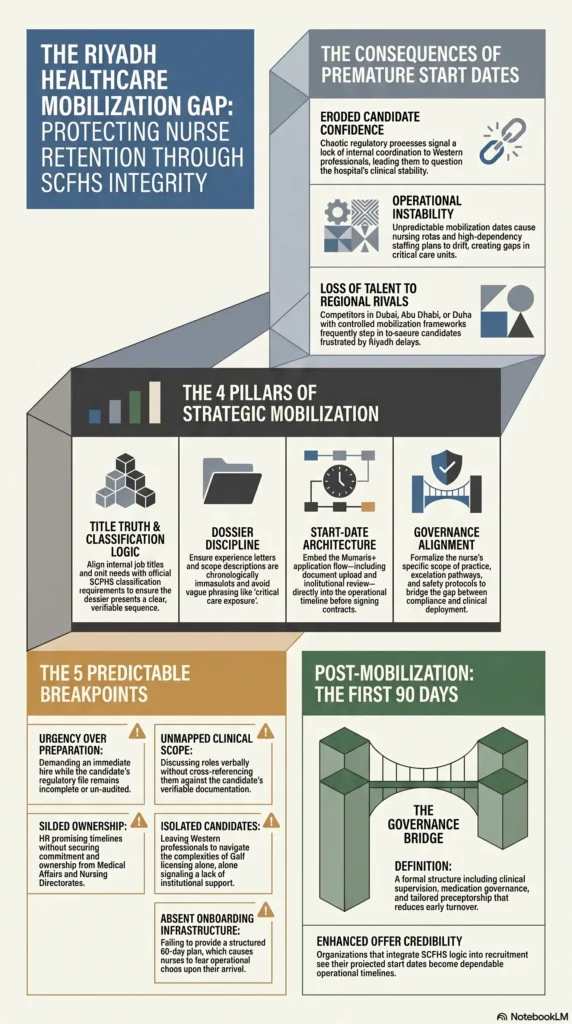
SCFHS Professional Registration for Western-Trained Nurses: Why Riyadh Private Hospitals Lose Control of the Hiring Timeline
SCFHS professional registration for Western-trained nurses is where many Riyadh private hospitals quietly lose control of their hiring timeline.
This friction rarely occurs because the nurse is unqualified or the financial offer is uncompetitive. Instead, the failure is deeply structural. It happens when an employer promises a definitive start date before the candidate’s Mumaris+ dossier is regulator-readable, ready for Primary Source Verification (PSV), and internally aligned with the specific unit’s operational scope.
At Medical Staff Talent, we recruit Western-trained Doctors, Physiotherapists, and Nurses for private hospitals, premium clinics, royal households, and UHNW families across Dubai, Abu Dhabi, Riyadh, and Doha. Through our extensive regional experience, we consistently see nursing hires stall in the exact same place: the critical gap between issuing an offer and securing a clean Saudi Commission for Health Specialties (SCFHS) registration.
The Core Problem: Premature Start Dates in Riyadh Private Healthcare
In Saudi Arabia, a Western-trained nurse can possess outstanding clinical credentials and still see their application stall if their file is incomplete, inconsistent, or misclassified. The SCFHS professional registration for Western-trained nurses runs strictly through the official Mumaris Plus platform, which operates under a highly rigid application flow and document verification sequence.
When healthcare employers treat this regulatory process as a post-offer administrative afterthought, four damaging consequences occur rapidly:
-
Candidate Confidence Drops: A process that feels chaotic signals to a highly sought-after Western professional that the organization lacks internal coordination.
-
Unit Operational Instability: Nursing rotas, bed management, and high-dependency staffing plans begin to drift.
-
Internal Stakeholder Friction: Blame blocks form between Human Resources, Nursing Directorates, and Medical Affairs.
-
Loss of Talent to Competitors: Regional rivals with a controlled, highly predictable mobilization framework step in and secure the candidate.
Why Licensing Integrity Matters in Premium Gulf Healthcare
Riyadh’s expanding private healthcare sector is not merely hiring “a nurse.” It is securing operational reliability for high-trust, elite environments, including:
-
VIP inpatient floors and royal suites
-
Intensive Care Units (ICU) and High Dependency Units (HDU)
-
Executive health and preventative medicine programmes
-
Complex surgical pathways requiring seamless post-op surveillance
In premium Gulf healthcare settings, the true reputational risk is rarely the initial vacancy itself. It is the visible organizational wobble—a promised mobilization date that turns into a quiet delay, followed by a frustrating renegotiation, and ultimately, a failed search that must be restarted from scratch. Furthermore, understanding how a candidate’s home-country licence status in GCC hiring impacts eligibility is a prerequisite for any successful mobilization framework.
4 Strategic Controls Strong Riyadh Employers Get Right
Top-tier healthcare employers in Saudi Arabia recruit with the understanding that the regulator will audit every line of the file. To eliminate regulatory bottlenecks, they build a comprehensive pre-offer mobilization structure around four critical pillars:
1. Title Truth and Classification Logic
Before presenting a clinical role to a candidate, ensure your internal job title, the clinical unit’s actual need, and the official SCFHS classification logic point in the exact same direction. The Saudi Commission for Health Specialties (SCFHS) publishes explicit professional classification requirements emphasizing the readability of official qualifications. Your dossier must present a clear, verifiable professional sequence rather than a marketing narrative.
2. Dossier Discipline and Verifiable Experience
The vast majority of Mumaris+ delays do not stem from missing CV components; they stem from weak, ambiguous evidence. Experience letters, scope descriptions, and licensing histories must be chronologically immaculate. If you are hiring a Western-trained ICU nurse, the supporting evidence must prove intensive care reality, avoiding vague phrasing like “worked across critical care environments.”
To optimize your internal workflow for validation processes, align your hiring protocols with a standard framework early on. Discover more via our dedicated guide on DataFlow and PSV for Gulf Licensing: a clear workflow for Western-trained clinicians.
Because the DataFlow Group acts as the primary source verification partner for the SCFHS, eliminating evidence gaps directly shortens your onboarding timeline.
3. Start-Date Architecture Integrated with Mumaris+
The actual start date is determined by the regulatory sequence within Mumaris+, not by the date the employment contract is signed. Premium employers embed the standard Mumaris+ application flow (logging in, service selection, data entry, document upload, and institutional review) directly into their operational timeline.
An elite offer workflow should always include:
-
A pre-audited document checklist completed prior to the final interview.
-
A designated internal stakeholder responsible for resolving regulatory queries and insufficiencies.
-
A realistic mobilization window accounting for verification delays and internal onboarding steps.
-
A strategic contingency plan in the event that the final SCFHS classification varies from the initial assumption.
For organizations looking to scale their operations across Saudi Arabia, explore our broader regulatory framework analysis: Mumaris+ 2026: the Western-trained licensing edge.
4. Governance Alignment Beyond the Licence
Securing an active registration does not automatically equate to a safe, successful clinical deployment. Private hospitals frequently lose premium talent if the nurse’s first-90-days operating model remains ill-defined. Elite healthcare providers bridge the gap between regulatory compliance and clinical operations by formalizing:
-
The precise scope of practice within the assigned clinical unit.
-
Clear clinical supervision and escalation pathways.
-
Strict medication governance and safety protocols.
-
Tailored orientation and clinical preceptorship planning.
To implement this governance bridge effectively within your institution, review our strategic resource on Credentialing and Privileging GCC: 4 critical rules for elite hiring.
5 Predictable Breakpoints in Riyadh Nurse Recruitment
When analyzing operational failures across the Riyadh private hospital ecosystem, onboarding delays routinely cluster around five distinct systemic failures:
-
Urgency Over Preparation: The clinical unit demands an immediate hire, yet the candidate’s regulatory file is incomplete.
-
Unmapped Clinical Scope: The operational scope of the role is discussed verbally but never cross-referenced against verifiable documentation.
-
Siloed Ownership: HR promises specific timelines without securing cross-departmental ownership from Medical Affairs.
-
Isolated Candidates: Expecting a Western professional to navigate the complexities of Gulf licensing entirely on their own, which signals a lack of institutional support.
-
Absent Onboarding Infrastructure: Failing to provide a structured 90-day plan, leaving the nurse to fear operational chaos or underutilization upon arrival.
Overcoming these structural barriers often depends on how an organization structures its talent acquisition partnerships. Understanding the operational distinction between an executive search vs recruitment agency in GCC healthcare is vital for securing a compliant, managed mobilization workflow.
Case Study: The True Cost of an Inconsistent Dossier
A prestigious private hospital group in Riyadh developing an advanced VIP surgical pathway targeted a UK-trained ICU Charge Nurse to stabilize post-operative surveillance and clinical escalation workflows.
The financial package was excellent, and the candidate accepted the offer promptly. However, the hospital’s submitted evidence pack relied on broad “critical care exposure” terminology. The supporting reference letters failed to clearly articulate her specific ICU responsibilities, shift leadership history, or acuity-level decision-making experience.
Consequently, the DataFlow PSV process returned multiple queries. During the ensuing delay, internal ownership of the file shifted between hospital departments twice, causing the projected start date to drift by several months.
Ultimately, the candidate withdrew from the process. She did not leave for a higher salary; she walked away because the disorganization signaled systemic operational instability. Her rationale was clear: “If the institution handles mobilization with this level of administrative friction, what will the clinical unit feel like on day one?” The hospital was forced to pay premium interim rates to cover the ongoing staffing gaps while completely restarting their recruitment campaign.
Elevating Your Healthcare Mobilization Strategy
When the complexities of SCFHS professional registration for Western-trained nurses are integrated into your talent acquisition strategy from day one, your institutional performance metrics shift immediately:
-
Enhanced Offer Credibility: Your projected start dates become highly dependable operational timelines rather than aspirational targets.
-
Stronger Candidate Trust: The incoming clinician feels structurally protected and operationally supported by their future employer.
-
Higher Long-Term Retention: The critical first 90 days feel carefully orchestrated, significantly reducing early turnover.
The differentiator in premium Gulf healthcare recruitment is rarely the CV alone; it is the comprehensive clinical and regulatory architecture supporting the placement.
To see how we integrate strict dossier control, proactive regulatory sequencing, and clinical governance into a singular executive process, discover our Full-Cycle Recruiting Service.
For a confidential consultation regarding your strategic hiring requirements in Riyadh, Dubai, Abu Dhabi, or Doha, please Contact Medical Staff Talent directly.

