
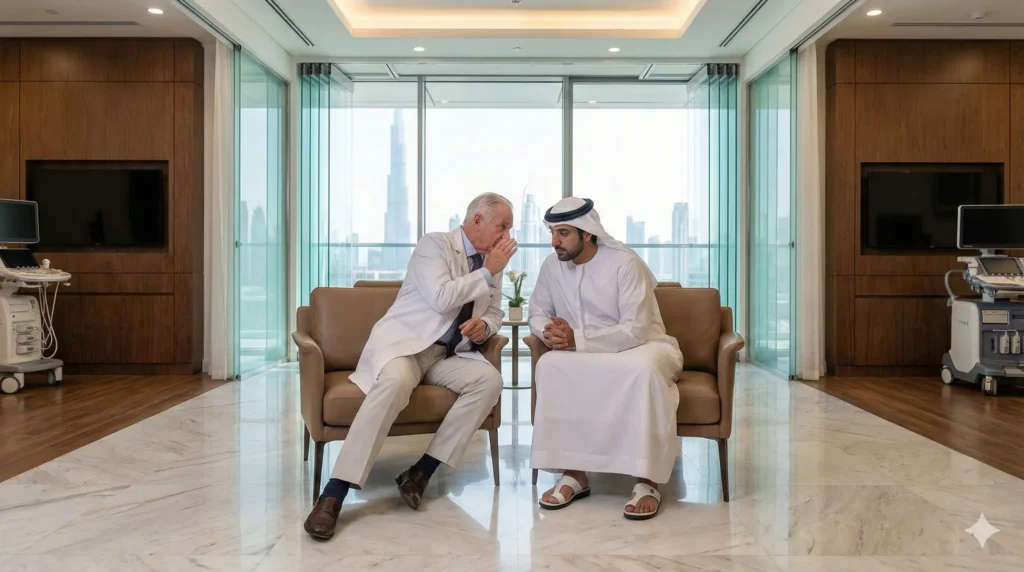
Concierge Medical Recruitment Dubai is no longer a niche topic reserved for a small corner of the private market. It is becoming a defining hiring priority for Royal Households, family offices, UHNW families, private medical suites, and executive health environments that need more than a doctor with a strong CV. They need a clinician who can deliver clinical precision, personal discretion, emotional control, and long-term trust inside highly private settings.
That is the real difference in this segment. In a premium household or ultra-private clinical environment, the question is not only whether a physician is clinically capable. The question is whether that physician can operate calmly, credibly, and discreetly in a setting where family confidence, privacy, continuity, and service quality all matter at the same time.
This is why Concierge Medical Recruitment Dubai requires a different level of search discipline. It is not a volume exercise. It is not a standard agency brief. It is a narrow, trust-driven search for clinicians who can function at the intersection of elite medicine, private service, and Gulf regulatory reality.
Medical Staff Talent works in exactly that niche, helping premium employers secure Western-trained Doctors, Nurses, and Physiotherapists for Private Hospitals, Private Clinics, Royal Households, and UHNW families across Dubai and the wider Gulf.
Why concierge medical recruitment in Dubai is not standard healthcare hiring
A hospital can often absorb a degree of mismatch. A private household cannot.
That is one of the clearest reasons why Concierge Medical Recruitment Dubai needs a specialist approach. In a hospital, a strong department structure can sometimes protect the system from a hire who is technically good but culturally awkward. In a private residence, a family office, or a discreet executive clinic, the margin for error is much smaller.
The clinician is often working closer to the principal, closer to the family, and closer to the emotional reality of care. The relationship is more personal. The exposure is more direct. Expectations around professionalism, appearance, communication, discretion, and responsiveness are far higher.
This means employers are not looking for “available talent.” They are looking for high-trust talent.
That search has to assess far more than specialty title and years of experience. It has to evaluate whether the candidate can operate in an environment where:
- privacy is non-negotiable
- communication must be calm and refined
- clinical judgment must remain strong without excessive institutional support
- family confidence matters as much as formal competence
- service culture and clinical authority must coexist
That is why broad recruitment often underperforms in this niche. The process is too general for a role that is, by nature, highly specific.
The real hiring standard in concierge medicine
The strongest employers in this segment do not ask a simplistic question such as, “Is this doctor excellent?”
They ask a more difficult question:
Is this doctor excellent in exactly this environment?
That is the standard that shapes successful Concierge Medical Recruitment Dubai mandates.
A physician may have an outstanding title, first-rate hospital experience, and strong academic credibility, and still be the wrong fit for a Royal Household or UHNW family if they cannot adapt to a private operating context. A household-based or concierge-facing physician must bring clinical authority without ego, discretion without distance, and presence without friction.
That is rare.
It is also why the best searches in this market are deliberately narrow. The objective is not to build a long shortlist. The objective is to identify one or two candidates whose clinical profile, communication style, privacy instincts, and long-term fit align with the role at a very high level.
Why Western-trained clinicians remain central to this market
In Dubai’s premium private healthcare segment, employers continue to value Tier-1 and Tier-2 Western-trained clinicians because these backgrounds often bring a combination of clinical credibility and governance discipline that matters in sensitive care environments.
These candidates frequently come from systems where standards around documentation, multidisciplinary communication, patient safety, escalation, and accountability are deeply embedded. In elite private care, those habits matter. A physician in a private villa or family office may not have the same institutional scaffolding as a tertiary hospital. That means the clinician’s own professional discipline becomes even more important.
The appeal is not only reputational. It is operational.
Employers often associate Western-trained profiles with stronger performance in areas such as:
- documentation clarity
- decision-making under pressure
- clinical governance awareness
- continuity planning
- family-facing professionalism
- calm interaction with multiple stakeholders
That does not mean every Western-trained candidate is right for concierge work. It means the market often starts there because the baseline governance habits are more aligned with what premium employers need.
Cultural intelligence and bedside manner are not secondary
One of the biggest mistakes in private healthcare recruitment is treating interpersonal qualities as soft extras.
In Concierge Medical Recruitment Dubai, they are core selection criteria.
A doctor working in a private family environment may be managing not only clinical needs, but also household dynamics, emotional sensitivities, travel schedules, privacy concerns, and long-term trust. The technical part of medicine remains critical, but it is not the whole role. The physician also has to function as a calm, credible, discreet clinical presence in a highly personal environment.
That means bedside manner is not decorative. It is operational.
So is cultural intelligence.
So is emotional restraint.
So is the ability to communicate complex medical issues clearly, without creating unnecessary alarm.
The strongest candidates for these roles are usually those who understand that premium care is not louder care. It is calmer, cleaner, more anticipatory care.
Why passive candidate access matters
Most of the best clinicians for this market are not sitting on job boards.
They are not publicly available. They are not chasing broad agency outreach. They are often already in well-structured roles, or in discreet appointments where privacy and stability matter. That means Concierge Medical Recruitment Dubai depends heavily on access to passive candidates.
This changes the nature of the search.
A recruiter in this space needs more than a database. They need:
- credibility with senior clinicians
- a clear and serious brief
- understanding of the care environment
- confidence discussing licensing and mobilisation
- the ability to position the opportunity discreetly
- the judgment to protect both employer and candidate
That is where a specialist process creates real value. Medical Staff Talent’s Full-Cycle Recruitment for GCC Private Healthcare is relevant here because it treats search, assessment, onboarding, and retention as one integrated process rather than as disconnected tasks.
Licensing has to be part of the strategy from day one
A weak licensing pathway can damage a premium hire before the clinician even arrives.
This is one of the most important operational truths in Concierge Medical Recruitment Dubai. Employers sometimes focus heavily on the shortlist and compensation package, then treat licensing as a later administrative step. In practice, that is risky.
For Dubai appointments, the Dubai Health Authority registration pathway is a core part of the hiring logic. Registration, title alignment, documentary readiness, and eventual licence activation all shape how credible the proposed appointment really is.
For UK-trained physicians, prior status under GMC registration and licensing may also matter as part of the wider professional background review.
The key point is simple: a candidate is not truly strong if the regulatory pathway is unclear.
That is why GCC Licensing Strategy for Tier-1 Consultants should sit close to the search process rather than far behind it. In premium private healthcare, speed without regulatory clarity is fragile. A household or family office does not want a shortlist that looks good in conversation but stalls in execution.
What employers get wrong when licensing is left too late
When licensing is treated as an afterthought, the same problems tend to appear:
- the proposed title is too optimistic
- documents are incomplete or inconsistent
- verification timelines are underestimated
- activation by the employing entity becomes slower
- the expected start date loses credibility
- candidate confidence starts to weaken
In elite settings, that kind of friction matters. It can affect trust long before the clinician starts practicing.
Compensation has to feel intelligently designed
In concierge medicine, a higher salary alone does not automatically create a stronger offer.
Senior clinicians in this segment often look at the whole architecture of the role. They assess whether the opportunity feels serious, coherent, discreet, and sustainable. That means salary is only one part of a broader decision.
They will also consider:
- housing and living arrangements
- scope of practice
- family support
- call expectations
- travel demands
- reporting lines
- professional autonomy
- privacy boundaries
- long-term career value
This is why a market benchmark such as GCC Physician Salary Trends: 2026 Executive Report is useful, but not sufficient on its own. The employers who attract the best clinicians in this space are usually the ones who design the role well, not simply the ones who offer the biggest headline number.
A poorly designed package can feel expensive and still fail.
A well-designed package feels stable.
How Medical Staff Talent fits into this niche
In this market, the recruiter is not just sourcing candidates. The recruiter is helping shape the conditions under which a sensitive clinical relationship can succeed.
That is why Medical Staff Talent’s role is broader than vacancy filling. The firm focuses specifically on recruiting Western-trained Doctors, Physiotherapists, and Nurses for Private Hospitals, Private Clinics, Royal Households, and UHNW families in Dubai, Abu Dhabi, Riyadh, and Doha. In practical terms, that means combining search, fit assessment, licensing awareness, and long-term team logic around one premium clinical brief.
This matters because elite employers do not simply need access to talent. They need help translating a private care requirement into a credible, legally viable, attractive clinical role.
That translation is where many generalist recruiters fall short.
Why this niche will keep growing in Dubai
Dubai’s position as a centre for private wealth, international mobility, luxury living, and premium healthcare investment continues to strengthen the long-term case for Concierge Medical Recruitment Dubai.
As expectations around preventive medicine, longevity, family-facing care, and private clinical support rise, so will demand for clinicians who can operate with both medical sophistication and personal discretion.
That does not make this easier. It makes it more specialised.
The employer who wins in this space will usually be the one who understands that private healthcare credibility is built through:
- careful role design
- better candidate selection
- clean licensing logic
- quiet onboarding
- long-term retention thinking
That is the real architecture behind successful concierge hiring.
FAQ: Concierge Medical Recruitment Dubai
What is concierge medical recruitment in Dubai?
It is the specialist recruitment of clinicians for highly private healthcare settings such as Royal Households, UHNW families, private villas, executive health platforms, and premium medical suites. The focus is usually on clinicians who can combine clinical excellence with discretion, trust, and strong interpersonal judgment.
Why is concierge medical recruitment different from hospital recruitment?
Because the care environment is different. In a private setting, the clinician is often closer to the patient, family, and household structure. That raises the importance of privacy, communication style, cultural fit, and emotional intelligence alongside clinical competence.
Why do employers prefer Western-trained clinicians for these roles?
Many premium Gulf employers value Western-trained clinicians because of the governance habits often associated with those systems, including documentation quality, multidisciplinary communication, patient safety awareness, and calm decision-making.
Why is licensing so important in Dubai concierge recruitment?
Because a strong candidate still has to become a legally deployable clinician. If the DHA pathway, documentary readiness, or title logic is weak, the appointment can slow down or fail. In private care, that delay affects employer confidence quickly.
What makes a concierge medicine offer attractive to senior clinicians?
Not salary alone. The strongest offers usually combine clear scope, realistic schedule design, privacy boundaries, strong living arrangements, coherent reporting structure, and long-term professional stability.
Who does Medical Staff Talent recruit for in the Gulf?
Medical Staff Talent recruits Western-trained Doctors, Nurses, and Physiotherapists for Private Hospitals, Private Clinics, Royal Households, and UHNW families across Dubai, Abu Dhabi, Riyadh, and Doha.
Final thought
Concierge Medical Recruitment Dubai is not routine staffing. It is the design of a high-trust clinical relationship inside one of the most sensitive care environments in modern Gulf healthcare.
That is why the right hire depends on much more than title, CV, or salary. It depends on fit, discretion, licensing readiness, communication quality, and long-term stability.
For a confidential discussion about securing your next elite hire or role, visit Contact Us.