

DataFlow delays in GCC hiring rarely begin as a visible crisis. Instead, they start as weak evidence, unclear chronology, or late regulator planning. Left unmanaged, these minor administrative friction points quickly expand into severe start-date drift, weaker £ package credibility, and avoidable operational disruption for private hospitals, clinics, and premium care teams.
For premium Gulf healthcare employers, primary source verification (PSV) cannot be treated as a simple back-office formality. It must be treated as a critical commercial workstream.
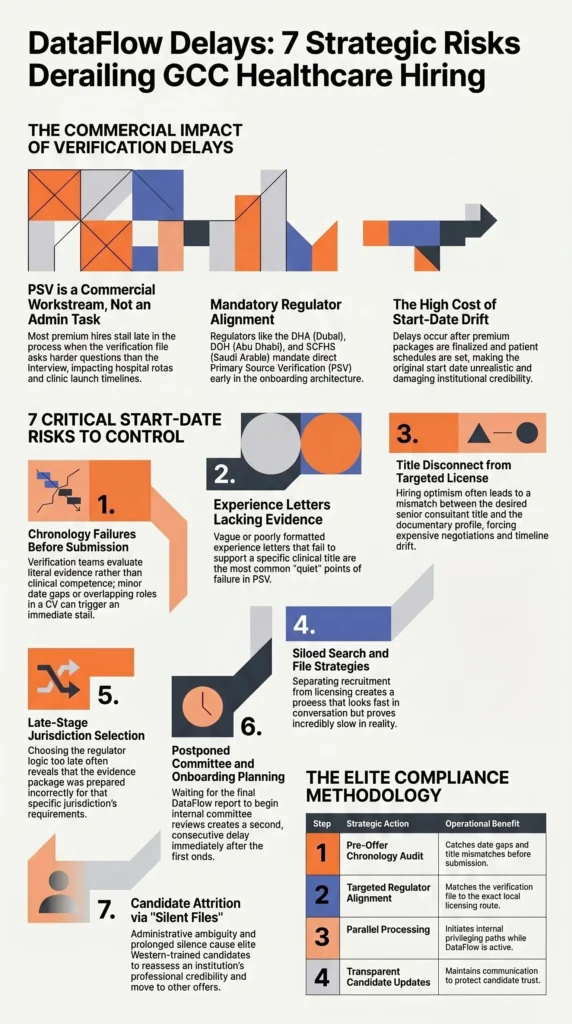
Why PSV is a Commercial Workstream, Not an Admin Task
Most premium Gulf hires do not break at the shortlist stage. They slow down much later, when the verification file starts asking harder questions than the interview ever did.
This is exactly why DataFlow delays in GCC hiring deserve immediate, strategic attention from executive teams across Dubai, Abu Dhabi, Riyadh, and Doha. The operational damage of a stalled file is rarely limited to paperwork. A delayed verification sequence directly compromises:
-
Hospital rota planning and clinic launch timelines
-
Governance committee confidence and stakeholder trust
-
Patient access to specialized medical services
-
The overall credibility of your international offer
Officially, primary source verification is the foundational bedrock of Gulf credentialing. The DataFlow Group defines PSV as direct verification with the original issuing source. In practice, regional regulators mandate this early in the onboarding architecture:
Regulator Requirements At a Glance:
Dubai (DHA): The Get Registered framework mandates direct submission to the PSV agency as part of initial preparation.
Abu Dhabi (DOH): Official directives route all applicants through mandatory document verification via DataFlow.
Saudi Arabia (SCFHS): The practitioner qualification guidelines explicitly state that all certificates from outside the Kingdom must be handled by DataFlow.
For serious employers, the lesson is clear: do not treat verification as a task that begins after verbal enthusiasm. Treat it as a core component of your hiring architecture from day one.
The True Cost of Start-Date Drift
The commercial problem with verification delays is timing. By the time a DataFlow issue surfaces, the employer has often already sold the role internally, finalized patient appointment schedules, and built a premium £ package around a start date that is no longer realistic.
In elite international recruitment, regulator logic must sit before hiring momentum, not behind it.
To understand how to sequence this effectively, read our comprehensive framework on GCC Licensing Strategy for Tier-1 Consultants.
Here are the 7 critical start-date risks private healthcare employers must proactively control.
1. The Chronology Fails Before the Regulator Does
Many verification files do not collapse because the candidate lacks clinical competence. They slow down because their professional story is not presented in a clean, logical sequence.
A Western-trained doctor, nurse, or physiotherapist may be entirely credible in practice, yet their paperwork may show minor date gaps, overlapping roles, or varying corporate titles. Verification teams do not evaluate professional confidence; they evaluate literal evidence.
Elite employers audit document chronology before making an offer. The CV, license history, logbooks, and good standing trail must read as a single, coherent narrative. Securing a clean history early is essential, as detailed in our guide on Good Standing Certificates GCC: Quiet Licensing Edge.
2. Experience Letters Treated as Admin Instead of Evidence
In premium healthcare hiring, experience letters are the most common quiet point of failure. These letters are frequently too vague, poorly formatted, missing specific scope details, or written in a way that fails to support the precise clinical title the employer is trying to secure.
A polished consultant interview cannot repair a weak documentary record. Private-sector Gulf employers must read experience evidence as vital commercial documentation. If a letter cannot carry weight under rigorous primary source verification, it will derail your timeline.
3. The Title on the CV Disconnects From the Targeted License
This is where hiring optimism becomes exceptionally expensive. A board may want to hire a senior consultant, or a Royal Household may require a private duty nurse with broad clinical authority. However, the regulatory pathway still requires a strictly defensible title match.
If the documentary profile points toward a narrower clinical rank, the employer is suddenly forced to negotiate around timeline drift rather than building around operational certainty. In Dubai, navigating this properly requires understanding the nuances found in our DHA Registration vs License: Dubai Hiring Guide.
In Saudi Arabia, this connects directly to strict classification frameworks covered in Medical Licensing in Saudi Arabia: A Tier-1 Guide.
4. Separating Search Strategy From File Strategy
One of the most common structural mistakes is splitting the onboarding workflow into isolated silos:
[Recruitment Search] ➔ [Licensing Questions] ➔ [Onboarding / Credentialing]
When recruitment moves on one track while licensing and credentialing sit elsewhere, the result is a premium hire that looks fast in conversation but proves incredibly slow in reality. Elite operators do not split these functions. They connect search, evidence review, regulator choice, credentialing, and mobilization into a single, controlled sequence through Full-Cycle Recruitment for GCC Private Healthcare.
5. Choosing the Wrong Regulator Logic Too Late
Not every Gulf role should be sequenced through the identical regulatory route. A private hospital in Abu Dhabi, a specialist clinic in Dubai, a Riyadh expansion platform, and a discreet family office medical structure all face entirely distinct deployment logics.
When employers delay the jurisdiction decision, they often discover too late that the evidence package was not prepared correctly for the specific target regulator. Very often, DataFlow delays in GCC hiring are actually sequencing problems disguised as verification issues.
6. Postponing Committee and Onboarding Planning
Verification is not the finish line. Even a perfectly clean PSV report must seamlessly connect to institutional onboarding, clinical privileging, and safe activation. Employers who wait for the final DataFlow report before initiating internal committee reviews create a second, consecutive delay immediately after the first one ends.
To prevent this, ensure your team follows the core pillars in Credentialing and Privileging GCC: 4 Critical Rules for Elite Hiring.
7. Candidate Attrition Caused by Silent Files
The emotional and psychological cost of verification delays is routinely underestimated. High-caliber, Western-trained candidates evaluating Gulf opportunities rarely object to strict regulatory processes. What actively destroys their trust is prolonged silence, administrative ambiguity, or overconfident timelines that must later be revised.
In the competitive private sector, top-tier clinicians always hold multiple local and international options. If the file stays silent, they may quickly reassess your institution’s internal discipline and professional credibility.
What Elite Healthcare Employers Do Differently
To insulate operations from severe start-date drift, leading healthcare providers across the GCC deploy a highly disciplined compliance methodology:
| Step | Strategic Action | Operational Benefit |
| 1 | Pre-Offer Chronology Audit | Catches date gaps and title mismatches before submission. |
| 2 | Targeted Regulator Alignment | Matches the verification file to the exact local licensing route. |
| 3 | Parallel Processing | Initiates internal privileging paths while DataFlow is active. |
| 4 | Transparent Candidate Updates | Maintains communication to protect candidate trust. |
At Medical Staff Talent, this is where our specialized expertise becomes a practical commercial advantage. We assist private hospitals, premium clinics, Royal Households, and UHNW families across the Gulf in successfully recruiting Western-trained Doctors, Physiotherapists, and Nurses.
We protect your timelines by perfectly aligning role design, document readiness, licensing realism, and mobilization logistics long before candidate momentum begins to drift.
Strategic Summary
DataFlow delays in GCC hiring should never be dismissed as minor administrative inconveniences. They are highly predictable commercial risks that signal a misalignment between your recruitment strategy and local regulatory realities.
The employers who manage this process successfully do not wait for a verification file to cause an operational crisis—they engineer the entire pipeline so fewer problems can form in the first place.
Ready to secure your next premium healthcare hire without avoidable timeline drift? Contact Us to align your regional recruitment strategy with bulletproof credentialing execution.