
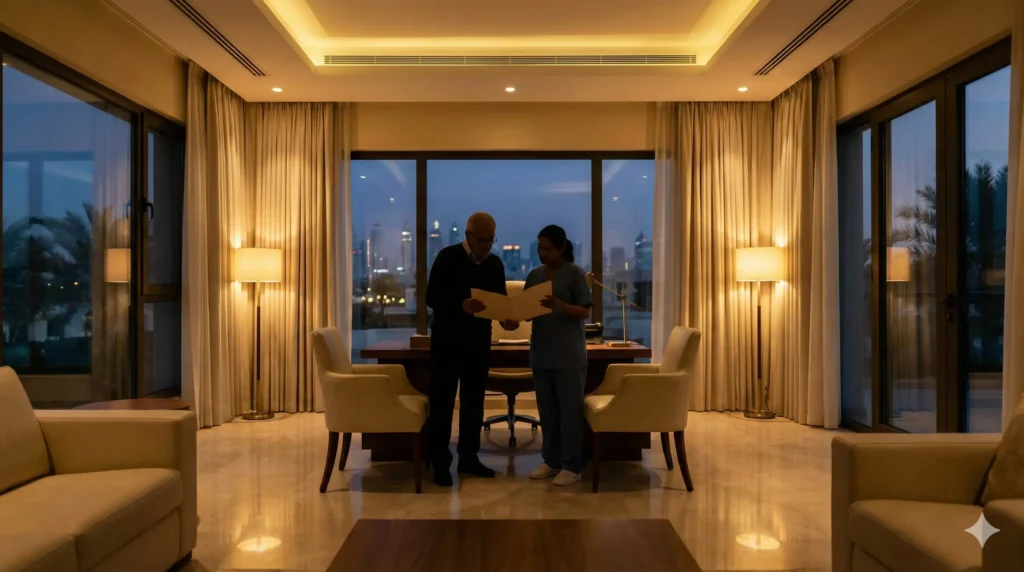
In UHNW elder care, the crisis rarely arrives as a single dramatic event. It arrives as “small” changes that nobody owns: a new sedative added by one specialist, a diuretic adjusted by another, a fall that is framed as bad luck, a urinary infection that becomes delirium, a caregiver quietly escalating because the patient is no longer safe at home.
A western-trained geriatrician Dubai doesn’t simply manage old age. They control drift. In elite Gulf settings, that drift is expensive—clinically, reputationally, and operationally—because the patient’s care is spread across private hospitals, clinics, home teams, and international second opinions. A western-trained geriatrician Dubai provides essential oversight that mitigates these risks effectively.
Market / Problem (GCC reality: Dubai/Abu Dhabi/Riyadh/Doha)
Dubai and Abu Dhabi increasingly see private, family-led elder pathways: consultant-led medicine at home, VIP admissions when required, and discreet oversight to avoid preventable hospital stays. Riyadh is expanding premium services alongside rapid healthcare investment and higher expectations of governance. Doha remains verification-led and quality-sensitive, with a low tolerance for ambiguity when credentials and scope are scrutinised.
Across the four markets, three issues repeat:
With the support of a western-trained geriatrician Dubai, families can feel secure in their loved one’s care, knowing that expert guidance is available.
Polypharmacy is the hidden hazard. Medication lists grow faster than anyone de-prescribes. The result is falls, hypotension, delirium, bleeding risk, and renal injury—often misattributed to “age.”
Specialists don’t create a plan; they create fragments. Cardiology, neurology, psychiatry, orthopaedics—each is rational inside their silo. The patient lives outside the silos.
Families want certainty without noise. They want fewer emergency calls, fewer unexpected admissions, fewer public-facing events, and a clinician who can say “no” to unnecessary interventions while staying defensible.
In COE-minded private providers, geriatric medicine is an enabler service line: it stabilises outcomes, length of stay, and post-discharge safety. The strategic logic is the same as building any high-governance institute: The COE Blueprint: Western-trained Leadership for Gulf Centres of Excellence.
Qualifications (Tier-1 vs Tier-2 standards; what “good” looks like)
This post is Tier-1 / Tier-2 Western-trained standards only (training and credentialing standards, not nationality).
Incorporating a western-trained geriatrician Dubai into the healthcare team can lead to better health outcomes and improved quality of life for elderly patients.
Families seeking peace of mind often turn to a western-trained geriatrician Dubai for their expertise and compassionate approach.
Tier-1 (preferred)
Consultant-level geriatric medicine training in audited systems where governance is not optional (e.g., UK CCT/CCST-equivalent pathways, ABMS/ACGME routes, and comparable high-governance jurisdictions). These clinicians arrive with embedded discipline: structured assessment, documentation clarity, and escalation logic under pressure.
Tier-2 (viable, but must be stress-tested)
Tier-2 can work when the clinician can evidence Western-equivalent governance exposure, independent consultant practice, and a clean documentation pack that survives PSV and licensing without ambiguity.
What “good” looks like in elite Gulf elder care:
Frailty decision-making: clear logic for “what is reversible” versus “what is decline,” with defensible thresholds for admission, imaging, antibiotics, and specialist referrals.
Deprescribing ownership: not just adding treatments—removing risk (sedatives, anticholinergics, duplications, high-risk anticoagulation scenarios) and documenting why.
Delirium discipline: ability to distinguish delirium from dementia progression, and to stabilise causes without reflex over-sedation.
Falls governance: postural vitals, environment assessment, vision/hearing review, medication risk scoring, and a plan that caregivers can execute.
Capacity and consent clarity: structured documentation for capacity, family involvement, guardianship dynamics, and escalation preferences—quietly and correctly.
Failure modes to screen out early:
“VIP concierge” language with no evidence of governance and boundaries.
Clinicians who treat symptoms but cannot run a system (handover, care plans, escalation triggers).
Comfort with informal prescribing and weak documentation (fatal in UHNW contexts).
For permanent, discreet teams that must hold continuity across home and hospital, you need an end-to-end process that designs the role and scope before recruiting into it. That’s exactly what Full Cycle Recruiting Service is built for.
Discretion / Value (confidentiality, risk, continuity, governance)
Geriatrics in UHNW settings is confidentiality-heavy by default: cognition, family tension, financial vulnerability, private staff dynamics, and sensitive diagnoses. The right western-trained geriatrician Dubai protects four assets simultaneously:
Confidential information control: disciplined documentation, controlled stakeholder access, no casual disclosures to extended networks.
Continuity architecture: one clinician owning the plan across sites, with named backups and predictable review cadence.
Risk containment: fewer avoidable admissions, fewer medication-related events, fewer behavioural crises driven by mismanagement.
Governance defensibility: decisions that survive scrutiny—by regulators, insurers, and family offices—without theatrics.
This is where elite elder care differs from “premium appointments.” It is governance, not hospitality.
Regulatory Context (licensing + PSV/DataFlow + privileging + onboarding risk points)
Most onboarding failures happen because employers promise continuity before the licensing reality is secured.
UAE: PQR alignment first, then timelines
In the UAE, the qualification framework and evidence expectations need to be aligned before you market “consultant-led” elder care. Use the unified reference: Unified Healthcare Professional Qualification Requirements (PQR) PDF.
KSA: professional registration requirements shape what is possible
Saudi processes punish ambiguity in training evidence and current practice documentation. Build your onboarding plan around SCFHS requirements from day one: SCFHS Professional Registration Requirements.
Qatar: PSV is a hard gate
If PSV is inconsistent (titles, dates, missing good standing), everything slows and credibility suffers. Use: Qatar DHP Primary Source Verification.
Geriatrics-specific risk points that derail elite programmes:
The expertise of a western-trained geriatrician Dubai ensures that sensitive information is managed with the utmost confidentiality, preserving family trust.
Scope inflation: hiring “geriatric leadership” but granting privileges that don’t match reality (or failing to define what they can sign off, prescribe, and escalate).
Home-care governance gaps: no written protocols for caregiver escalation, delirium triggers, falls response, and medication reconciliation.
Documentation softness: “VIP shortcuts” that later become indefensible when outcomes deteriorate.
Unowned night-time decisions: families call the loudest person available, not the most appropriate clinician.
A western-trained geriatrician Dubai offers a structured approach to managing complex health issues, ensuring comprehensive care for elderly patients.
A safe sequence that holds: define scope → map privileges → complete PSV/licensing → privilege formally → onboard into protocols, escalation, and documentation standards on day one.
Close
A western-trained geriatrician Dubai is a stabiliser hire. In Dubai, Abu Dhabi, Riyadh, and Doha, they reduce drift, prevent avoidable crises, and create the calm continuity UHNW families actually pay for—without compromising defensibility.
In the world of elite elder care, having a western-trained geriatrician Dubai significantly enhances the level of service and governance.
Contact David for a confidential discussion on securing your next elite hire or role.
For families living in the UAE, engaging a western-trained geriatrician Dubai can be a game changer in accessing high-quality elder care.
Many families find that working with a western-trained geriatrician Dubai helps to navigate the complexities of the healthcare system effectively.
A western-trained geriatrician Dubai is invaluable in ensuring that elder patients receive the best possible care tailored to their unique needs.
Ultimately, the role of a western-trained geriatrician Dubai is to provide stability and reassurance for families navigating the complexities of elderly care.