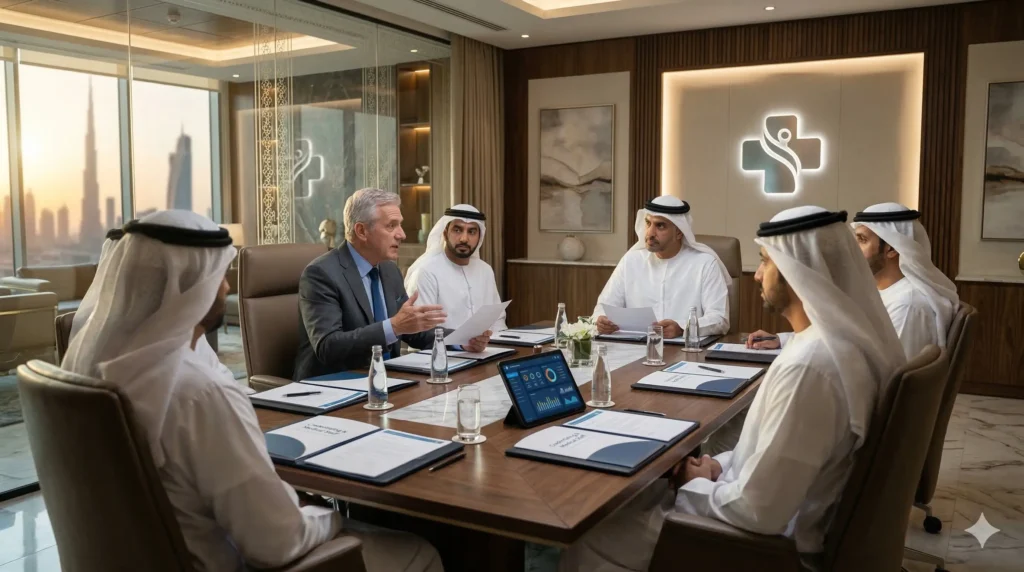

Reprivileging in Gulf Private Hospitals is becoming the quiet decision point that separates a stable consultant career from a slowly narrowing one. In Dubai, Abu Dhabi, Riyadh, and Doha, elite employers no longer compete only on licence activation. They compete on whether a Tier-1 Western-trained clinician can preserve, expand, and defend scope of practice over time.
That is why Reprivileging in Gulf Private Hospitals should not be treated as a background committee ritual. For private hospitals, royal clinics, and UHNW programmes, it is the mechanism that protects clinical authority, patient trust, and the commercial logic behind a serious £ package.
A doctor may enter through a smart GCC licensing strategy and a well-run full-cycle recruiting service. However, the real long-term test comes later, when the organisation decides whether advanced procedures, executive-health scope, sedation rights, theatre access, or high-trust home care privileges should remain, widen, or quietly contract.
Why Reprivileging in Gulf Private Hospitals matters after go-live
The first licence is only the legal starting point. The first committee approval confirms that the consultant can begin safely. Yet Reprivileging in Gulf Private Hospitals decides whether that original promise is still defendable six, twelve, or twenty-four months later.
This is especially important in premium GCC settings. A private hospital may recruit a respected Western-trained proceduralist, but if case volume falls, documentation drifts, or leadership confidence weakens, the privilege set can tighten without public drama. Consequently, revenue weakens, referrals cool, and the clinician begins to feel smaller than the original offer suggested.
That is why refined employers connect Reprivileging in Gulf Private Hospitals to earlier phases such as credentialing and privileging, FPPE in Gulf Private Hospitals, and ongoing governance review through OPPE in Gulf Private Hospitals. The sequence must feel like one architecture, not four disconnected events.
The four signals committees actually read
1. Case volume and recency of practice
The first question is brutally simple: is the consultant still doing enough, often enough, at the level originally granted? Reprivileging in Gulf Private Hospitals depends on current, readable evidence. Historical prestige helps, but committees must still defend continued advanced privileges using recent activity, not old reputation.
For procedural specialties, this becomes decisive. A surgeon, interventionalist, or advanced diagnostician who no longer shows stable case numbers may remain valuable to the institution, but the committee may still narrow scope to protect clinical governance.
2. Documentation and escalation discipline
Elite employers often underestimate how much Reprivileging in Gulf Private Hospitals depends on behaviour rather than brilliance. Excellent clinicians can still create avoidable committee friction if notes are inconsistent, escalation is delayed, or MDT communication becomes irregular.
In premium environments, that matters more, not less. VIP and UHNW care requires calm records, disciplined consent logic, and defensible decisions. A consultant who documents beautifully protects both the patient and the organisation’s ability to renew privileges with confidence.
3. OPPE performance patterns
Good committees do not wait for a crisis. They watch pattern drift. Therefore, Reprivileging in Gulf Private Hospitals is often shaped by the signals already captured in OPPE: outcomes, complaints, complication context, documentation quality, and scope utilisation.
When OPPE is well designed, reprivileging becomes calmer. When OPPE is vague, reprivileging becomes emotional. Elite clinicians do not fear scrutiny; they fear ambiguity.
4. Service-line and commercial fit
A serious private hospital is not renewing privileges in a vacuum. It is asking whether the doctor still fits the service line the business is trying to build. That may involve robotics, executive health, women’s health, oncology, longevity, or discreet family-office medicine.
Accordingly, Reprivileging in Gulf Private Hospitals is also a commercial protection tool. A £ package only remains credible if the consultant can still practise at the level the employer is paying for.
What elite employers still get wrong
The first error is assuming that reprivileging will “sort itself out” because the initial hire was strong. It will not. Committees need written evidence, recent scope, and governance consistency.
The second error is separating recruitment from long-term privilege maintenance. Sophisticated operators now build the future review logic into the original role design. They explain thresholds, dashboards, review periods, and what counts as success before the doctor relocates.
The third error is failing to support doctors who are also maintaining external standing. For UK-trained physicians, that often means respecting the standards mindset behind GMC revalidation for doctors. For regional deployment, hospitals should also stay grounded in regulator logic such as the DHA renewal pathway and the SCFHS professional classification requirements.
How to make Reprivileging in Gulf Private Hospitals a retention advantage
The cleanest model is transparency. Publish the privilege framework early. Define the evidence expected. Separate core privileges from advanced ones. Then make review intervals predictable.
This is where Reprivileging in Gulf Private Hospitals becomes a retention lever rather than a threat. Tier-1 Western-trained consultants stay longer when they understand exactly how authority is preserved. They perform better when they know the organisation does not improvise around scope of practice.
Ultimately, Reprivileging in Gulf Private Hospitals is not about limiting great doctors. It is about proving, at regular intervals, that a great doctor is still safe, current, trusted, and commercially aligned inside a high-stakes GCC environment.
For private hospitals, royal households, and UHNW employers, that is the real objective. Not merely to hire impressive talent, but to keep that talent fully live, fully trusted, and fully deployable over time.
Contact Us for a confidential discussion on securing your next elite hire or role.