
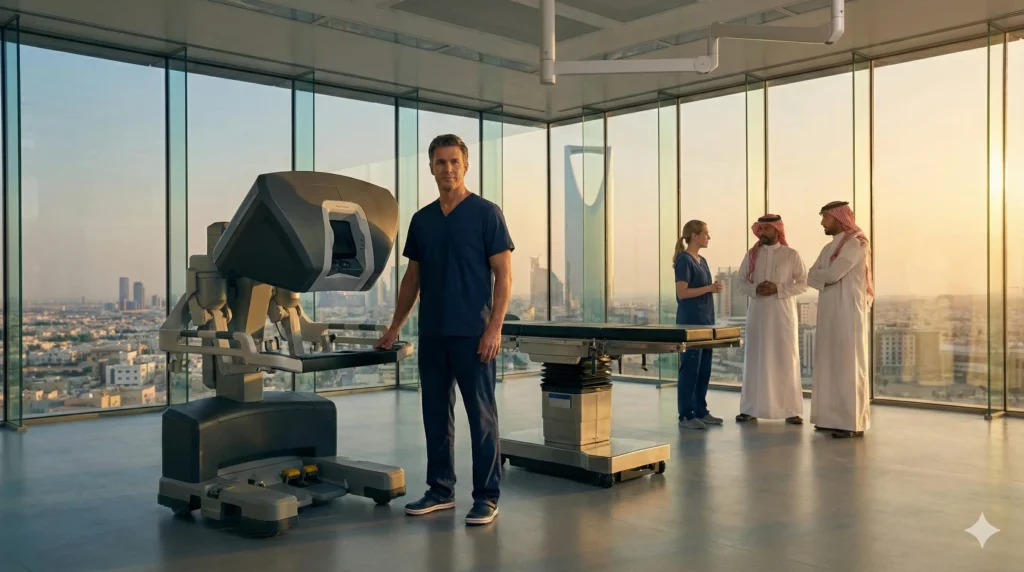
For Western-trained consultant surgeons, Robotic Surgery in the GCC is no longer a prestige niche reserved for a small number of flagship institutions. In 2026, it is becoming one of the clearest indicators of where surgical investment, institutional ambition, and premium patient demand are heading across Dubai, Abu Dhabi, Riyadh, and Doha.
The real shift is not simply technological. It is strategic. Across the Gulf, advanced providers are no longer asking only whether a surgeon is clinically strong. They are asking whether that surgeon can work confidently inside a robotic ecosystem, support programme credibility, mentor teams, protect governance, and strengthen institutional distinction over time.
That is why Robotic Surgery in the GCC now matters to both sides of the market. For employers, it is a service-line growth question. For surgeons, it is a career architecture question. The move is no longer only about tax efficiency or attractive infrastructure. It is about whether the next chapter of practice offers better technical capability, cleaner operating conditions, stronger institutional support, and a more meaningful leadership platform.
Why Robotic Surgery in the GCC Is Accelerating
The Gulf is no longer trying to catch up in advanced surgery. In several flagship environments, robotic capability is being treated as part of long-term institutional positioning.
This matters because surgical recruitment follows capital allocation. When a provider invests in robotic theatres, advanced perioperative pathways, premium inpatient environments, and higher-acuity referral positioning, the hiring brief changes immediately. A traditional consultant profile is no longer enough. Employers begin looking for independent robotic case exposure, procedural maturity, calm judgement, and the ability to help a programme become clinically and commercially credible.
That dynamic is especially visible in the UAE and Saudi Arabia. Dubai Health reported in October 2025 that Dubai Hospital had completed more than 145 robotic surgeries since the programme began in the second half of 2022. KFSHRC in Riyadh has also continued publishing major robotic milestones, reinforcing that robotics is being embedded into real surgical strategy rather than promotional language.
Dubai Health reference:
https://dubaihealth.ae/w/dubai-health-performs-over-145-successful-robotic-surgeries-at-dubai-hospital
KFSHRC reference:
https://www.kfshrc.edu.sa/en/news/2025/10/kfshrc-pushes-the-boundaries-of-robotic-surgery-with-world-first-achievements
For a related recruitment angle, see:
https://medicalstafftalent.com/robotic-surgery-recruitment-gcc/
The Consultant Profile Is Changing
A strong robotic hire is not simply a surgeon who has touched a console.
The real premium now sits with consultants who can demonstrate independent case exposure, specialty-specific credibility, safe judgement under pressure, and the ability to operate inside a mature multidisciplinary system. In elite Gulf hiring, employers increasingly want evidence that the surgeon can contribute beyond the procedure itself.
That means questions like these now matter more:
- Can this surgeon help build or stabilise a robotic programme?
- Can they mentor theatre teams and junior staff?
- Can they contribute to audit, training, and pathway design?
- Can they protect patient trust in a premium environment?
This is why Robotic Surgery in the GCC is not just a technology story. It is a leadership story. The strongest mandates increasingly look for surgeons who combine technical precision with institutional value.
For a broader search model, see:
https://medicalstafftalent.com/executive-search-in-the-gulf-when-private-hospitals-need-more-than-standard-recruitment/
Licensing Still Decides Who Can Actually Move
No matter how strong the surgeon looks on paper, the move only becomes real when licensing logic is correct.
In Dubai, the official DHA registration pathway makes clear that registration confirms the professional meets the requirements for the applied category, title, and specialty, while a healthcare facility must then activate that registration into a licence before practice begins. DHA also lists the last two years of logbook for surgical specialties, a valid Good Standing Certificate, and verification of qualifications and experience among the required documents.
DHA reference:
https://dha.gov.ae/en/services/details?id=245&segment=professional_services
In Abu Dhabi, the Department of Health explains that the Professional Qualification Requirements framework is used to assess educational standards, experience, and licensure requirements for safe practice.
DOH Abu Dhabi reference:
https://www.doh.gov.ae/en/pqr
In Saudi Arabia, SCFHS continues to anchor professional classification around formal qualifications, specialty documentation, and professional pathway alignment.
SCFHS reference:
https://scfhs.org.sa/en/professional-classification-requirements
That is why Robotic Surgery in the GCC rewards excellence, but still operates through title accuracy, documentary coherence, regulator choice, and scope clarity. A hospital may be impressed by a candidate’s robotic exposure, but that enthusiasm means little if the evidence file is incomplete, the specialty title is mismatched, or the licensing route has been framed badly from the beginning.
Related internal reads:
https://medicalstafftalent.com/gcc-licensing-strategy-tier-1-consultants/
https://medicalstafftalent.com/dha-registration-vs-license-dubai/
https://medicalstafftalent.com/doh-pqr-abu-dhabi/
https://medicalstafftalent.com/good-standing-certificates-gcc/
https://medicalstafftalent.com/credentialing-privileging-gcc/
https://medicalstafftalent.com/gcc-consultant-licensing-7-critical-rules/
Robotic Capability Alone Is Not Enough
Many providers still underestimate this point.
A robotic surgeon can be technically excellent and still fail to create institutional value if governance is weak, onboarding is improvised, committee approval is slow, or scope-of-practice control is vague. In a premium hospital or Royal-adjacent setting, that gap becomes expensive quickly.
The issue is not only whether the surgeon can operate. The issue is whether the organisation can convert that surgeon into a stable clinical asset. That includes committee-ready documentation, clear privileging logic, safe launch planning, multidisciplinary credibility, and disciplined quality assurance.
This is where weaker employers quietly lose strong people. Elite surgeons do not usually fear standards. They fear ambiguity. If a robotic programme looks impressive in marketing but fragile in governance, the best Western-trained consultants will hesitate.
That is why Robotic Surgery in the GCC increasingly overlaps with broader questions of clinical leadership, governance maturity, and retention design.
For a governance angle, see:
https://medicalstafftalent.com/medical-staff-bylaws-gcc/
Why Private Hospitals Value Robotic Programme Builders
The most sophisticated private hospitals in the Gulf do not invest in robotics merely to own a machine.
They invest because robotic capability can reshape brand positioning, referral confidence, consultant attraction, and premium patient experience. A respected surgeon with genuine robotic credibility can become the visible face of a whole service line.
For the hospital, the right hire can help strengthen centre-of-excellence positioning, improve patient confidence in high-value surgical pathways, support premium pricing logic, increase referral quality, and attract additional senior talent.
That is why board-level hiring discussions increasingly sit closer to governance and remuneration strategy. Employers need to understand not only what the surgeon costs, but what the surgeon enables.
For compensation context, see:
https://medicalstafftalent.com/gcc-physician-salary-trends-2026-report/
Where Medical Staff Talent Fits in This Market
At Medical Staff Talent, we help private hospitals, private clinics, Royal Households, and UHNW environments recruit Western-trained Doctors, Physiotherapists, and Nurses across Dubai, Abu Dhabi, Riyadh, and Doha.
In surgeon hiring specifically, that means robotics cannot be treated as a branding phrase. It has to be treated as a sequence. First, the consultant’s background must actually fit the target service line. Then the role has to align with licensing logic, documentation quality, likely privileging scope, and the employer’s operational reality.
That matters because premium Gulf recruitment fails when too much is left to assumption. A surgeon may be excellent. A hospital may be ambitious. But unless the role, evidence, regulator path, and governance environment all align, the hire becomes slower, riskier, and harder to retain.
This is particularly important when private providers want Western-trained surgical talent in discreet or prestige-sensitive environments. In those cases, the question is not simply who looks impressive. The question is who can go live safely, credibly, and with long-term value.
What the Next Few Years Will Reward
The market is already moving.
The surgeons who will be most attractive in the next cycle of Robotic Surgery in the GCC are likely to be those who combine five things at once: true specialty depth, clean documentation, robotic credibility, governance maturity, and the ability to support programme development.
Likewise, the employers who will attract them are not necessarily those with the loudest recruitment campaigns. They will be the ones who offer real structure: strong licensing preparation, serious privileging logic, visible leadership, premium theatre environments, and institutional clarity.
That is the deeper reason this market matters. It is not only about doing modern surgery in a modern building. It is about whether a surgeon can build legacy in a system that is still investing upward.
Conclusion
Robotic Surgery in the GCC is no longer a futuristic talking point. It is already helping define which hospitals feel advanced, which surgeons feel market-leading, and which recruitment processes deserve serious attention in 2026.
For Western-trained consultant surgeons, the opportunity is significant. For private hospitals and discreet premium employers, the recruitment standard has become clearer. Robotic capability now needs to sit beside licensing discipline, governance quality, programme-building value, and long-term fit.
That is where the strongest Gulf surgical platforms are beginning to separate themselves from the rest.
If you are assessing a confidential move or designing a high-value robotic hiring strategy, the real question is no longer whether the region has the ambition. It does. The real question is whether the role has been structured well enough to deserve the surgeon.
Incoming links
- https://medicalstafftalent.com/gcc-licensing-strategy-tier-1-consultants/
- https://medicalstafftalent.com/credentialing-privileging-gcc/
- https://medicalstafftalent.com/good-standing-certificates-gcc/
- https://medicalstafftalent.com/dha-registration-vs-license-dubai/
- https://medicalstafftalent.com/doh-pqr-abu-dhabi/
- https://medicalstafftalent.com/executive-search-in-the-gulf-when-private-hospitals-need-more-than-standard-recruitment/
- https://medicalstafftalent.com/medical-staff-bylaws-gcc/
- https://medicalstafftalent.com/gcc-physician-salary-trends-2026-report/