
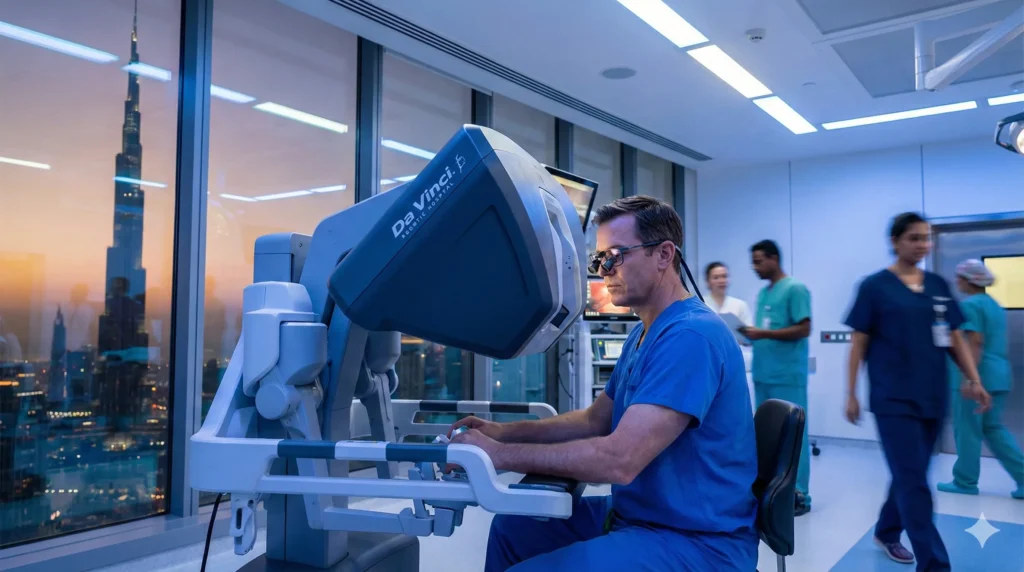
Executive Summary: The Architecture of Surgical Excellence
In the rarefied atmosphere of Gulf Cooperation Council (GCC) healthcare, a seismic shift is occurring. The era of recruiting purely for clinical volume is receding, replaced by a mandate for clinical architecture. As we navigate 2026, the strategic imperative for Royal Medical Offices, Ultra-High-Net-Worth (UHNW) private foundations, and flagship academic medical centers has evolved into a pursuit of transformative leadership.
The current apex of this demand lies in Robotic Surgery Recruitment GCC—a niche so specialized that it requires a fundamental rethinking of executive search methodologies.
The objective for elite institutions in Dubai, Abu Dhabi, and Riyadh is no longer merely to purchase a Da Vinci Xi or a Medtronic Hugo RAS system; capital expenditure is rarely the constraint in this region. The bottleneck is human capital. Specifically, the acute shortage of Tier-1 Western-trained consultants who possess not only the dexterity to operate these systems but the pedagogical authority to act as “Proctors.”
These are the surgeon-educators capable of building a department, training local cohorts, and establishing the rigorous clinical governance frameworks required for Joint Commission International (JCI) accreditation.
At Medical Staff Talent, we define this tier of candidate as the “Clinical Innovator.” They are typically sourced from high-volume academic centers in London, New York, or Toronto, where they have performed over 500 robotic cases. Their value proposition to a GCC employer is dual: they deliver immediate, world-class patient outcomes for complex pathologies (oncology, urology, gynaecology), and they serve as the reputational anchor for the hospital’s marketing strategy. This report serves as a definitive guide for stakeholders navigating this complex recruitment landscape.
The Strategic Imperative: Beyond the Operator to the Proctor
The trajectory of the GCC surgical market is aggressive. With the global surgical robotics market projected to reach nearly $16 billion by 2026, the Gulf is a primary driver of this expansion. The Saudi Commission for Health Specialties (SCFHS) and the Department of Health – Abu Dhabi (DOH) are actively incentivizing the adoption of minimally invasive techniques to reduce patient length-of-stay and improve morbidity rates.
However, the hardware is outpacing the software—the human expertise. A Da Vinci system sitting idle due to a lack of qualified operators is a liability, both financially and reputationally. This gap drives the urgency for specialized Robotic Surgery Recruitment GCC.
Our analysis indicates that for every 10 robotic systems deployed in the region, there are fewer than 4 consultants qualified to utilize them to their full “multi-quadrant” potential. This scarcity creates a fiercely competitive talent market where compensation packages must be meticulously structured to lure consultants away from established tenures in the National Health Service (NHS) or US academic systems.
Employers must understand that they are not just hiring a surgeon; they are hiring a system of care. The successful candidate brings with them a philosophy of perioperative management, a demand for specific nursing competencies, and a requirement for advanced pathology support. Therefore, the recruitment process must be holistic, often involving the simultaneous placement of specialized theatre nurses and first assistants—a capability central to our full cycle recruiting service.
The Market Context: A Trajectory of Precision
The shift towards robotic surgery is not merely a technological upgrade; it is a clinical necessity driven by the region’s changing epidemiological profile. As the GCC population ages and lifestyle diseases such as obesity and diabetes become more prevalent, the incidence of complex cancers (prostate, colorectal, endometrial) is rising. These pathologies require the precision of robotic intervention to spare nerves, preserve function, and ensure rapid recovery.
In Riyadh, the expansion of private healthcare under Vision 2030 has created a massive demand for Western talent. The “Headquarters” requirement for international firms has brought a wave of expatriate executives who demand healthcare standards equivalent to their home countries. Consequently, private hospitals are racing to establish “Centers of Excellence” in robotic surgery to capture this lucrative market segment.
Similarly, in Dubai and Abu Dhabi, the focus on medical tourism necessitates the presence of “Star Surgeons”—clinicians whose international reputation can attract patients from across the MENA region and beyond. These surgeons act as magnets, drawing in complex cases that would otherwise travel to London or Cleveland.
The “Clinical Innovator” Profile: Defining Tier-1 Talent
When we engage in Robotic Surgery Recruitment GCC, we apply a rigorous filter that eliminates 95% of the global surgical workforce. The target profile is narrow. It requires a consultant who holds a Certificate of Completion of Training (CCT) from the UK, or American Board of Medical Specialties (ABMS) certification, with a sub-specialty fellowship in robotic oncology or reconstruction.
The “High-Volume” Metric
In robotic surgery, volume is the proxy for safety. Western data consistently shows that outcomes in radical prostatectomies or complex hysterectomies improve significantly after a surgeon passes the 200-case mark. For our GCC clients, we set the benchmark higher.
We seek candidates who are “High-Volume/High-Complexity” operators—those managing T3/T4 tumors or performing salvage procedures. This level of expertise ensures that the consultant can handle intra-operative complications independently, a critical requirement when working in a private hospital that may lack the massive resident support teams found in Western teaching hospitals.
The Academic Proctor
The distinction between a user and a proctor is vital. A user can operate; a proctor can teach. The latter is essential for the GCC’s sustainability goals (Saudisation and Emiratisation). We prioritize candidates who are certified proctors for major device manufacturers (Intuitive Surgical, Medtronic, CMR Surgical).
These individuals carry an inherent badge of authority. They are accustomed to peer review, video auditing of surgical technique, and morbidity & mortality (M&M) conferences—elements of clinical governance that are non-negotiable for our elite clients.
Integrating these leaders often requires a bespoke approach to licensure. While the standard medical licensing requirements for the DHA or SCFHS focus on primary source verification, the credentialing for robotic privileges requires the submission of surgical logbooks validated by the hospital of origin. We manage this granular data collection to ensure that when the surgeon arrives in Riyadh or Dubai, their privileges are active on day one.
Competency Matrix: Validating the “Expert”
In the unregulated lexicon of recruitment, terms like “expert” are often diluted. For Robotic Surgery Recruitment GCC, we utilize a strict Competency Matrix to grade candidates before they are presented to a client. This protects the institution from “learning curve” liability.
-
Novice / Learner: < 50 Cases Lifetime (< 20 Annual). No Proctorship. Not Suitable for Consultant roles.
-
Competent: 50–150 Cases Lifetime (30–50 Annual). No Proctorship. Suitable for supervised roles or team positions.
-
Proficient: 150–300 Cases Lifetime (50–80 Annual). Regional Proctor. Tier-2 Target. Capable of independent practice.
-
Expert / Master: > 500 Cases Lifetime (> 100 Annual). Global/Master Proctor. Tier-1 Target. Clinical Director / Department Head material.
Insight: Many candidates inflate their numbers by including cases where they were a “console assistant.” Our vetting process requires the submission of an ACGME or Royal College validated case log, distinguishing between “primary surgeon” and “assistant” roles. We verify these logs directly with the candidate’s previous Medical Director.
The Recruitment Architecture: A Full Cycle Approach
Recruiting a robotic surgeon is not a transaction; it is a strategic acquisition. At Medical Staff Talent, we employ a “clinical architecture” approach that mirrors the precision of the surgery itself. This full-cycle recruiting service ensures that every placement is viable, sustainable, and culturally aligned.
Phase 1: Role Design and Needs Analysis The process begins with a deep dive into the client’s infrastructure. Does the hospital have the necessary robotic platform? Is the central sterile supply department (CSSD) equipped to handle delicate robotic instruments? Is there a dedicated robotic nursing team?
We work with the client to define the precise clinical mandate. For example, a hospital launching a robotic urology program needs a different candidate profile than one expanding into robotic thoracic surgery. We help structure the job description to attract the right talent, emphasizing the opportunity to build a legacy—a powerful motivator for academic surgeons.
Phase 2: Targeted Global Search Our search strategy is global but targeted. We focus on “Centers of Excellence” in the UK (e.g., The Royal Marsden, Guy’s and St Thomas’), the US (e.g., Mayo Clinic, Cleveland Clinic), and Canada (e.g., University of Toronto). We utilize our proprietary database of Western-trained consultants, filtering for those with active proctorship status.
We also leverage our network within professional societies (e.g., EAU, AUA) to identify “passive” candidates—those not actively looking for a job but open to a compelling proposition. This “headhunting” approach is essential for securing Tier-1 talent.
Phase 3: The “UHNW Readiness” Assessment For placements in Royal Households or UHNW private clinics, clinical excellence is just the baseline. The candidate must also possess “UHNW readiness”—the emotional intelligence, discretion, and cultural adaptability to function in a high-stakes, service-oriented environment.
We assess candidates for their ability to navigate the nuances of elite care, such as:
-
Discretion: The absolute protection of patient privacy.
-
Availability: The willingness to be on call 24/7 for the principal and their family.
-
Concierge Medicine: The ability to coordinate care across multiple specialties and geographies.
Phase 4: Clinical Governance and Verification Before a candidate is presented, we conduct a rigorous verification of their credentials. This includes:
-
Primary Source Verification (PSV): Utilizing the DataFlow Group to verify degrees, licenses, and employment history.
-
Reference Checks: Speaking directly with previous Medical Directors and peers to validate clinical skills and professional conduct.
-
Video Assessment: For surgical roles, we often request anonymized video clips of the candidate’s robotic technique to be reviewed by our clinical advisors.
Regulatory Landscapes: Navigating the 2026 Unified Platform
The regulatory environment in 2026 has become more streamlined yet more rigorous. The impending launch of the UAE’s National Unified Digital Health Licensing Platform aims to harmonize standards across the Ministry of Health and Prevention (MOHAP), https://services.dha.gov.ae/, and Department of Health (DOH).
The “Practice Gap” Trap For robotic surgeons, the most critical regulatory hurdle is the “discontinuity of practice” rule. Both the https://scfhs.org.sa/en in Saudi Arabia and the UAE authorities maintain a strict policy: a gap in clinical practice exceeding two years can lead to a downgrade in professional title. For executive surgeons who may have taken administrative sabbaticals, this is a lethal blow to their eligibility.
In Robotic Surgery Recruitment GCC, we scrutinize the candidate’s timeline with forensic detail. We ensure that their “clinical currency”—the number of procedures performed in the last 12 months—meets the specific thresholds of the target regulator. For the SCFHS, this often involves a “Locum Tenens” verification to prove that even during research periods, the surgeon maintained hand skills.
Algorithmic Literacy and Bioethics A novel dimension in 2026 is the DOH’s focus on Algorithmic Literacy. As robotic systems increasingly integrate AI for image guidance and haptic feedback, the regulator requires surgeons to demonstrate an understanding of these automated inputs. Our recruitment vetting now includes an assessment of the candidate’s familiarity with AI-driven surgical adjuncts, ensuring they align with the latest https://medicalstafftalent.com/2026-doh-bioethics-guidelines-vs-western-st/.
This requirement is particularly relevant for “Proctor” roles, as these individuals will be responsible for teaching local teams how to use these advanced tools safely. The ability to explain the logic behind AI-driven decisions to patients and colleagues is now a core competency for elite consultants in the GCC.
The Financial Architecture: Compensation in Pounds Sterling (£)
To secure a Tier-1 Robotic Urologist or Gynaecological Oncologist from a leading Western institution, the financial proposition must be compelling. We conduct all negotiations in Pounds Sterling (£) to provide clarity and stability for our candidates.
Benchmarking the “Golden Circle” As detailed in our salary guide, the base salary for a standard Western Consultant in the GCC typically ranges from £15,000 to £22,000 per month tax-free. However, Robotic Surgery Recruitment GCC operates on a different tier. For a Proctor-level surgeon, the total compensation package often exceeds £35,000 to £45,000 per month (£420k–£540k per annum).
This “Golden Circle” package is structured to mitigate the risk of career interruption and incentivize long-term commitment:
-
Base Salary: £20,000 – £25,000 Monthly (£240k – £300k Annual). Strategic Purpose: Guaranteed income stability for the family.
-
Performance Bonus: £5,000 – £15,000 Monthly (£60k – £180k Annual). Strategic Purpose: Tied to revenue generation and clinical outcomes.
-
Academic Grant: £1,500 – £4,000 Monthly (£18k – £48k Annual). Strategic Purpose: Protected funds for attending global conferences (AUA, EAU).
-
Housing Allowance: £3,000 – £5,000 Monthly (£36k – £60k Annual). Strategic Purpose: Ensures luxury accommodation in prime expatriate zones.
-
Education Allowance: £2,500 – £3,000 Monthly (£30k – £36k Annual). Strategic Purpose: Covers premium British/American school fees for up to 3 children.
Insight: For UHNW private families establishing personal medical teams, the compensation model shifts from revenue generation to availability. A private surgeon on a yacht or royal estate may command £500,000+ per annum purely for exclusivity and rapid-response capability. This premium reflects the opportunity cost of leaving active hospital practice.
The “Hardship Premium” and Regional Variance
While Dubai remains a lifestyle magnet, Riyadh is the growth engine. The “Headquarters” requirement for international firms and the explosion of private healthcare under Vision 2030 have created a massive demand for Western talent in the Kingdom. Recruitment for Riyadh often carries a “hardship premium” of approximately 15-20% over Dubai to attract consultants who are in the wealth-accumulation phase of their careers. However, rapid lifestyle reforms in Saudi Arabia are eroding this perception, and we are seeing increasing parity in compensation across the GCC.
The “Hyper-Specialist” Ecosystem
Successful Robotic Surgery Recruitment GCC cannot occur in a vacuum. A robotic surgeon requires a high-performance ecosystem to function effectively. This includes:
-
Robotic First Assistants: We frequently recruit specialized Registered Nurses (RNs) or Physician Assistants (PAs) who are experts in “docking” the robot and managing arm clashes. Their ability to anticipate the surgeon’s moves is critical for efficiency and safety.
-
Specialized Anaesthetists: Professionals capable of managing the unique physiological demands of steep Trendelenburg positioning used in robotic pelvic surgery. They must be adept at managing intra-ocular pressure and ventilatory dynamics during prolonged pneumoperitoneum.
-
Pathology & Genomics: As outlined in our report on executive wellness and longevity, elite oncology care now requires genomic sequencing of tumors. The surgeon must work in concert with molecular pathologists to tailor adjuvant therapies.
This ecosystem approach is why we encourage clients to view recruitment not as a singular hire, but as a “Service Line Acquisition.” When we place a Director of Robotic Surgery, we often map the entire support team required to make them effective within 90 days.
Royal & UHNW Specifics: The Private Domain
For Royal Households and UHNW families, the requirements for a robotic surgeon extend beyond the operating theater. These clients often require a “Medical Director” figure who can oversee their entire healthcare portfolio, from preventative longevity protocols to acute interventions.
The “Personal Physician” Model In this context, the surgeon acts as a “Personal Physician” with surgical capabilities. They must be available to travel with the principal, manage their medical records, and coordinate care with other specialists globally. The vetting process for these roles focuses heavily on personality fit, discretion, and the ability to operate autonomously in non-traditional settings (e.g., on a yacht or private estate).
We also see a trend towards “Longevity Medicine” within these households. The surgeon is expected to be knowledgeable about the latest advancements in age-reversal and bio-optimization, integrating these into the family’s wellness plan.
Risk Management: Why Searches Fail
The primary reason for assignment failure in the GCC is not clinical incompetence; it is family unhappiness. For a Tier-1 Robotic Surgeon (who is likely mid-career, aged 40–55), family dynamics are the fulcrum of the decision.
The “Trailing Spouse” & Family Integration
-
Spousal Employment: The spouse of a high-net-worth surgeon is often a professional themselves (lawyer, academic, executive). We proactively link spouses with executive search networks in Dubai/Riyadh to ensure dual-career continuity.
-
Education: With waiting lists for schools like Dubai College or King’s College Riyadh being notoriously long, we leverage our network to secure placements as part of the negotiation. This is often the “deal-breaker” for families with school-aged children.
-
Housing Equity: Long-term retention is improved when candidates move from renting to owning. With the UAE’s Golden Visa now linked to property investment, we advise clients to structure “housing down-payment assistance” as a retention bonus, vesting over 3–5 years.
The “Cultural Fit” Factor We also screen for “Cultural Intelligence.” The GCC healthcare environment is hierarchical and relationship-driven. Western consultants who adopt an overly aggressive or transactional approach often struggle to build the necessary alliances with administration and local staff. We look for candidates who demonstrate patience, diplomacy, and a mentorship mindset—essential qualities for a “Proctor” role.
Future Outlook: The 2030 Horizon
Looking ahead to 2030, the demand for robotic surgery in the GCC will only intensify. We anticipate several key trends:
-
Telesurgery: As 5G infrastructure matures, we will see the emergence of remote robotic surgery, where a surgeon in a central hub (e.g., Riyadh) can operate on a patient in a remote location. This will require a new set of regulatory and credentialing standards.
-
AI Integration: The role of the surgeon will evolve from “operator” to “supervisor” as AI algorithms take over more routine tasks. Recruitment will focus on candidates with high “digital dexterity.”
-
Genomic Medicine: The integration of genomics into surgical planning will become standard, requiring surgeons to be fluent in molecular biology.
At Medical Staff Talent, we are committed to staying ahead of these trends, ensuring that our clients have access to the visionary leadership required to navigate this future.
Conclusion: Securing the Future of Surgical Excellence
The window to secure top-tier Robotic Surgery Recruitment GCC talent is narrowing. As global shortages of surgical specialists intensify, the “Golden Circle” of the Gulf must compete not just on salary, but on purpose.
We are inviting consultants to build the future of medicine in a region that is investing more heavily in healthcare infrastructure than anywhere else on earth. For the employer, the message is clear: precision requires patience. Sourcing a Proctor-level surgeon is a 4-to-6-month process involving complex credentialing, negotiation, and family onboarding.
At Medical Staff Talent, we act as the bridge between these two worlds. We translate the clinical pedigree of the West into the strategic needs of the Gulf, ensuring that every placement is a cornerstone for a Center of Excellence.
Contact Us for a confidential discussion on securing your next elite hire or role.
DEEP DIVE: The Anatomy of a Robotic Surgery Recruitment Strategy
This section provides granular data and strategic frameworks for HR Directors and C-Suite Executives.
I. The Competency Matrix: Validating the “Expert” In the unregulated lexicon of recruitment, terms like “expert” are often diluted. For Robotic Surgery Recruitment GCC, we utilize a strict Competency Matrix to grade candidates before they are presented to a client. This protects the institution from “learning curve” liability.
-
Novice / Learner: < 50 Cases Lifetime (< 20 Annual). No Proctorship. Not Suitable for Consultant roles.
-
Competent: 50–150 Cases Lifetime (30–50 Annual). No Proctorship. Suitable for supervised roles or team positions.
-
Proficient: 150–300 Cases Lifetime (50–80 Annual). Regional Proctor. Tier-2 Target. Capable of independent practice.
-
Expert / Master: > 500 Cases Lifetime (> 100 Annual). Global/Master Proctor. Tier-1 Target. Clinical Director / Department Head material.
Insight: Many candidates inflate their numbers by including cases where they were a “console assistant.” Our vetting process requires the submission of an ACGME or Royal College validated case log, distinguishing between “primary surgeon” and “assistant” roles. We verify these logs directly with the candidate’s previous Medical Director.
II. The “Trailing Spouse” & Family Integration The primary reason for assignment failure in the GCC is not clinical incompetence; it is family unhappiness. For a Tier-1 Robotic Surgeon (who is likely mid-career, aged 40–55), family dynamics are the fulcrum of the decision.
-
Spousal Employment: The spouse of a high-net-worth surgeon is often a professional themselves (lawyer, academic, executive). We proactively link spouses with executive search networks in Dubai/Riyadh to ensure dual-career continuity.
-
Education: With waiting lists for schools like Dubai College or King’s College Riyadh being notoriously long, we leverage our network to secure placements as part of the negotiation.
-
Housing Equity: Long-term retention is improved when candidates move from renting to owning. With the UAE’s Golden Visa now linked to property investment, we advise clients to structure “housing down-payment assistance” as a retention bonus, vesting over 3–5 years.
III. The Licensing Critical Path (DHA/DOH/SCFHS) The timeline for Robotic Surgery Recruitment GCC is dictated by licensure. A Tier-1 candidate cannot simply “start.”
-
DataFlow Verification: This primary source verification process takes 4–8 weeks. We initiate this before the contract is signed to parallel-process the timeline.
-
The “Good Standing” Trap: Certificates of Good Standing (CGS) from the GMC or ABMS are valid for only 3–6 months. We time the request of these documents to ensure they do not expire during the visa processing window.
-
Privileging vs. Licensing: A medical license grants the right to practice medicine; privileging grants the right to perform specific procedures. We assist candidates in compiling a “Privilege Delineation” dossier—a specific list of robotic procedures they are competent to perform, backed by evidence. This is crucial for hospital indemnity insurance in the GCC.
IV. Recruitment Funnel Metrics For a standard search for a Robotic Urologist in Riyadh, the metrics typically follow this funnel:
-
Longlist: 150 identified targets (Global).
-
Screened: 30 candidates engaged.
-
Qualified: 8 candidates meeting the “Proctor” criteria and interested in GCC.
-
Shortlist: 3 candidates presented to client.
-
Offer: 1 candidate selected.
-
Time-to-Hire: The industry average is 9 months. Through our proactive pipelining and “warm bench” of candidates, Medical Staff Talent aims to reduce this to 4–5 months.
For further details on our specific methodologies for securing C-Suite and Clinical Leadership, please review our guide on https://medicalstafftalent.com/gcc-medical-leadership-recruitment-strategy/.
Strategic Analysis: The Interplay of Clinical Innovation and Corporate Governance in 2026
The convergence of clinical innovation and corporate governance is a defining characteristic of the 2026 GCC healthcare market. As hospitals strive to achieve “Center of Excellence” status, the role of the robotic surgeon extends beyond the operating theater into the boardroom. They are increasingly expected to contribute to strategic planning, budgeting, and quality assurance initiatives.
The Surgeon as a Strategic Asset In the past, surgeons were viewed primarily as revenue generators. Today, they are strategic assets. A world-class robotic surgeon can enhance a hospital’s brand reputation, attract high-value patients, and drive referrals from other specialists. This “halo effect” is a key consideration for hospital administrators when evaluating the ROI of a robotic surgery program.
However, capitalizing on this potential requires a sophisticated recruitment strategy. It involves identifying candidates who possess not only surgical virtuosity but also business acumen. These “physician-executives” are rare, and securing them requires a tailored approach that speaks to their dual ambitions.
The Role of Data in Executive Search Data is becoming increasingly central to the executive search process. At Medical Staff Talent, we utilize advanced analytics to identify trends in physician migration, compensation, and clinical performance. This data-driven approach allows us to provide our clients with actionable insights that inform their recruitment strategies.
For example, our analysis of 2026 physician salary trends reveals that the “Golden Circle” compensation package is evolving. While base salaries remain important, there is a growing emphasis on performance-based incentives and long-term equity participation. This shift reflects the broader trend towards value-based care, where providers are rewarded for outcomes rather than volume.
Navigating the Geopolitical Landscape The geopolitical landscape of the GCC is also a factor in recruitment. The rivalry between Dubai and Riyadh for regional dominance is driving investment in healthcare infrastructure and talent. This competition is creating opportunities for Western consultants, but it also introduces complexity.
Candidates must navigate different regulatory regimes, cultural norms, and lifestyle considerations. Our role as recruitment strategists is to guide them through this maze, providing objective advice and support at every step of the journey. We help them understand the nuances of each market, from the tax implications of working in Saudi Arabia to the residency options in the UAE.
The Importance of Soft Skills While clinical skills are paramount, soft skills are often the differentiator for Tier-1 candidates. The ability to communicate effectively with patients from diverse backgrounds, to lead multi-disciplinary teams, and to navigate complex organizational structures is essential for success in the GCC.
We assess these skills through behavioral interviewing and reference checking. We look for candidates who demonstrate empathy, resilience, and adaptability—qualities that are particularly important in the high-pressure environment of elite healthcare.
Conclusion: A Partnership for Excellence
Robotic Surgery Recruitment GCC is a complex, high-stakes endeavor. It requires a deep understanding of the market, a rigorous vetting process, and a strategic approach to compensation and integration. At Medical Staff Talent, we are dedicated to helping our clients build world-class surgical teams that deliver exceptional patient care.
We invite you to partner with us in this mission. Whether you are a hospital administrator seeking to establish a robotic surgery program or a consultant looking for your next career challenge, we have the expertise and the network to help you succeed.
Contact Us for a confidential discussion on securing your next elite hire or role.