

Why Western-trained hires underperform after a strong shortlist when title, licensing, privileges, and service-line reality do not match
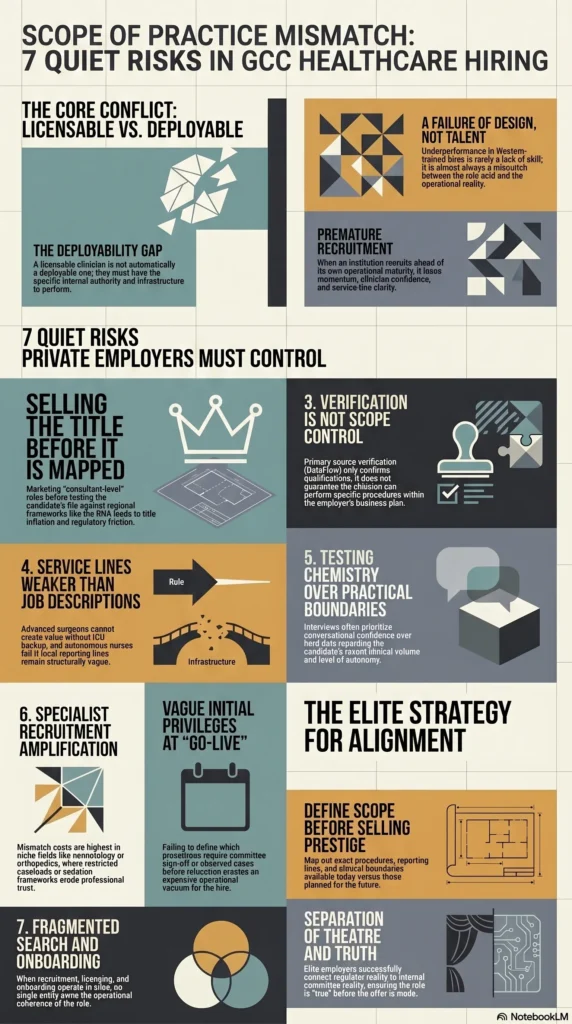
Why Western-Trained Hires Underperform: The Scope of Practice Mismatch in GCC Hiring
The CV looks exceptionally strong. The interview feels reassuring. The regulatory pathway appears manageable, and the compensation package is entirely credible. Yet, shortly after the clinician arrives, the role begins to narrow.
The promised procedures are not fully approved. The referral base is thinner than expected. The internal credentialing committee moves significantly slower than the hiring team suggested. A senior, Western-trained clinician who looked commercially powerful on paper suddenly becomes only partially deployable in practice.
That failure is rarely a talent problem. It is almost always a design problem.
In private hospitals, premium clinics, royal households, and UHNW medical environments across Dubai, Abu Dhabi, Riyadh, and Doha, employers do not lose elite hires simply because of salary, relocation issues, or licensing delays. They lose them because the scope sold during recruitment does not match the scope that can actually go live.
The True Cost of Deployability vs. Licensability
A licensable clinician is not automatically a deployable clinician.
This distinction matters immensely in the Gulf’s premium private sector because reputation, patient trust, and service-line economics are inextricably linked. A Western-trained doctor, nurse, or physiotherapist may be technically brilliant and fully credible by origin-country standards, but still arrive into a role defined by unclear authority, restricted practical scope, or weak internal clinical pathways.
Key Takeaway: When an institution recruits ahead of its own operational maturity, the result is commercially damaging. The employer loses momentum, the clinician loses confidence, and the service line loses clarity.
This is precisely why scope of practice mismatch in GCC hiring must be addressed early in the same conversation as credential review, privileging design, and go-live planning—rather than after the contract has already been executed.
7 Core Triggers of Scope Mismatch in the Gulf
1. Selling the Title Before It Is Mapped
The first risk is title inflation. A hospital may market a role as consultant-level, leadership-facing, or specialist-led before the candidate’s file has been rigorously tested against regional frameworks.
In Dubai and the wider GCC, registration with bodies like the Dubai Health Authority (DHA) is not automatic scope approval. A clinician may look close to deployable on paper, but actual practice still depends on facility context, internal approvals, and the practical boundaries of the post.
2. Treating Verification as Paperwork Instead of Scope Control
Primary source verification confirms that qualifications, registrations, and career chronology are genuine. While passing the mandatory audits via the DataFlow Group is essential, it does not answer the deeper operational question: Can this clinician perform the exact work the employer has promised in interviews, in the contract, and in the service-line business plan?
Discipline-focused employers use verification as one control inside a wider scope audit. They actively test subspecialty exposure, procedure history, case volume, and clinical continuity before over-promising the role.
3. A Service Line Weaker Than the Job Description
A Service Line Weaker Than the Job Description A Western-trained clinician can only create value inside a structure that is operationally ready to utilize them. To prevent these delays, institutions must align their clinical infrastructure with regional onboarding frameworks before mobilization, as detailed in our guide on DataFlow and PSV for Gulf Licensing: A Clear Workflow for Western-Trained Clinicians.
-
Doctors may be cleared for advanced surgical interventions, but local theatre access or ICU backup is limited.
-
Nurses may be highly autonomous, but local reporting lines remain structurally vague.
-
Physiotherapists may possess premium rehabilitation expertise, but the internal referral pathway is underbuilt.
4. Testing Chemistry Over Practical Boundaries
Many healthcare employers still conduct interviews that identify conversational confidence rather than true clinical deployability.
In premium private healthcare, a polished Western-trained clinician may communicate beautifully, but scope questions must test actual practice boundaries: What clinical volume have they managed recently? With what level of autonomy? Under what specific clinical governance structure?
5. Specialist Recruitment Amplification
Scope mismatch becomes exponentially more expensive in niche or procedure-sensitive appointments, such as pain medicine, neonatology, or specialized orthopedics regulated by the Saudi Commission for Health Specialties (SCFHS) or local ministries.
If the actual caseload, sedation framework, or facility capability is narrower than the role suggested during recruitment, both revenue expectations and professional trust erode rapidly.
6. Vague Initial Privileges at Go-Live
The license may be active and the welcome warm, yet the practical privilege set remains ambiguous. Which procedures go live on day one? Which require specific committee sign-off, observed cases, or localized peer references?
If these questions are left unanswered until relocation, the clinician begins work inside an expensive operational vacuum.
7. Fragmented Search, Licensing, and Onboarding
When recruitment sits in one lane, licensing in another, and onboarding in a third, nobody owns the operational coherence of the role. The shortlist looks excellent, the regulator file is acceptable, and the offer is signed—but the actual execution sequence is fundamentally fragmented.
How Elite GCC Employers Prevent Scope Mismatch
Serious employers define scope before they sell prestige. They map out the practical role before they announce the strategic ambition.
Role Design ➔ Title Logic ➔ Verification ➔ Privilege Planning ➔ Mobilization
They map out exactly which procedures, decisions, reporting lines, and clinical boundaries are genuinely available today, which are planned for tomorrow, and which should not be promised at all. They successfully connect regulator reality to committee reality, separating recruitment theatre from clinical truth.
Aligning Role Architecture with Medical Staff Talent
Medical Staff Talent operates exclusively in the sector of the market where scope mistakes are most costly.
We partner with premium private hospitals, clinics, royal households, and UHNW families across Dubai, Abu Dhabi, Riyadh, and Doha to recruit Western-trained Doctors, Physiotherapists, and Nurses. Our methodology ensures a tight, unbroken alignment between the initial search brief, regulatory licensability, practical scope, and post-arrival stability.
In this elite tier of healthcare recruitment, a strong CV is just the baseline. The role itself has to be true.
For a confidential discussion about aligning title, licensing, privileges, and deployable scope in Western-trained clinical hiring across the Gulf, Contact Medical Staff Talent today to arrange a bespoke consultation.