
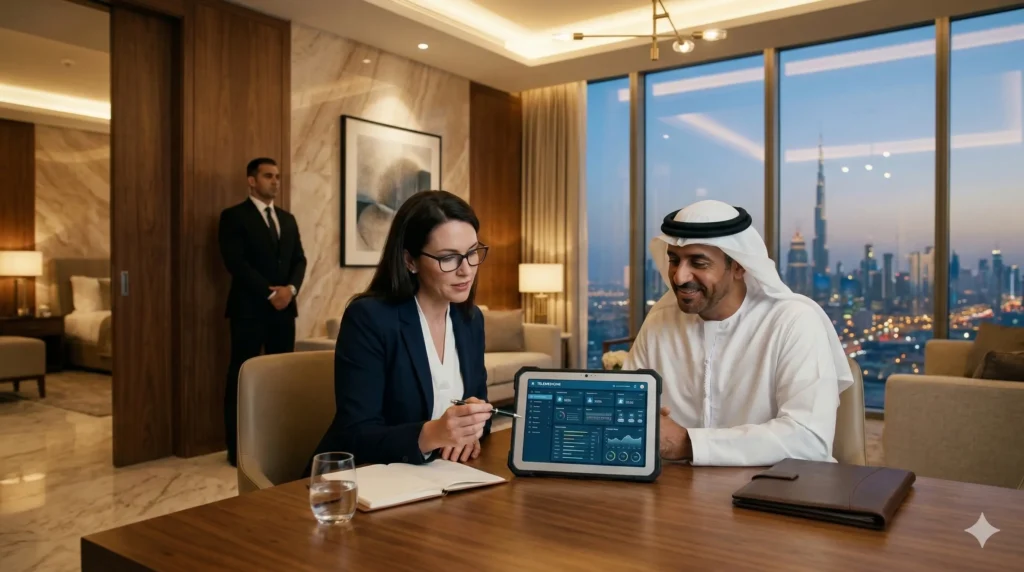
Telemedicine Recruitment GCC is no longer a “future capability.” It is a present-day clinical product that must feel as premium as the in-person experience.
However, elite telemedicine fails fast when it is staffed like a call centre. In Dubai, Abu Dhabi, Riyadh, and Doha, the telehealth clinician is an extension of your brand, your clinical governance, and your confidentiality posture.
Why Telemedicine Recruitment GCC is a different search
In standard hiring, the employer evaluates competence and fit. In Telemedicine Recruitment GCC, you are also recruiting for remote trust: the ability to reassure, document, and escalate without theatre.
Therefore, the shortlist must be filtered for three non-negotiables:
-
Tier-1 / Tier-2 Western training with clean regulator history
-
Calm, structured communication under ambiguity
-
Evidence of governance discipline (documentation, escalation, audit readiness)
If any of those are missing, the programme becomes noisy. And in elite settings, noise is the enemy of retention.
The regulatory truth: “virtual” still needs real licensing
Many decision-makers assume telemedicine can bypass the hard parts. It cannot.
Even when care is delivered remotely, regulators still anchor practice to jurisdiction, scope, and accountability. Consequently, Telemedicine Recruitment GCC must be built on licensing realism, not optimistic assumptions.
Start with a licensing lens early via the GCC Consultant Licensing framework, because the title on the licence affects what the clinician can legally do, how they can be marketed, and how the service can scale.
Meanwhile, build your compliance posture around regulator-grade references such as the Dubai Health Authority (DHA) and the Saudi Commission for Health Specialties (SCFHS). These are not “links for HR.” They are the ecosystem your telemedicine service must survive.
The four telemedicine roles elite employers actually need
Telemedicine Recruitment GCC becomes predictable when roles are designed precisely. Vague roles attract vague candidates.
1) Telemedicine Medical Director
This is clinical architecture, not administration. The Director sets protocols, escalation pathways, and documentation standards that protect the organisation.
2) Tier-1 Second-Opinion Consultant
This profile sells outcomes and confidence. They must be able to deliver decisive guidance, document defensibly, and protect reputation when cases are politically or personally sensitive.
3) Tele-triage nurse or advanced practice clinician
In premium services, this role is about prevention of friction. They reduce unnecessary escalation while ensuring nothing unsafe is missed.
4) Hybrid concierge clinician (virtual + on-site availability)
This is the gold standard for UHNW programmes. It requires discretion, mobility, and absolute clarity around boundaries, rota, and handover.
How to assess telemedicine capability (without being fooled)
Telehealth interviews reward polish. Elite hiring rewards proof.
Use scenario-based assessment with short, hard prompts:
-
“A VIP wants antibiotics now. What do you do in the first 90 seconds?”
-
“A patient refuses escalation but you’re concerned. Document and manage.”
-
“You suspect a safeguarding issue. What’s your chain of action?”
Then check for three signals:
-
Structured thinking (clear steps, no drama)
-
Documentation instinct (what they would record, not just what they would say)
-
Escalation discipline (knows when to move from virtual to physical care)
Finally, match this to your hiring method. A telemedicine build is not a job ad; it is a targeted search. If you want to see how premium employers run this quietly, anchor your process to an executive search approach rather than mass-market recruitment.
Offer architecture in Pounds Sterling (£): what closes Tier-1 talent
Telemedicine Recruitment GCC becomes expensive when offers are improvised. Tier-1 clinicians are not persuaded by salary alone; they are persuaded by operational truth.
Benchmark compensation against real Tier-1 market signals using the GCC Physician Salary Trends, and then structure the offer around:
-
Scope clarity (what is and isn’t included)
-
Availability design (rota, response times, cross-border travel expectations)
-
Clinical governance support (audit-ready templates, escalation partners, named facilities)
-
Confidentiality protections (information access rules, redaction protocols, single-point scheduling)
As a rule, the more UHNW the patient cohort, the more the clinician will price the risk of visibility. Pay in £, but de-risk in systems.
Mobilisation: the dossier-first standard
Telemedicine collapses when mobilisation drifts. Therefore, build a dossier-first pipeline before the final interview round.
Use a PSV-ready checklist mentality early—especially for Western-trained profiles with multiple hospitals and layered fellowships. If you want a clean baseline, operationalise documentation using the DataFlow Checklist, then align timelines to licensing reality.
Ultimately, Telemedicine Recruitment GCC is not a tech project. It is a clinical credibility project delivered through technology.
Contact Us for a confidential discussion on securing your next elite hire or role.

