VIP Yacht Nursing Recruitment: Managing High-Caliber Clinical Governance at Sea
For Ultra-High-Net-Worth (UHNW) families and prominent Gulf family offices, seasonal travel aboard private superyachts across the Mediterranean or Caribbean represents the pinnacle of privacy and luxury. However, when an elderly or clinically vulnerable principal is on board, the operational priority instantly shifts from luxury hospitality to absolute clinical safety.
Deploying high-acuity medical care on the open sea introduces a unique set of challenges. Isolated from immediate tertiary hospital support, a private vessel must function as a self-sustaining medical unit. Achieving this level of security requires a highly sophisticated approach to VIP yacht nursing recruitment, focused entirely on establishing strict mobile clinical governance managed by Western-trained private nurses.
The Illusion of Hospitality vs. The Reality of Acute Care
A common pitfall in private estate and maritime recruitment is conflating the environments. A superyacht is an elite hospitality asset, but its medical suite must be treated with the clinical rigor of an onshore intensive care unit.
When a principal suffers from complex chronic conditions, cardiovascular vulnerabilities, or requires intricate medication schedules, hiring a nurse with a background in premium private clinics or corporate wellness is a profound operational risk.
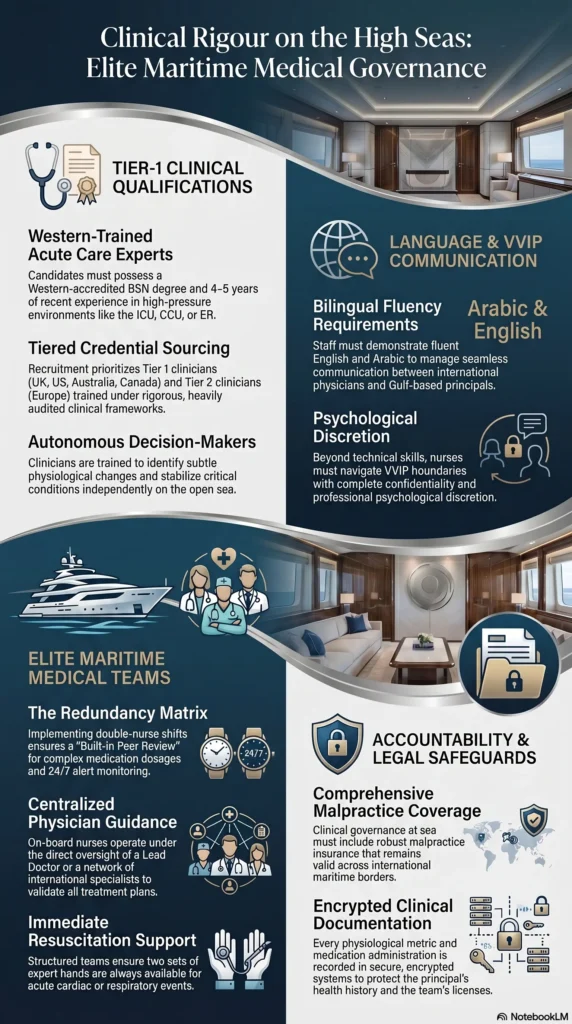
The Executive Standard: True mobile clinical governance requires autonomous, split-second decision-making. Elite recruitment strategies mandate that candidates possess a minimum of 4 to 5 years of recent experience within high-pressure Acute Hospital environments—specifically Intensive Care Units (ICU), Coronary Care Units (CCU), or Emergency Rooms (ER).
These clinicians are uniquely trained to identify subtle physiological changes, manage advanced medical equipment, and stabilize critical conditions independently before an aero-medical evacuation can be organized.
Structuring Elite Maritime Medical Teams for Risk Mitigation
Operating a 1:1 clinical rotation at sea leaves zero room for error. Fatigue, miscommunication, or isolated practice can compromise patient safety. To mitigate these risks, sophisticated Gulf private healthcare frameworks and family offices implement structured elite maritime medical teams that mirror modern hospital safety protocols.
1. The Redundancy Matrix: Double-Nurse Shifts
True patient safety relies on continuous alertness. Elite maritime assignments frequently utilize double-nurse shifts, ensuring that two qualified clinicians are on duty together. This architecture ensures:
-
Built-in Peer Review: Cross-checking complex medication dosages and intravenous protocols to prevent errors.
-
Fatigue Mitigation: Managing 24/7 care without compromising the sharp observational skills required in ICU-grade monitoring.
-
Immediate Resuscitation Support: Ensuring a second pair of expert hands is instantly available during an acute cardiac or respiratory event.
2. Centralized Physician Guidance
Private nurses do not operate in a legal or professional vacuum. Mobile clinical governance dictates that the on-board nursing team works under the direct oversight of an on-board Lead Doctor or a centralized network of international specialists. This command structure ensures that every adjustment to a chronic care treatment plan is clinically validated, documented, and compliant with Western medical standards.
Sourcing Strategies: Sifting for Tier-1 and Tier-2 Western Credentials
When executing a search within the specialized domain of UHNW private medical staffing, credential verification is the ultimate gatekeeper. To maintain international healthcare standards on a private vessel, family offices rely on a strict vetting hierarchy for medical talent.
| Credential Tier | Region of Origin / Training | Core Clinical Attributes |
| Tier 1 | United Kingdom, United States, Australia, Canada | Trained under highly rigorous, heavily audited clinical governance structures (e.g., NHS, ABMS frameworks). Exceptional autonomy and systematic risk-management skills. |
| Tier 2 | Southern and Eastern Europe (e.g., Spain, Ireland) | Exceptional technical hospital training, strong acute care clinical compliance, and seamless adaptability to multicultural, elite team settings. |
Beyond technical acumen, elite recruitment focuses intensely on “soft” operational filters. A top-tier yacht nurse must demonstrate complete psychological discretion, an understanding of VVIP boundaries, and—frequently—bilingual fluency (such as English and Arabic) to manage direct communications between international physicians and Gulf-based principals seamlessly.
Establishing malpractice and Accountability at Sea
Medical accountability does not dissolve at international maritime borders. When establishing an offshore medical operation, clinical governance must encompass comprehensive malpractice insurance coverage and meticulous clinical documentation.
Every assessment, medication administration, and physiological metric must be recorded utilizing secure, encrypted systems. This systematic approach protects the principal’s health history, provides the onshore medical infrastructure with pristine data during a transition of care, and legally safeguards the professional licenses of the clinical team on board.
Securing Your Maritime Medical Infrastructure
As international waters become the setting for extended family residences, the demand for uncompromised medical security continues to rise. Relying on standard maritime staffing agencies or general recruitment pipelines frequently results in a critical mismatch of clinical capabilities.
Securing the health of an UHNW principal requires a dedicated partner who understands that maritime medicine is not an extension of hospitality—it is the deployment of elite hospital governance onto the high seas.
Frequently Asked Questions (FAQ)
What clinical qualifications are mandatory for a VIP Yacht Nurse?
An elite VIP Yacht Nurse must hold a Western-accredited degree (such as a 4-year Bachelor of Science in Nursing – BSN) and possess a minimum of 4 years of recent experience within an acute hospital setting, specifically ICU, ER, or CCU. This background guarantees they can operate advanced medical equipment and handle critical emergencies autonomously.
Why do Gulf family offices prioritize Western-trained private nurses for maritime roles?
Western training (Tier-1 and Tier-2 frameworks) ensures strict adherence to international clinical governance, systematic risk management, and evidence-based protocols. This specific rigorous training is crucial when managing complex medical cases on a vessel far from immediate hospital support.
How do double-nurse shifts improve clinical governance on a superyacht?
Double-nurse shifts ensure that two acute care clinicians are always on duty simultaneously. This structure eliminates the risk of professional fatigue during 24/7 care, provides a mandatory second signature for complex medication administration, and ensures immediate, coordinated team support during emergency resuscitation.