
Hiring a Western-trained ICU nurse Riyadh private hospitals can confidently deploy is less about “finding an ICU nurse” and more about designing a regulated, scope-sensitive hire that will go live cleanly and stay.
In Riyadh, ICU nursing outcomes are highly visible inside the organisation—consultant confidence, escalation discipline, documentation quality, VIP sensitivity, and reputational risk all converge on the ICU floor. A Western-trained critical care nurse typically brings audited-system habits (structured handover, protocol discipline, calm escalation, documentation maturity). But those strengths only translate if your hiring sequence, scope definition, and internal approvals are aligned from day one.
This guide is written for private hospital CEOs, medical directors, and senior HR leaders hiring Western-trained nurses into ICU roles in Riyadh—where the cost of a mismatch is not just a resignation, but delayed activation, governance friction, and clinical instability.
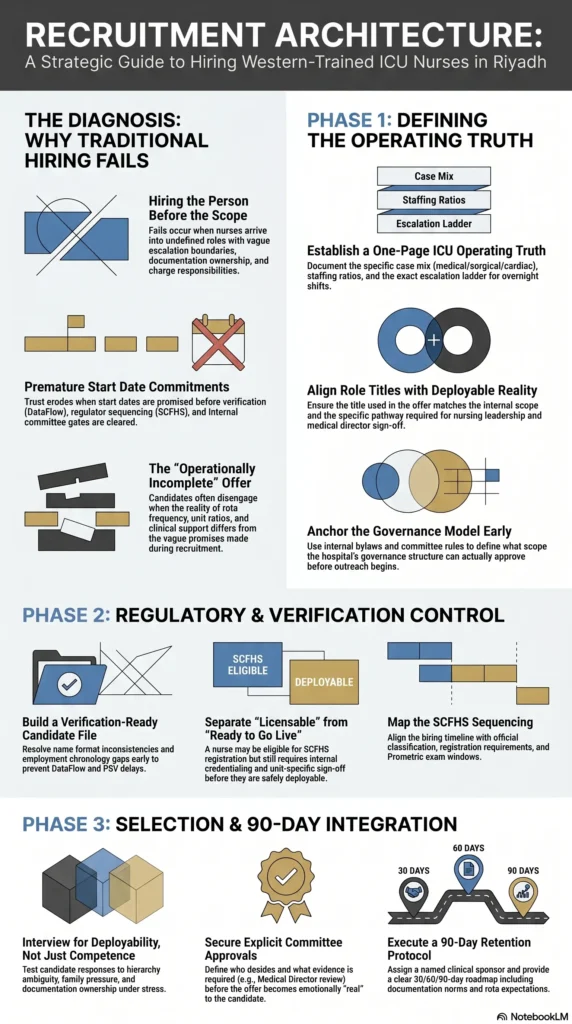
THE EXACT PROBLEM: WHY WESTERN-TRAINED ICU NURSE HIRES FAIL IN RIYADH
Most failures follow one of three patterns:
- The hospital hires the person before it hires the scope.
A “senior ICU nurse” arrives into an ICU model that was never defined: escalation ladder, autonomy boundaries, documentation ownership, charge responsibilities, and what “senior” means in your unit. - Start dates are promised before the file is predictable.
Verification, regulator sequencing, exam windows (where applicable), and internal committee gates are treated as separate workstreams—so timelines drift and trust erodes. - The offer is attractive, but operationally incomplete.
Rota reality, night frequency, unit ratios, case-mix truth, and clinical support are left vague. The nurse accepts the role on brand and salary, then disengages quietly once the operating reality appears.
In premium private healthcare, these are rarely candidate problems. They are hiring-structure problems.
WHY THIS MATTERS IN RIYADH PRIVATE HOSPITALS
ICU is not a background department in a serious Riyadh private hospital. It shapes:
- Patient safety and escalation discipline
- Consultant confidence and multidisciplinary performance
- High-sensitivity case management
- Service-line credibility with family offices and premium payors
- Retention across the nursing team (ICU instability spreads)
When you recruit Western-trained nurses, you are implicitly recruiting a standard of practice. If your environment cannot support that standard—or if your hiring structure sells a scope you cannot deliver—you create preventable churn.
WESTERN-TRAINED ICU NURSE RIYADH: WHAT STRONG EMPLOYERS GET RIGHT
- Define the ICU model before defining “seniority”
Before outreach, write a one-page ICU operating truth that answers:
- Case mix (medical/surgical/cardiac/neuro/mixed)
- Staffing ratios and how often they are stretched
- Escalation ladder (who is reachable, how fast, especially overnight)
- Clinical boundaries (ventilator management, sedation support, line handling policies, family communication expectations, documentation ownership)
- What “charge” or “senior” means in your unit—practically, not aspirationally
If you want a governance-safe lens on scope risk, align this to your internal rules and review the principles in:
https://medicalstafftalent.com/scope-of-practice-mismatch-in-gcc-hiring-7-quiet-risks-private-employers-must-control/
- Align role title language with deployable reality
Riyadh hiring often fails quietly when the title, the internal scope, and the committee approvals are not the same thing.
Decide early:
- The deployable title you will use consistently (offer, onboarding, internal approvals)
- The actual ICU scope you need
- The internal pathway that makes that scope real (nursing leadership sign-off, medical director approval, credentialing/privileging where relevant)
Where hospitals run into trouble is offering a scope that their own governance structure cannot yet approve. If committee gates are part of your model, anchor them early using:
https://medicalstafftalent.com/committee-approval-in-gulf-private-hospitals-7-quiet-rules-before-a-western-trained-hire-goes-live/
- Treat verification readiness as a start-date control tool
International ICU hires fail timing because “small” inconsistencies become “big” delays: name formats, employment chronology gaps, missing role descriptions, unclear seniority evidence, or references that don’t match documented dates.
Build a verification-ready candidate file early, not late. For employer teams who want to understand the PSV logic, use the regulator-aligned context from:
https://dataflowgroup.com/organization/saudi-commission-for-health-specialties/
- Interview for ICU deployability, not generic competence
Western-trained nurses usually interview well. That is not the point.
Interview for retention-critical realities:
- Escalation behaviour when hierarchy is ambiguous
- Decisions under stretched ratios and high family pressure
- Documentation ownership and handover discipline under stress
- Comfort operating inside committee-driven governance
- Acceptance of boundaries without resentment (scope discipline is a retention factor)
A structured framework for this is outlined in:
https://medicalstafftalent.com/interview-design-for-western-trained-hires-7-quiet-rules-for-gulf-private-hospitals/
- Separate “licensable” from “ready to go live”
A candidate can be eligible to progress in the regulator pathway and still not be ready to go live in your ICU on your intended date.
To keep governance clean, plan the sequence:
- Regulator classification/registration steps (as applicable to your hire)
- Verification milestones
- Internal credentialing/privileging gates (if used)
- Onboarding and unit sign-off that makes the nurse deployable safely
For official regulator references, use SCFHS pages directly when mapping your internal sequence:
https://scfhs.org.sa/en/professional-classification-requirements
https://scfhs.org.sa/en/professional-registration-requirements
If exams are relevant for your hiring scenario, use:
https://scfhs.org.sa/en/classification-exams
https://www.prometric.com/exams/schs
https://scfhs.org.sa/en/Mumares/SPLE/DATES
- Make internal committee gates explicit before issuing the offer
If your ICU hire requires approvals beyond HR—nursing leadership, medical director sign-off, committee review—define:
- What gets reviewed
- Who decides
- What evidence they require
- When it happens in the sequence
When this is unclear, the offer becomes emotionally “real” before it is operationally real. That is where candidate trust breaks.
A governance anchor many premium employers use is:
https://medicalstafftalent.com/medical-staff-bylaws-gcc/
- Design the first 90 days like a retention protocol
Western-trained ICU nurses leave early when the first month feels like surprise practice.
Before arrival, pre-commit to:
- A named clinical sponsor (not only HR)
- An ICU orientation pathway that reflects real nights/weekends
- Documentation norms and escalation rules in writing
- A credible rota plan (including night frequency)
- A clear “what good looks like” at 30/60/90 days
This is where private hospitals protect the hire—quietly, but decisively.
WHERE THE PROCESS BREAKS IN REAL RIYADH ICU HIRING
Common breakpoints we see in premium mandates:
- Offer issued before the file is verification-ready → start date becomes fictional
- “ICU” role is functionally step-down/HDU → scope disappointment and fast attrition
- Rota reality softened in interviews → trust breaks after arrival
- No clinical sponsor → the nurse becomes “owned by HR,” not by the unit
- Internal approvals treated as late paperwork → delayed live date, morale drop
- Housing/transport/family logistics left vague → relocation stress contaminates performance
None of these problems are solved by more CVs. They are solved by better recruitment architecture.
A CONCRETE RIYADH EXAMPLE: THE HIRE THAT NEARLY FAILED (AND WHAT FIXED IT)
A Riyadh private hospital sought a Western-trained ICU nurse for a high-sensitivity unit. The candidate was clinically strong and referenceable.
The risk appeared after offer momentum started:
- Title language in the offer didn’t match internal ICU scope expectations
- Chronology gaps in the candidate file predicted verification delay
- Rota reality was discussed verbally but never written down
The fix was structural, not cosmetic:
- The ICU scope was written in one page and signed off internally
- The candidate file was rebuilt into a verification-ready narrative
- Interview questions were re-run against real ICU operating truth (nights, escalation, documentation)
- The onboarding plan was issued with a clinical sponsor and a clear 30/60/90 pathway
The nurse arrived, went live cleanly, and stayed—because ambiguity was removed before it became emotional.
WHAT CHANGES WHEN IT’S HANDLED PROPERLY
When hiring is structured properly:
- Start dates become controllable because the pathway is planned, not hoped
- Scope becomes defensible because internal approvals match what was sold
- Retention rises because the first 90 days feel governed, not improvised
This is why specialist recruitment in the Gulf is rarely about “finding someone.” It is about designing a hire that can be verified, approved, deployed, and retained without silent friction.
WHERE MEDICAL STAFF TALENT TYPICALLY ADDS VALUE
Medical Staff Talent recruits Western-trained Doctors, Physiotherapists, and Nurses for Private Hospitals, Private Clinics, Royal Households, and UHNW Families across Dubai, Abu Dhabi, Riyadh, and Doha.
In ICU nursing mandates, the difference is rarely the CV alone—it’s the structure around it:
- Role design that matches real ICU operating truth
- Verification-ready shortlists (not just available candidates)
- Interviews that test deployability, not polish
- Sequencing that respects regulator reality and internal committee gates
- Onboarding architecture that protects the first 90 days
Employers that define this early usually protect the hire more effectively. This is often where specialist recruitment architecture matters.
If you want a discreet conversation about a Riyadh ICU nursing hire—scope-first, governance-safe, and retention-led—use:
https://medicalstafftalent.com/contact-us/
You can also view related governance and hiring frameworks in:
https://medicalstafftalent.com/blog/
And the employer service overview at:
https://medicalstafftalent.com/full-cycle-recruiting-service/