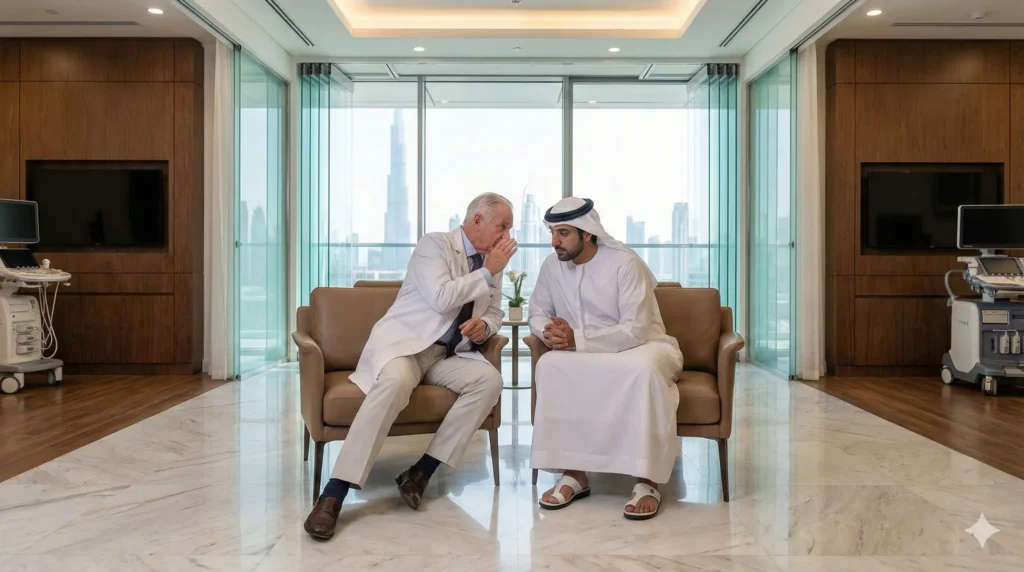

The first paediatric emergency call is never scheduled. It arrives after a long-haul flight, during a private event, or at 02:30 when the family’s tolerance for uncertainty is at zero. In elite Gulf settings, “someone on call” is not a plan. A plan is a named clinician with privileges, escalation authority, and a system that functions quietly under pressure.
Paediatric Emergency Medicine (PEM) is one of the fastest ways to raise the safety ceiling of VIP programmes—because it reduces panic-driven decisions, unnecessary transfers, and documentation gaps that become liabilities later.
Market / Problem (GCC reality: Dubai/Abu Dhabi/Riyadh/Doha)
Across Dubai, Abu Dhabi, Riyadh and Doha, premium providers and UHNW households are converging on the same operational problem: paediatric crises are infrequent but unforgiving. When the system is weak, the response becomes improvised, highly visible, and reputationally expensive.
Three Gulf-specific drivers make PEM hiring different from standard paediatrics recruitment:
-
The patient pathway is fragmented by design. Villa → ambulance → private ED → ICU → back to home care. If escalation rules are not explicit, responsibility diffuses and error probability rises.
-
Families demand senior decisions early. They are not paying for a junior triage loop. They want a consultant-level clinician who can decide what matters, what doesn’t, and what must happen now.
-
The biggest risk is “soft failure.” Delayed antibiotics, missed sepsis physiology, premature discharge, uncontrolled asthma escalation, unsafe sedation decisions—these do not look dramatic in the moment, but they compound quickly.
If you are building a credible premium service line (hospital-based or family-office-linked), PEM is a governance hire, not a rota hire. This is the same leadership logic described in The COE Blueprint: Western-trained Leadership for Gulf Centres of Excellence.
Qualifications (Tier-1 vs Tier-2 standards; what “good” looks like)
This post is Tier-1 / Tier-2 Western-trained standards only (training and credentialing standards, not nationality).
Tier-1 (preferred)
Consultant-level PEM training in systems with mature emergency governance and audited outcomes (e.g., UK CCT/CCST-equivalent pathways, ABMS/ACGME routes, and comparable high-governance jurisdictions). The premium you are buying is not a CV line—it is embedded discipline: escalation thresholds, documentation consistency, and safe boundary-setting.
Tier-2 (viable, but must be stress-tested)
Tier-2 can work when the clinician can evidence Western-equivalent governance exposure, independent consultant practice, and a documentation pack that survives PSV and licensing without ambiguity.
What “good” looks like in elite Gulf PEM:
-
Triage authority: can stratify risk in minutes and justify decisions clearly (admit vs observe vs discharge).
-
Sepsis and respiratory reflexes: early recognition and action pathways that do not depend on “watching and waiting.”
-
Safe procedural scope: clear competence boundaries for sedation, airway support, and high-risk procedures—matched to privileges.
-
Family communication control: calm, precise explanations without overpromising; clear consent discipline for interventions.
-
Interface governance: can align ED–PICU–specialty teams with explicit handover rules and escalation triggers.
Failure modes to exclude:
-
Overconfidence without boundaries (“I handle everything”).
-
“VIP experience” language without evidence of governance and escalation ownership.
-
Reliance on informal workarounds instead of defensible protocols.
To hire correctly, you need an end-to-end process that designs scope first, then recruits into it—rather than hiring first and discovering constraints later. That is exactly what Full Cycle Recruiting Service is built to do.
Discretion / Value (confidentiality, risk, continuity, governance)
Paediatric VIP care is uniquely sensitive: the patient is a child, the stakeholders are multiple, and emotion drives decision-making. A strong Western-trained PEM consultant protects four assets simultaneously:
-
Confidentiality hygiene: controlled information flow, disciplined documentation, no casual sharing, and clean handoffs.
-
Continuity under stress: the same escalation logic applies at 14:00 and 03:00; care does not change with whoever is on shift.
-
Risk containment: fewer unnecessary admissions, fewer missed early deteriorations, and fewer “panic transfers” abroad.
-
Governance credibility: defensible clinical notes, clear consent, and a visible safety posture that reassures families and boards.
In elite settings, discretion is not silence—it is structured, controlled communication with decisions that can withstand scrutiny.
Regulatory Context (licensing + PSV/DataFlow + privileging + onboarding risk points)
PEM hires fail when employers treat licensing and privileging as a late-stage admin task. In reality, they are the gating mechanisms that determine whether your “24/7 cover” is real or imaginary.
UAE: align title and scope to PQR expectations before you promise coverage
The UAE’s unified framework is the baseline reference for how authorities assess qualification and scope. If your role title and evidence pack don’t align, timelines slip and services become unsafe to advertise. Use: DoH Abu Dhabi – Professional Qualification Requirement (PQR).
Saudi Arabia: registration requirements must be designed into the onboarding timeline
KSA processes are intolerant of ambiguity in evidence and current practice documentation. Build your plan around SCFHS requirements from day one: SCFHS – Professional Registration Requirements.
Qatar: PSV is a gate, not a formality
If PSV is messy—mismatched dates, unclear titles, missing good standing—everything downstream slows and credibility erodes. Use: Qatar DHP – Primary Source Verification.
PEM-specific risk points to control:
-
Privilege mismatch: marketing implies consultant-led sedation or high-risk stabilisation, but privileges don’t support it.
-
No PICU interface contract: unclear responsibility handoffs to intensivists, creating dangerous limbo at deterioration points.
-
Documentation drift: “VIP shortcuts” that later become indefensible.
-
Cover model fragility: one clinician carrying the service at night without a second-on-call design.
The safe sequence is simple: define scope → map privileges → verify evidence (PSV) → license → privilege formally → onboard into protocols, escalation, and documentation standards on day one.
Close
A Western-trained PEM consultant is an insurance policy that operates in real time: faster correct decisions, fewer avoidable deteriorations, and calmer stakeholder management when emotion is highest.
If you want VIP paediatric care that holds under stress, hire for escalation governance and boundary discipline—not for brand names on a CV.
Contact David for a confidential discussion on securing your next elite hire or role.