

The Exact Problem: Volume Recruitment vs. Clinical Reality
Securing elite clinical talent in the Gulf requires more than an attractive financial package. Medical Staff Talent recruits Western-trained Doctors, Physiotherapists, and Nurses for Private Hospitals, Private Clinics, Royal Households, and UHNW Families across Dubai, Abu Dhabi, Riyadh, and Doha. Yet, a recurring problem persists across the sector: premium private clinics in Dubai frequently lose exceptional candidates between the offer stage and their first day on the clinic floor.
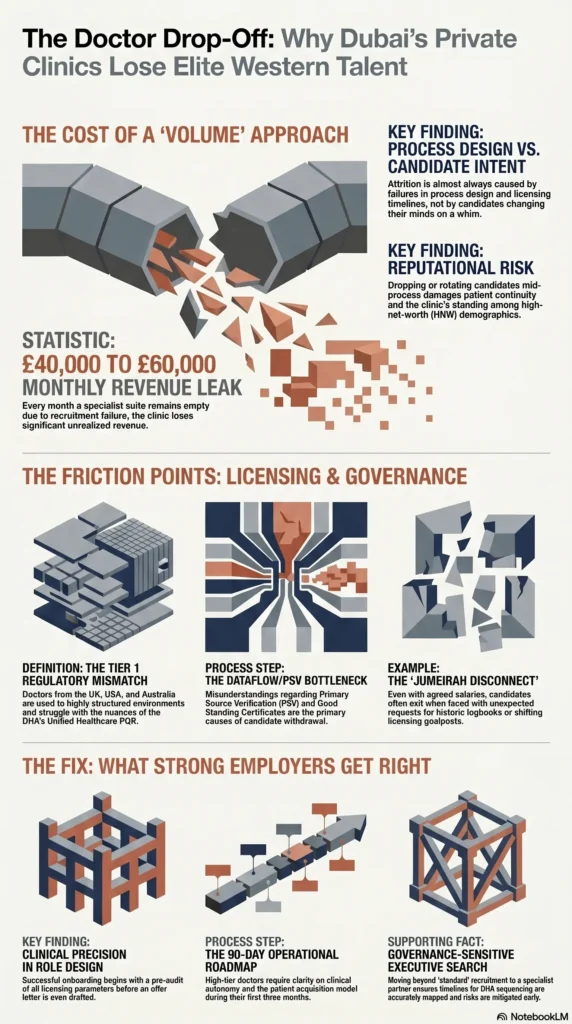
This attrition is rarely about the candidate changing their mind on a whim. It is almost always a failure in process design. Standard recruitment models treat the acquisition of Western-trained Doctors in Dubai as a volume exercise, focusing heavily on CV distribution rather than governance, licensing timelines, and strategic relocation alignment.
Why It Matters in Gulf Private Healthcare
In the competitive landscape of Dubai’s private healthcare sector, a vacant clinical room represents a severe commercial leak. An empty high-end specialist suite can easily cost a clinic upwards of £40,000 to £60,000 per month in unrealized revenue. Beyond the financial impact, rotating or dropping candidates damages patient continuity and compromises the clinic’s reputational standing among high-net-worth patient demographics.
Medical Staff Talent is not a volume recruiter. It is a specialist partner focused on governance-sensitive, discreet, premium healthcare hiring in the Gulf. Understanding the nuance between a candidate who is simply interested in Dubai and one who is structurally prepared to relocate is what separates successful hiring from costly delays.
Where the Process Breaks: DHA Licensing and Credentialing
The majority of drop-offs occur during the licensing phase. Candidates from Tier 1 jurisdictions—such as the UK, Ireland, USA, Canada, Australia, New Zealand, and South Africa —are accustomed to highly structured domestic regulatory environments. When they interface with Gulf regulatory frameworks without an expert guide, confusion sets in.
Clinics often assume the candidate will independently navigate the Dubai Health Authority (DHA) requirements. However, translating Western qualifications into the DHA’s Unified Healthcare Professional Qualification Requirements (PQR) is a nuanced process. Misunderstandings regarding Primary Source Verification (PSV) through the DataFlow Group, or delays in securing Good Standing Certificates, cause prolonged friction. Without precise communication regarding eligibility, candidates lose confidence in the hiring institution and withdraw their applications.
A Concrete Gulf Example: The DataFlow Disconnect
Consider a prestigious private clinic in Jumeirah extending an offer to a highly sought-after UK-trained Consultant Dermatologist. The base salary and revenue-share model are agreed upon. However, the standard recruitment agency fails to pre-audit the candidate’s documentation for licensing readiness.
Weeks later, the candidate is unexpectedly asked to provide historic logbooks and additional university transcripts for DataFlow verification. Frustrated by what feels like shifting goalposts and lacking a clear timeline for license activation, the Consultant accepts a competing offer in London. The Dubai clinic loses three months of processing time and must restart the search from zero. In cases where assessments are required, poor preparation for examinations via Prometric further exacerbates the risk of losing the candidate entirely.
What Strong Employers Get Right
Premium healthcare employers recognize that successful onboarding begins before market outreach. They design roles with clinical precision and conduct rigorous pre-screening of all licensing parameters before an offer is drafted. Strong employers ensure that the candidate’s expectations regarding medical staff bylaws and committee approval processes are fully aligned with the clinical setting.
They also provide clarity on the operational realities of the first 90 days. A Western-trained Doctor needs to know how their clinical autonomy will be supported, how the patient acquisition model works, and the exact timeline from offer acceptance to seeing their first patient.
What Changes When Handled Properly
When executive search methodologies replace standard recruitment, the outcome fundamentally shifts. The process becomes predictable. Timelines for DHA sequencing are accurately mapped, relocation risks are mitigated early, and the candidate feels guided by a medically and commercially aware partner throughout the transition.
Strong hiring outcomes depend on structure, governance, and specialist recruitment design. Partnering with Medical Staff Talent ensures that your clinic attracts elite professionals and successfully navigates the complex credentialing landscape, resulting in stable, long-term clinical teams.