
How serious private hospitals in Dubai, Abu Dhabi, Riyadh, and Doha should interview Western-trained Doctors, Nurses, and Physiotherapists before the shortlist becomes expensive
In elite Gulf healthcare, weak hiring rarely begins with a bad CV. It usually begins with a badly designed interview.
A private hospital may meet an impressive Western-trained Doctor, Nurse, or Physiotherapist, feel immediate confidence, and then discover later that the file is harder to license, the scope is harder to defend, or the setting fit is weaker than the interview suggested. By that stage, the role is already expensive.
That is why interview design for Western-trained hires should never be treated as a soft HR exercise. In Dubai, Abu Dhabi, Riyadh, and Doha, the interview must test whether the clinician can be licensed cleanly, trusted internally, and retained without friction.
For senior or commercially sensitive mandates, this sits close to Executive Search in the Gulf: When Private Hospitals Need More Than Standard Recruitment. The strongest employers do not interview for charisma alone. They interview for deployable value.
Interview design for Western-trained hires should test operational truth
A premium interview process should answer one practical question:
Can this clinician go live safely, credibly, and profitably in this exact organisation?
That is a different standard from “Would this person look strong on a brochure?” It is also a different standard from “Did the panel like them?”
For private hospitals, private clinics, royal households, and UHNW-linked medical settings, that distinction matters. The Gulf market rewards precision, not theatre.
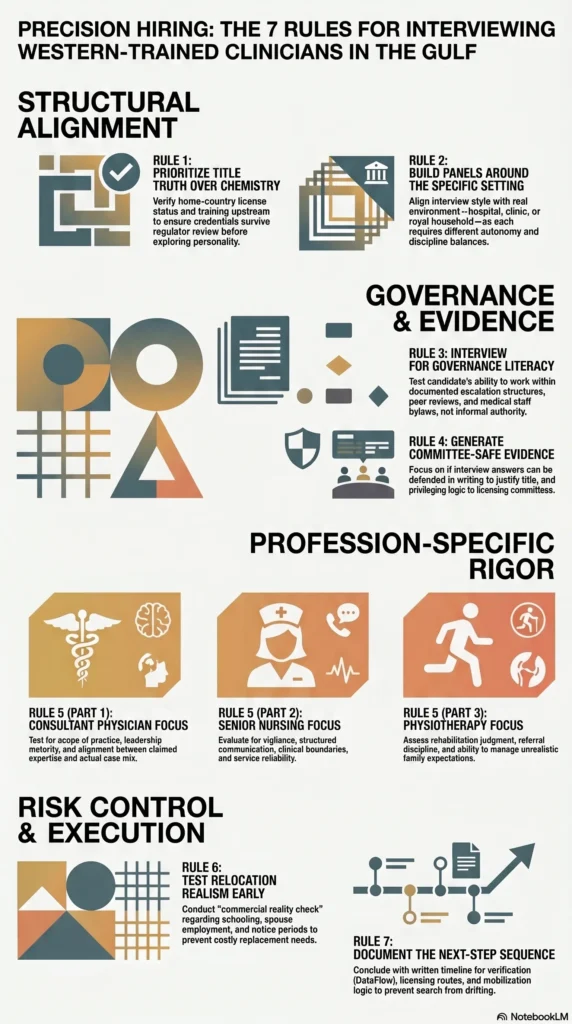
1. Start with title truth before chemistry
The first rule is simple: do not let personal chemistry outrun title reality.
Before the panel explores leadership style, patient communication, or relocation motivation, the employer should already understand whether the clinician’s home-country training, registration history, and recent practice will support the title being discussed. That is why home-country licence status in GCC hiring belongs upstream of the interview, not after it.
If a hospital is interviewing a UK consultant, an Irish physiotherapist, or a Western-trained nurse for a premium post, the question is not only whether they are excellent. The question is whether the same excellence will survive regulator review, committee scrutiny, and scope approval.
2. Build the panel around the setting, not generic excellence
A clinician can be outstanding and still be wrong for the environment.
This is where many Gulf employers lose clarity. They run the same interview style for a private hospital, a private clinic, and a discreet UHNW or royal setting, then act surprised when the hire feels unstable after arrival. In reality, those environments require different balances of autonomy, escalation discipline, documentation style, and cultural boundaries.
That is exactly why Credentialing Differences in the Gulf: 7 Costly Mistakes to Avoid matters. The interview should reflect the real operating environment, not a generic version of “clinical excellence.”
3. Interview for governance literacy, not only clinical reputation
Western-trained clinicians are often hired because their credentials are strong. That part is visible.
The quieter question is whether they can work inside the governance reality of the employer. Can they operate calmly under committee oversight? Do they respect written scope? Can they work within a documented escalation structure rather than relying on informal authority?
A well-designed panel will test how the clinician thinks about privilege boundaries, peer review, documentation, multidisciplinary communication, and accountability. In serious organisations, those are not secondary details. They are the operating system.
For that reason, employers should align their interview questions with the internal authority structure described in Medical Staff Bylaws GCC: Elite Governance Guide. A premium hire should fit the governance model, not merely impress the room.
4. Separate presentation skill from committee-safe evidence
Some candidates interview beautifully. Some do not.
That alone should not decide a Gulf hiring outcome. In premium private healthcare, the real question is whether the story told in the interview can later be defended in writing. Can the hospital show why this title was offered, why this scope was granted, and why this clinician was considered suitable for this exact service line?
That is where many employers benefit from a tighter link between interview design and GCC Consultant Licensing: 7 Critical Rules to Avoid a Costly Specialist Downgrade. The interview should generate evidence that supports the eventual licensing and privileging logic.
A polished answer in the room is helpful. A committee-safe file is more important.
5. Use profession-specific questions, not one shared script
Doctors, Nurses, and Physiotherapists should not be interviewed as though they carry identical operational risk.
A Western-trained consultant should be tested on scope, leadership maturity, escalation judgement, and alignment between claimed expertise and actual case mix. A senior nurse should be tested on vigilance, structured communication, clinical boundaries, and service reliability. A physiotherapist should be tested on rehabilitation judgement, setting suitability, referral discipline, and how they manage progress when family or employer expectations become unrealistic.
This is also where a disciplined interview pack should connect back to official registration logic. A serious employer may cross-check standing with the General Medical Council, the Nursing and Midwifery Council, or the Health and Care Professions Council as relevant, then prepare for verification through DataFlow Group.
The objective is not bureaucracy. It is cleaner decision-making.
6. Test relocation realism before the offer becomes emotional
A strong Gulf interview should include one calm commercial conversation.
Not a hard sell. Not a tax-free fantasy. A serious reality check.
The panel should understand whether the clinician’s spouse, children, schooling priorities, notice period, documentation readiness, and package expectations fit the likely timeline and setting. Many replacement costs begin here. The clinician says yes to the headline, then slows down when the full move becomes real.
The most commercially intelligent employers treat that discussion as part of risk control. They understand that retention begins before signature, not after relocation.
7. Close the interview with a documented next-step sequence
The final rule is the quietest and often the most important.
A good interview process should end with written next steps covering evidence, references, verification, likely licensing sequence, expected committee route, and target mobilisation logic. When this is vague, even excellent searches begin to drift.
At Medical Staff Talent, this is exactly why we favour a more integrated model. We recruit Western-trained Doctors, Physiotherapists, and Nurses for Private Hospitals, Private Clinics, Royal Households, and UHNW/UHNWI Families across Dubai, Abu Dhabi, Riyadh, and Doha with the interview, licensing, and onboarding sequence connected from the beginning. That is also why our Full-Cycle Recruiting Service is built around permanent team stability rather than simple candidate flow.
Conclusion
Interview design for Western-trained hires is not a cosmetic part of Gulf recruitment. It is where private hospitals decide whether a search will become a clean appointment or a delayed correction.
The strongest employers do not interview to be impressed. They interview to reduce ambiguity.
In Dubai, Abu Dhabi, Riyadh, and Doha, that means testing title truth, governance fit, setting alignment, verification readiness, and relocation realism before the shortlist becomes emotional. That is how premium organisations protect patient trust, service-line stability, and long-term retention.
Incoming links
- Executive Search vs Recruitment Agency in GCC Healthcare: 5 Critical Risks
URL: https://medicalstafftalent.com/executive-search-vs-recruitment-agency-in-gcc-healthcare/ - Executive Search in the Gulf: When Private Hospitals Need More Than Standard Recruitment
URL: https://medicalstafftalent.com/executive-search-in-the-gulf-when-private-hospitals-need-more-than-standard-recruitment/ - Home-Country Licence Status in GCC Hiring: 5 Filters Elite Employers Use Before They Promise a Start Date
URL: https://medicalstafftalent.com/home-country-licence-status-in-gcc-hiring/ - Credentialing Differences in the Gulf: 7 Costly Mistakes to Avoid
URL: https://medicalstafftalent.com/credentialing-differences-in-the-gulf/ - GCC Consultant Licensing: 7 Critical Rules to Avoid a Costly Specialist Downgrade
URL: https://medicalstafftalent.com/gcc-consultant-licensing-7-critical-rules/ - Medical Staff Bylaws GCC: Elite Governance Guide
URL: https://medicalstafftalent.com/medical-staff-bylaws-gcc/ - Full-Cycle Recruiting Service
URL: https://medicalstafftalent.com/full-cycle-recruiting-service/
Final CTA
For a discreet discussion about designing calmer, safer interviews for permanent Western-trained medical hires across Dubai, Abu Dhabi, Riyadh, and Doha, Contact Us.