
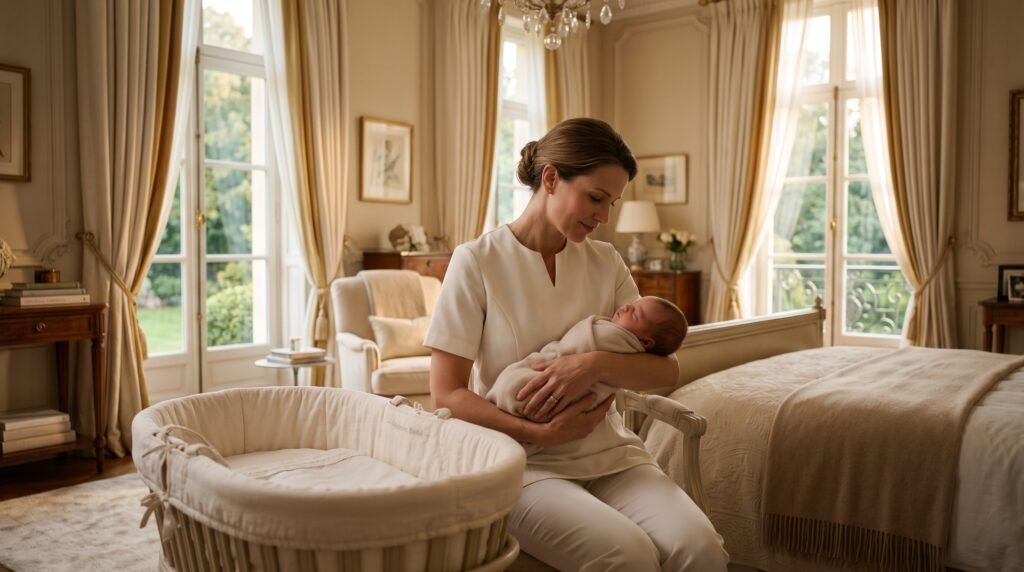
Private & Maternity Nurses
Newborn Care Specialists, Maternity Nurses, and Critical Care & Rotational Nurses — exclusively for Royal Households and UHNW Families across Saudi Arabia, the UAE and Qatar.
Medical Staff Talent places UK and European-trained nurses in Private Duty Nursing of the highest standing. Every nurse we introduce is matched for clinical skill, household etiquette and absolute discretion — placed under strict confidential routing, never through a hospital ward roster.
The Mandate
- Newborn Care Specialists & Maternity Nurses — expert neonatal care, infant sleep routines, and dedicated postpartum recovery support for the mother and household.
- Critical Care & Rotational Nurses — 24/7 palace rota shifts, advanced ICU/PICU management, complex geriatric care, and worldwide travel on private jets and superyachts.
Private duty placements are rarely solo appointments: our most senior mandates deploy in coordinated teams — typically two or more nurses working rotation alongside physiotherapy and physician staff — to give a principal continuous, undisrupted cover. Every appointment is scoped against one of the seven deployment models Royal Households use for their clinicians — from a live-in residential post to a rota, a travelling appointment alongside the family or a fixed-term maternity engagement — before a search opens.
Who We Serve
Royal Households and UHNW Families in Saudi Arabia, the United Arab Emirates and Qatar, including residential appointments and travelling cover for principals moving between the Gulf, the Mediterranean and further afield. Family offices can review how a private duty nurse mandate is structured and how the confidential hiring process runs.
Standards We Require
- UK or European nurse training with an active, verified registration in the country of qualification.
- Eligibility for Gulf licensing (SCFHS, DHA, DoH, MOH) and successful DataFlow primary source verification.
- Demonstrated neonatal, critical care, or private duty experience matched to the specific mandate — household etiquette and single-patient case management, not ward-based nursing.
- Fluent English; Arabic is an advantage but not a requirement.
- Willingness to sign a non-disclosure agreement and operate under strict confidential routing — standard on every household mandate.
Compensation and Package Structure
Private duty nursing for a Royal Household or UHNW family is paid well above institutional bands because the nurse is retained for one principal, or one child, rather than a ward. Across our current mandates, packages typically run from £55,000 to £100,000 tax-free, paid net, with senior private duty, aeromedical flight-nursing and Royal Household paediatric appointments at the top of the band. Furnished accommodation, medical cover and annual flights are normally provided in addition to salary, and the rota, travel expectations and on-call structure are agreed in writing before an offer is made.
Our 2026 nursing salary benchmarks set out the bands by market, and the UK vs GCC Net Position Calculator shows what a tax-free package actually leaves you with once housing and schooling are accounted for.
Representative Mandates
- Private Duty Nurse — Royal Household, Riyadh
- Neonatal Nurse — Royal Household, Riyadh
- Private Duty Nurse, Neonatal & Paediatric — Royal Household, Doha
- Senior ICU & Critical Care Nurse — Royal Household, Doha
- Private Duty Nurse — UHNW Family Residence, Dubai
- Senior VIP Flight Nurse — Private Aviation, Dubai
See all live mandates by specialty, or the nursing registers for Dubai, Abu Dhabi, Riyadh, Jeddah, the Eastern Province and Doha.
If no current mandate matches your profile, our standing registers keep a confidential file open for the next nursing appointment in each city: Riyadh · Jeddah · Eastern Province · Dubai · Abu Dhabi · Doha · Private yacht, Mediterranean summer and Gulf winter.
Licensing by Jurisdiction
A nurse practising inside a private residence still requires a professional licence in the market concerned, and the scope that licence permits at home matters as much as the registration itself. We sequence licensing in parallel with the search so that the appointment and the licence land together.
- Saudi Arabia — classification and registration through the Saudi Commission for Health Specialties (SCFHS) via Mumaris+, after DataFlow primary source verification.
- United Arab Emirates — the Dubai Health Authority (DHA) for Dubai and the Department of Health (DoH) for Abu Dhabi; the two licences do not transfer between emirates.
- Qatar — the Department of Healthcare Professions (DHP) under the Ministry of Public Health.
Read our guides to who may lawfully treat inside a private residence in the Gulf, what a private maternity nurse licence actually permits and keeping your NMC or NMBI registration alive while you nurse in the Gulf. The full pathway is on our Gulf licensing support page.
Coverage
Saudi Arabia | United Arab Emirates | Qatar
How the Process Works
- Confidential brief taken directly with the principal, family office, or household representative — under NDA before any candidate detail is shared.
- Individual, targeted approach to vetted nurses already known to the practice; mandates are never advertised publicly.
- Verification of registration, DataFlow and reference history before any introduction is made.
- Gulf licensing and relocation support through to onboarding.
For Households Commissioning a Nurse
- Private Nurse for Your Family in Dubai: 24/7 Care, Vetting and Cost — coverage models, the vetting standard and indicative tax-free bands.
- Maternity Nurse and Newborn Care Specialist for a Royal Household — which classification to specify, and what each may lawfully do in a residence.
- Post-Operative and Cosmetic Surgery Recovery Nursing at Home in Dubai — fixed-term cover from discharge to discharge from care.
- Vetting a Private Medical Team: The Family Office Checklist — DataFlow, references and NDAs, in sequence.
Frequently Asked Questions
What does private duty nursing for a Royal Household involve?
Single-patient care inside a private residence rather than a ward: continuity for one principal, one newborn or one elderly family member, coordinated with the household’s physician and physiotherapy staff. The clinical standard is that of an ICU or neonatal unit; the setting and etiquette are those of a private home, and everything is covered by a non-disclosure agreement.
Do private duty nurses work alone?
Rarely. Senior household mandates deploy two or more nurses in rotation, working alongside physiotherapy and physician staff, so that a principal has continuous cover without a single nurse carrying a 24-hour burden.
How much do private duty nurses earn in Saudi Arabia, the UAE and Qatar?
Across our current mandates, private duty nursing packages typically run from £55,000 to £100,000 tax-free, paid net, with accommodation, medical cover and flights on top. Senior private duty, flight-nursing and Royal Household paediatric appointments sit at the upper end of that band.
Will my NMC, NMBI or European registration be recognised?
Your registration is verified through DataFlow primary source verification and then licensed by the regulator of the market you are moving to: SCFHS, DHA, DoH or DHP. A UK or European registration is the entry requirement; the local licence is what permits you to practise, and we run that file alongside the search.
Is travel part of the role?
On many rotational mandates, yes: principals move between the Gulf, the Mediterranean and further afield by private jet and superyacht, and the nursing team travels with them. Travel expectations are agreed in writing before an offer is made.
Further Reading
- Neonatal and paediatric private duty nursing for Royal Households
- The invisible safety net: nursing in Gulf Royal Households
- The senior private duty nurse: case management and international coordination
- Private duty nursing vs hospital nursing: which suits you
- Evaluating a nursing job offer in the Gulf
- Nursing salary benchmarks in the Gulf 2026
Hiring a private duty or maternity nurse? Review the Private Duty Nurse mandate structure or start a confidential conversation. Introducing a principal on their behalf? See our Referral & Introduction Partners page.
A UK or European-trained nurse exploring the Gulf? See licensing and DataFlow support, model your net position with the UK versus GCC calculator, or submit your CV.