

A Spanish nurse can look fully appointable on paper and still lose a Doha opportunity for reasons that have nothing to do with bedside quality.
In Qatar’s private sector, the real filter is not enthusiasm. It is deployability. A private hospital in Doha wants a nurse who can move from interview to licence to safe ward-level practice without confusion, silence, or timeline drift.
That is why a serious Spanish nurse should not ask only, “Can I get a job in Doha?” The better question is: Is this specific private hospital role clean enough to justify the move?
Spain sits comfortably inside our approved Tier-2 universe, so this is not a fringe route. But it is also not a path that should be approached casually. The opportunity becomes attractive only when the role title, regulator pathway, verification file, and employer quality all align perfectly.
Why the Spanish Nurse to Doha Private Hospital Route Works
The appeal is easy to understand. Doha offers premium private-sector environments, internationally mixed teams, modern infrastructure, and packages that look significantly stronger once tax-free income is converted into retained value.
But the private-hospital market in Doha does not reward generic mobility. It rewards nurses who can present a clean professional story: readable experience, coherent documents, strong English communication, calm patient handling, and an employer that thoroughly understands the regulator sequence.
For a deeper look into the regional landscape, it helps to read this route alongside Qatar Licensing 2026: The Western-Trained Advantage and the wider Doha market context outlined in Elite Medical Recruitment Doha: 7 Critical Shifts Driving Quiet-Luxury Hiring in 2026.
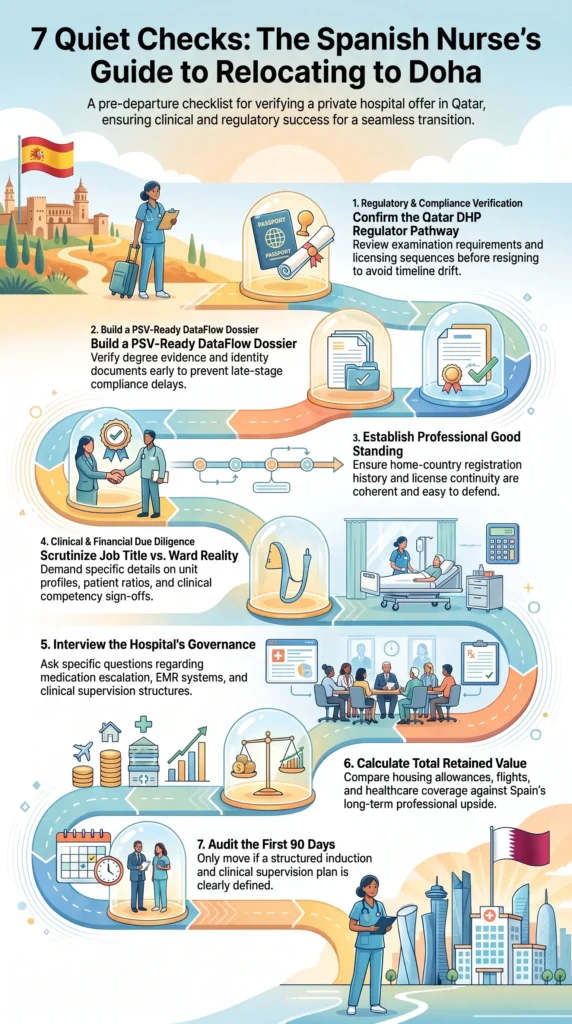
1. Read the Job Title Before You Read the Package
A polished offer letter can still hide a weak role.
Before you get emotionally attached to Doha, check whether the hospital is hiring for a true private-hospital nursing position with defined specialty exposure, clear reporting lines, and ward reality. A serious employer should be able to explain:
-
The specific unit and patient profile
-
Shift patterns and nurse-to-patient ratios
-
Orientation structure and clinical competency sign-offs
If that detail is vague, the problem is not only operational—it is regulatory. A weakly defined job often produces a weakly defined licence journey.
For a Spanish nurse moving to Qatar, clarity matters more than marketing language. “Premium hospital” is not a nursing brief. ICU, theatre, paediatrics, outpatient infusion, executive health, women’s health, or general medical-surgical practice are entirely different propositions.
2. Check the Qatar Regulator Pathway Before You Resign
This is where many otherwise intelligent candidates become too trusting.
Qatar’s regulator structure is highly specific. You must review the requirements before you spend money, resign, or narrow your options. (Note: You can check the official DHP Registration & Licensing, DHP Primary Source Verification, and DHP Qualifying Examination pages for the latest criteria).
Most importantly, do not assume the exam question has disappeared. The current guidelines still list the examination requirements for a Registered General Nurse. That does not mean every case feels identical in practice, but it does mean you should never let a recruiter dismiss the issue with a casual “it’s fine.”
A credible employer will tell you exactly what they believe applies in your case, why they believe it, and how they will sequence your file. A weak employer will simply ask you to “trust the process.” In premium Gulf hiring, those two cultures produce completely different outcomes.
3. Build a PSV-Ready Dossier Before the Emotional Commitment
The Doha move becomes dramatically safer when your compliance file is built early.
That means degree evidence, passport details, licence history, employment certificates, and identity consistency should all be verified before the transition becomes psychologically expensive. The DataFlow verification logic is straightforward: the process is regulator-linked, document-sensitive, and built around readable source evidence rather than institutional prestige.
This is where many Spanish nurses lose time. Not because their background is weak, but because the documentation pack was assembled too late, translated inconsistently, or left with small contradictions that become large delays under scrutiny.
The calm model is simple: treat your dossier like an active part of your job search, not admin paperwork to handle after the offer.
4. Treat Good Standing as a Live Risk Control
The strongest Doha transitions are quiet because the nurse’s professional standing is already coherent before the employer starts promising start dates.
Your good-standing story is not a mere formality; it is a core element of how regulators and employers judge whether your file can move cleanly. For a closer look at this process, read Good Standing Certificates GCC: Quiet Licensing Edge.
For a Spanish nurse, this means your home-country registration history, licence continuity, and disciplinary cleanliness should feel easy to defend. If any part of that story needs explanation, build that narrative early and calmly. A premium offer can tolerate complexity, but it does not tolerate confusion.
5. Interview the Hospital as Hard as They Interview You
Do not let a Doha hospital interview you on charisma alone. A serious Spanish nurse should test the employer on four critical pillars: governance, ward reality, orientation, and manager quality.
Make sure to ask:
-
How does medication escalation work?
-
Who supervises new international arrivals?
-
How are handovers structured and what EMR system is used?
-
How are incidents documented, and what support exists in the first 30 days?
The strongest hospitals answer without defensiveness. They sound organised, specific, and realistic about relocation.
This is where a niche, specialized approach changes the paradigm. Candidates evaluating serious private-sector options should benchmark opportunities against the standards set out on our page: Send Your CV | Western-Trained Doctors, Nurses & Physiotherapists for GCC and review the employer-side sequence via Full-Cycle Medical Recruitment GCC | Permanent Teams, Licensing & Onboarding.
6. Separate the Tax-Free Promise from the Real Package
A monthly number can look impressive on paper and still be commercially thin.
For a Spanish nurse assessing a Doha private hospital offer, the package should be read as one interconnected operating system:
-
Base pay
-
Housing or comprehensive housing allowance
-
Transport provisions
-
Annual return flights
-
Premium health cover
-
Overtime logic, shift burdens, and probation conditions
In other words, do not compare Doha with Spain using salary alone. Compare retained value, workload quality, and long-term professional upside. A refined move should improve at least three things at once: earnings retention, institutional quality, and career positioning. If it only improves one, the move may not be worth the transition.
7. Move Only When the First 90 Days Look Structured
The safest Doha transitions are not won at the contract stage. They are won in the first three months on the ground.
A private hospital that is truly ready for an international nurse should already have a clear view on induction, initial supervision, competency sign-off, unit integration, and the practical support that reduces early attrition. If the answer to every onboarding question is “HR will explain when you arrive,” you are not looking at a premium move. You are looking at operational optimism.
This matters because the first 90 days shape everything that follows: your confidence, manager trust, scope stability, and whether you feel respected or merely processed. Accept a Doha offer only when the role feels clinically real, regulator-aware, and manager-led.
Final Thought
The Spanish nurse to Doha private hospital route is highly viable—but viability is not the same as readiness.
The right move is not the first offer that flatters you. It is the offer that seamlessly survives regulator logic, document scrutiny, interview pressure, and the lived reality of a private ward after arrival. That is the true difference between a glamorous idea and a durable Gulf career.
Contact Us for a Discreet Placement
For a confidential conversation about permanent private-hospital opportunities, executive health roles, or specialized nursing positions in Doha, Contact Us.