

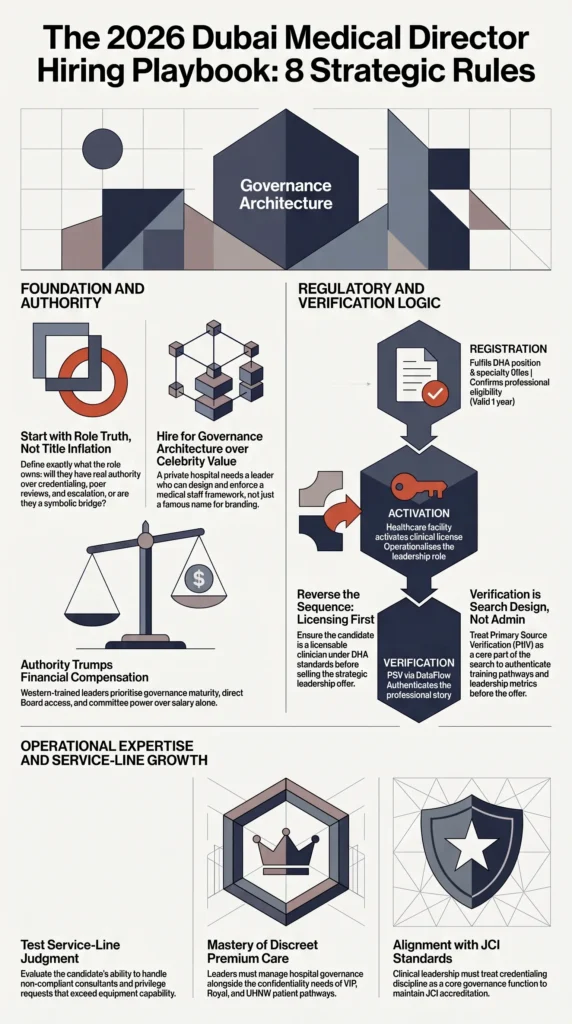
How to hire a medical director for a private hospital in Dubai is not the same question as how to appoint a respected senior doctor.
That distinction matters.
A private hospital can recruit an impressive name, announce the hire with confidence, and still create deep operational instability if that individual cannot convert clinical authority into cleaner privileging, stronger physician discipline, safer escalation, and calmer service-line growth.
In Dubai’s premium private healthcare sector, the Medical Director role now sits firmly at the intersection of clinical governance, talent acquisition, regulator-readiness, and institutional trust. That is why the strongest employers do not treat this as a prestige appointment. They treat it as a structural one.
For wider leadership and strategic depth, this resource is designed to be evaluated alongside Executive Search in the Gulf: When Private Hospitals Need More Than Standard Recruitment and The Strategic Value of Western-Trained Medical Directors in Dubai.
1. Start with Role Truth, Not Title Inflation
The first rule in how to hire a medical director for a private hospital in Dubai is to define what the role actually owns.
-
Is this a genuine clinical governance mandate?
-
Will the Medical Director hold real authority over credentialing decisions, medical staff behaviour, service-line standards, peer review, and escalation pathways?
-
Or is the hospital trying to use a senior hire as a symbolic bridge between ownership, operations, and doctors without giving the role operational force?
Elite candidates see through ambiguity very quickly. If reporting lines are vague, committee structures unclear, or the scope mixes high-level strategy with daily administrative firefighting, the role becomes incredibly difficult to fill—and even harder to keep filled.
Governance Note: Strong Western-trained leaders rarely relocate for ambiguity. They move for authority that is clearly defined, legally defensible, and fully aligned with the organisation’s real stage of growth.
2. Build the Licensing Logic Before the Offer Is Sold
A common mistake in Dubai is to position the Medical Director as a strategic leadership hire first and a licensable clinician second. The sequence should always be reversed.
The Dubai Health Authority (DHA) registration pathway makes a practical distinction between registration and license activation. Registration confirms that the professional fulfils the requirements for the applied position, title, and specialty, and it is valid for one year until a healthcare facility activates it into a clinical license.
A leadership appointment is not operationally real until the regulator pathway and facility activation sequence are completely clean. For an absolute deep dive into these regulatory dynamics, employers must align their search early with the DHA Registration vs License: Dubai Hiring Guide.
For UK-trained candidates, home-market seniority must be thoroughly verified. The General Medical Council (GMC) states that the Specialist Register lists doctors eligible for consultant appointments in the NHS. In premium Dubai hiring, checking records against benchmarks like the GMC Specialist Register GCC: Hiring Guide helps employers test whether the title being discussed will survive rigorous internal and regulatory scrutiny without friction.
3. Treat Verification as Part of Executive Search, Not Admin
Serious Medical Director recruitment fails quietly when credential verification begins too late in the process.
At this executive level, the issue is not only whether the doctor is qualified. It is whether every important part of the professional story can be verified cleanly and in a format that supports the specific leadership role being offered. This includes:
-
Training pathways and specialist standing.
-
Recent clinical seniority and licence history.
-
Leadership continuity and proven metrics around departmental building or quality oversight.
DataFlow describes Primary Source Verification (PSV) as a process in which qualifications and other records are authenticated by directly contacting the issuing authorities. This is exactly why premium employers should treat verification as a core part of search design rather than as a post-offer clerical task, connecting the execution framework directly to a Full Cycle Recruiting Service.
4. Hire for Governance Architecture, Not Celebrity Value
A private hospital does not need a Medical Director who merely looks credible in front of patients, investors, or visiting dignitaries. It needs a leader who can govern doctors.
Therefore, the best candidate is usually not the loudest or most famous name in the market. It is the clinician who can design, implement, and enforce a written, lived, and respected medical staff framework across consultants, specialists, nursing leadership, and multidisciplinary teams.
The Joint Commission International (JCI) hospital accreditation framework explicitly includes health care practitioner privileging and credentialing among the standards expected in hospital accreditation. In other words, a premium hospital cannot treat credentialing discipline as a background HR function while expecting governance maturity at the leadership level.
To bridge this operational gap, boards should cross-reference their compliance metrics with Credentialing and Privileging GCC: 4 Critical Rules for Elite Hiring and Medical Staff Bylaws GCC: Elite Governance Guide.
When evaluating candidates, employers must ask the hardest question: Can this person turn medical staff behaviour into a stable, compliant, and elite operating system?
5. Prioritise Service-Line Judgment Over Generic Leadership Language
Many Medical Director interviews stay too abstract. Candidates frequently talk about excellence, teamwork, standards, and patient-centred care. None of that is useless, but none of it is enough.
A top-tier Dubai private hospital must test whether the candidate can make difficult, high-stakes decisions regarding:
-
Underperforming or non-compliant consultants.
-
Privilege requests that exceed the hospital’s actual case mix or equipment capability.
-
Documentation inconsistency that risks regulatory penalties.
-
Friction between commercial volume urgency and strict clinical standards.
-
Service-line expansion that outpaces governance readiness.
A Medical Director is the final clinical filter on whether a clinical specialty can scale safely, credibly, and profitably. This operational expertise must be integrated directly into your comprehensive Clinical Service Line Recruitment GCC: 2026 Playbook.
6. Structure the Package Around Authority, Not Only Money
A premium compensation package in pounds sterling (£) is obviously required to attract top-tier talent. But in executive clinical hiring, financial compensation without structural authority always fails.
The strongest Western-trained Medical Directors compare opportunities through a much wider lens:
-
Governance maturity and direct Board access.
-
Reporting clarity between operations and clinical directorates.
-
Committee power, specifically over peer reviews and disciplinary actions.
-
Cultural seriousness of the ownership team.
If a hospital offers a lucrative financial package but expects the Medical Director to absorb unresolved operational chaos without written, institutional backing, the appointment will be both expensive and short-lived. True executive search ensures that the asset you are buying is not just their arrival, but their durable influence.
7. Partner with a Search Specialist Who Understands Private Healthcare and Discreet Premium Care
In Dubai, modern Medical Directors increasingly sit close to multiple, highly sensitive care models.
A premium private hospital may run executive health programs, VIP pathways, specialist luxury clinics, or discreet referral relationships with high-net-worth patients, royal households, and family offices. This means the clinical leader must master hospital governance alongside premium patient expectations, absolute confidentiality discipline, and physician behaviour in high-trust environments.
Medical Staff Talent operates exclusively within this elite segment. We specialise in recruiting Western-trained Doctors, Physiotherapists, and Nurses for Private Hospitals, Luxury Clinics, Royal Households, and UHNW/UHNWI Families across Dubai, Abu Dhabi, Riyadh, and Doha.
Conclusion
The real answer to how to hire a medical director for a private hospital in Dubai is simple, but it is not easy: Do not hire for prestige first. Hire for title truth, licensing realism, verification strength, governance authority, and service-line judgment.
When these five elements align, a Medical Director becomes far more than a respected senior doctor. They become the clinical operating centre of your institution.
Contact Medical Staff Talent
For private hospitals, royal healthcare wings, and elite clinics requiring a Western-trained Medical Director with genuine governance weight, discreet market access, and a clean licensing path, a confidential consultation is the most efficient next step.