

A calm due-diligence guide for UK-trained consultants assessing private hospital opportunities in Dubai without confusing prestige, speed, or tax-free earnings with a genuinely strong platform.
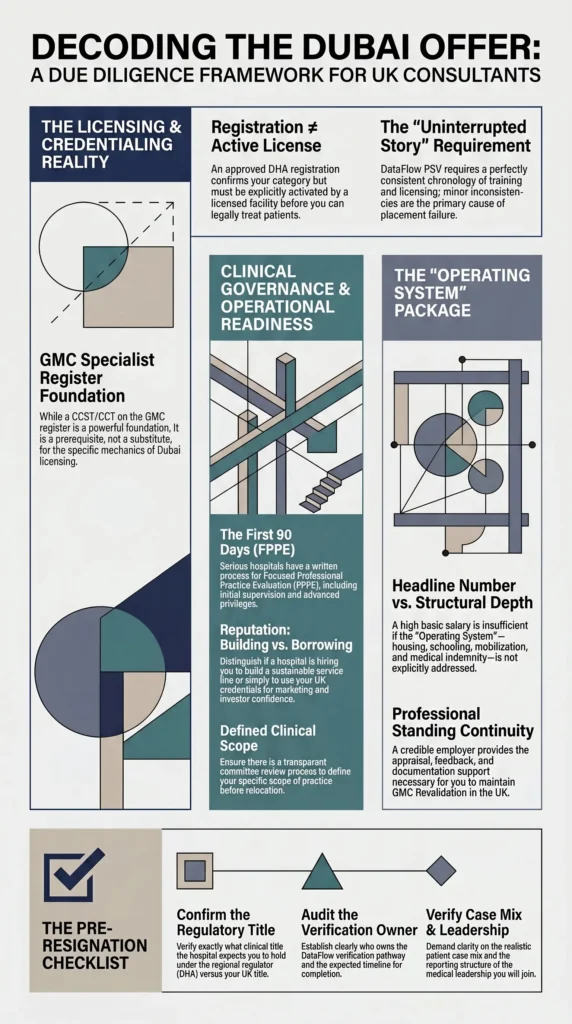
A UK consultant to Dubai private hospital move can be commercially and professionally powerful—but only when title, licensing, governance, and package architecture are genuinely aligned.
Most senior doctors do not make their biggest relocation mistake after arrival. They make it much earlier, when a polished commercial conversation, a strong tax-free headline number, or a prestigious-sounding hospital name is mistaken for a mature private-sector platform.
This guide provides a calm, structural due-diligence framework for UK-trained consultants assessing private hospital opportunities in Dubai, helping you separate marketing prestige from operational reality before you risk your NHS position or commit to license spend.
The Core Question: The right question is not, “Is Dubai attractive?” It is, “Is this specific private hospital offer structurally credible for my precise level, specialty, and career stage?”
Why the UK Consultant to Dubai Decision is Usually Made Too Late
By the time many senior consultants start asking hard operational questions, they have already become emotionally committed. The recruiter has sold the tax-free lifestyle, the hospital group has sold the global ambition, and the financial momentum is building.
However, the real test of a Dubai private hospital move is much quieter: Can your clinical profile convert cleanly into a usable title, an active license pathway, a defendable clinical scope, and a stable first year?
Leaving an established system like the NHS requires a strategic look at platform quality and practical economics. For a broader contextual framework, read our full analysis on the NHS to GCC Transition: 7 Powerful ROI Drivers for Senior Consultants.
The Lenses for Auditing a Dubai Private Hospital Offer
1. Confirm that “Consultant” Means Something Defensible
In the UK, consultant status carries a clear, universally understood institutional meaning. In Dubai, your professional file must be perfectly legible to both the regional regulator and the employer’s internal credentialing structure.
The first critical check is not the job title printed on your offer letter. It is whether your training pathway, CCST/CCT timeline, specialist history, and current standing support that exact title under local regulations. For UK-trained doctors, being on the GMC Specialist Register is an essential foundation that strengthens your position, but it is not a magical substitute for Dubai licensing mechanics.
Review our GMC Specialist Register GCC: Hiring Guide to understand exactly where the register strengthens your position and where candidates frequently overestimate what it solves.
2. Separate DHA Registration from Actual Clinical Go-Live
This is where many otherwise exceptional candidates misread the Dubai healthcare landscape.
The official regulatory DHA Get Registered pathway confirms your medical category, title, and specialty. However, an approved registration is valid for one year and must be explicitly activated into a live clinical license by a licensed healthcare facility before you can treat patients.
In practical terms, a hospital may speak confidently about your “approval,” but the real commercial risk sits in the activation timing, facility sponsorship, and operational readiness. The clinical and operational risks of this distinction are analyzed in depth within the DHA Registration vs License: Dubai Hiring Guide. If a hospital cannot give you a definitive timeline for when your license goes live via their specific facility, your revenue generation remains unresolved.
3. Treat Documentation and Verification as Strategic, Not Administrative
More consultant placements fail due to documentation and verification anomalies than poor interviews.
The official DataFlow Primary Source Verification (PSV) Services framework clarifies that qualifications and credentials are raw-verified directly with issuing authorities. For senior consultants, your degree history, training chronology, licensing trail, and supporting paperwork must tell one single, uninterrupted story. Delays rarely stem from a lack of seniority; they come from minor inconsistencies or the assumption that paperwork can be easily tidied up later by HR.
A disciplined documentation strategy must sit upstream of your resignation, not downstream of your excitement. Reviewing Good Standing Certificates GCC: Quiet Licensing Edge should happen before you spend on licensing or commit emotionally to the move.
4. Test the Hospital’s Governance Before You Test the Skyline
Private hospital quality in the UAE cannot be judged solely by interior design, luxury patient lounges, or marketing reach. For a Western-trained consultant, the deeper operational issue is whether the organization knows how to absorb and support senior talent.
Before signing, you must audit their clinical governance:
-
How is your specific clinical scope defined?
-
What happens during your first 90 days on the ground?
-
Is there a transparent, written process for committee review, initial supervision, and advanced privileges?
If a hospital leadership team cannot answer these questions calmly, you face a significant risk of operational delays or clinical under-utilization after you relocate. This is where understanding FPPE in Gulf Private Hospitals: The Hidden Second Gate becomes critical for protecting your practice.
5. Read the Package as an Operating System, Not a Headline Number
A Dubai offer can look immensely lucrative while remaining structurally thin.
When evaluating the financial architecture, look past the basic monthly salary. You must analyze whether the entire package supports the realities of a premium international relocation. Ensure your contract explicitly and realistically addresses housing allowances, schooling provisions for dependents, mobilization support, annual flight allowances, and comprehensive medical indemnity alignment. If a package is built solely to attract you but lacks the structural depth to stabilize your family in the region, your first 12 months will be significantly heavier than anticipated.
6. Match Licensing Logic to the Seniority of the Move
A common mistake in high-end GCC recruitment is assuming that a senior UK consultant can transition smoothly based on the strength of their reputation alone. In reality, seniority does not eliminate regulatory scrutiny—it raises the financial and professional cost of getting the details wrong.
That is where a more precise GCC Licensing Strategy for Tier-1 Consultants becomes commercially useful. Seniority does not remove regulatory detail; it demands that your credential file and employer-side planning are aligned from day one.
7. Protect GMC Continuity and Revalidation
A Dubai move should not create avoidable instability in your UK professional standing. The GMC is explicit that licensed doctors must complete regular cycles to maintain enrollment, and the official operational criteria can be reviewed via the GMC Revalidation for Doctors guidelines.
For consultants who intend to preserve optionality, UK credibility, or a clear future return pathway, this cannot be treated as a background issue. The strongest Dubai employers understand this and can explain how appraisal, documentation, feedback, and governance support will work in practice.
8. Is the Platform Building Your Reputation or Borrowing It?
This is the ultimate commercial question for any senior doctor moving from the NHS to the Dubai private sector.
Some private hospitals hire UK consultants because they are genuinely dedicated to building a sustainable, world-class clinical service line. Others hire them simply because a British consultant’s name enhances their local marketing, drives patient referrals, or builds investor confidence, while the internal clinical infrastructure remains immature.
Serious, premium platforms can explain clearly:
-
Where your specialty sits within the wider corporate service line.
-
What specific patient case mix is realistic for your department.
-
Who the reporting medical leader is and how peer reviews operate.
-
Exactly what clinical and commercial success looks like after 12 months.
If these answers are blurred or evasive, the hospital may be borrowing your reputation rather than supporting your medical practice.
The Quiet Checklist Before You Resign
Before your UK consultant to Dubai private hospital move becomes real, ask these six questions plainly:
-
[ ] What exact clinical title is the hospital expecting me to hold under the regulator?
-
[ ] Are we discussing a DHA registration only, or a definitive license activation sequence?
-
[ ] Who owns the verification pathway, and what is the expected DataFlow timeline?
-
[ ] What clinical privileges go live immediately, and which require internal committee review?
-
[ ] How will my first 90 days of practice be governed and evaluated?
-
[ ] How will I protect my UK professional continuity if I want to keep my UK license active?
A serious, high-end employer will never be irritated by these questions. A serious employer expects them.
Conclusion
A truly strong Dubai private hospital offer should feel clinically precise, not merely financially exciting. For a UK consultant, the right move is never the one with the loudest marketing or the fastest persuasion. It is the platform where title, license logic, documentation strategy, governance, and long-term quality all tell the exact same story.
That is the difference between a highly profitable Gulf chapter and a well-paid career detour.
Considering a clinical move to the UAE? If you want a discreet, professional second opinion before progressing with an interview or an offer letter, Contact Us today or submit your profile through our secure portal to Send Your CV for Confidential GCC Placements.