

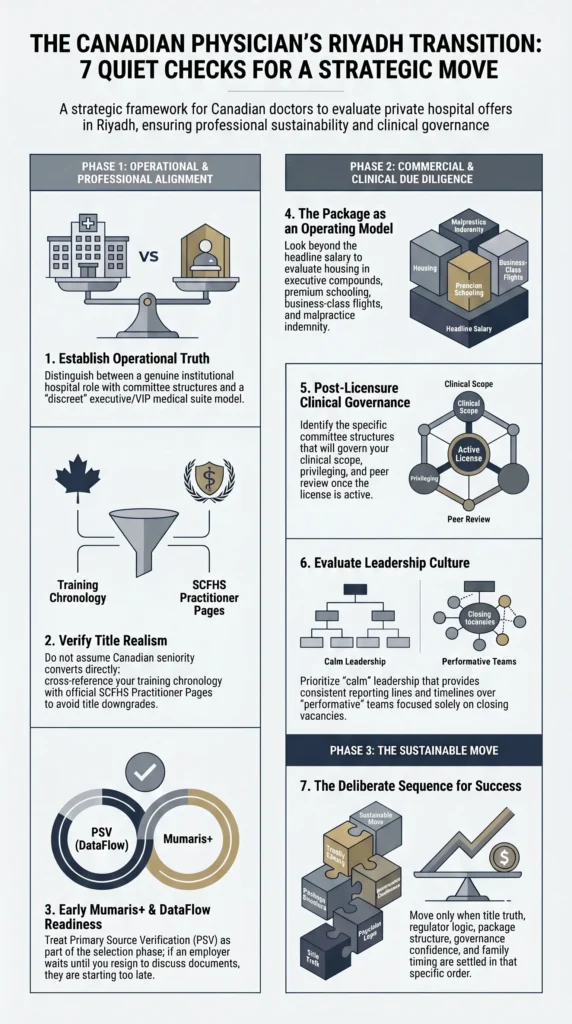
A Discreet Guide for Canadian Physicians: Assessing a Riyadh Private Hospital Move
A Canadian doctor Riyadh private hospital move can look attractive very quickly.
The clinical platform may be stronger. The compensation package may be more ambitious. The role may carry more visible leadership, better access to advanced diagnostics, or a faster service-line build than a comparable post at home.
But Riyadh is not a market where a polished offer letter is enough.
A Canadian physician can look highly appointable on paper and still lose time, title, or confidence if the role is badly defined, the regulator sequence starts too late, or the employer is selling a private hospital position that is actually a more discreet executive-care model in disguise. In Saudi Arabia, the practical route still runs through SCFHS classification and registration, with Primary Source Verification (PSV) sitting directly underneath that pathway.
That is why the right question is not simply, “Is Riyadh a good market for Canadian doctors?”
It is this: Is this specific Riyadh opportunity strong enough, clear enough, and governable enough to justify the move?
1. Confirm That “Private Hospital” Means What You Think It Means
The first quiet check is establishing operational truth.
Some Riyadh opportunities are genuine private hospital appointments with established committee structures, medical leadership, defined reporting lines, and clearer post-licensing governance. Others sit closer to executive health, VIP medicine, or discreet private-suite models, where confidentiality, 24/7 availability, and high-touch relationship management matter just as much as standard hospital processes.
Neither model is automatically better, but they are absolutely not the same job.
A Canadian doctor who wants institutional medicine, multidisciplinary structures, and visible departmental credibility should be cautious about roles that sound premium but feel operationally vague. For a deeper look at these operational distinctions, analyze Western-trained doctor jobs in Dubai, Abu Dhabi, Riyadh and Doha private hospitals: what really changes in daily practice.
Operational Red Flag: If the employer cannot explain whether the role is a hospital-based consultant appointment or a Private Medical Suite Recruitment GCC, the risk begins long before licensing.
2. Match Your Canadian Seniority to the Saudi Title Being Discussed
The second check is title realism.
Canadian residency training and fellowships carry immense credibility in Gulf private healthcare. However, that does not mean every senior Canadian post converts cleanly into the exact Saudi title being discussed in preliminary recruitment calls. The employer may say “Consultant,” but the real question is whether your training chronology, board certification, and post-specialty experience support that title under strict Saudi classification logic.
Before you become emotionally committed, read the professional classification requirements and the official SCFHS Practitioner Pages yourself. The market does not reward elegant assumptions; it rewards document accuracy.
This is precisely why reviewing a comprehensive Saudi Medical Licensing for Consultants: A Strategic Guide is essential. Developing a clear understanding of GCC Consultant Licensing: 7 Critical Rules to Avoid a Costly Specialist Downgrade before you assess the financial package too deeply prevents expensive title drift. In premium Gulf hiring, title drift weakens your negotiation leverage, delays start dates, and fundamentally alters how your role is perceived internally.
3. Treat Mumaris+ and PSV as Part of Selection, Not Post-Offer Admin
A successful Canadian doctor Riyadh private hospital relocation is usually decided before the final contract is signed. This is not because the interview sequence doesn’t matter—it does—but because in Saudi Arabia, the compliance file determines whether your professional momentum survives.
The most sophisticated employers now treat Mumaris+ readiness as part of the selection phase rather than an administrative task launched after contract acceptance. They know that even an exceptional candidate can face delays if document chronology is weak, scans are inconsistent, employment evidence is vague, or the proposed title lacks clean alignment on paper.
Understanding Mumaris+ 2026: The Western-Trained Licensing Edge provides a distinct competitive advantage. For your primary source verification, always cross-reference the official Saudi regulator partner page rather than relying on recycled online summaries. The Saudi Commission for Health Specialties (SCFHS) explicitly identifies DataFlow Group as its trusted PSV partner.
If an employer only begins discussing document compilation after you are ready to resign from your Canadian post, they are starting the process too late.
4. Read the £ Package as an Operating Model, Not a Headline Number
The fourth check is commercial clarity.
Most Western-trained physicians do not relocate for salary alone. They move for the full professional equation: a cleaner title, a stronger clinical platform, fewer bureaucratic hurdles, an interesting patient mix, and a tax-free package that genuinely improves long-term financial security.
Therefore, the right question is not, “Is the base salary high?”
The right question is: “Does the total package match the operational seriousness of the role?”
For a major international move, this means looking far beyond the monthly figure. You must evaluate:
-
Housing allowances or dedicated executive compounds
-
Premium schooling provisions (if relocating with family)
-
Annual leave rhythms and guaranteed business-class flights
-
Malpractice insurance indemnities and full licensing support
-
On-call expectations and structural overtime pay
A strong headline £ package loses its value rapidly if the clinical rota is unstable, onboarding is improvised, or the family transition is treated as an afterthought. To benchmark your offer against current regional standards, consult the GCC Physician Salary Trends: 2026 Executive Report.
5. Ask Who Governs Your Scope After the Licence Is Approved
A medical licence is not the whole job.
In established private hospitals, the true test begins after the regulator pathway concludes. Who approves your initial clinical scope? Which committee structure governs your day-to-day work? How are advanced or specialized procedures handled? What happens if the commercial team sold a broader service line than the hospital infrastructure is actually ready to support?
These questions matter because high-caliber Canadian physicians expect clinical governance to feel legible, transparent, and safe. They do not need corporate theatrics; they need structural clarity.
A private hospital that can explain its privileging, escalation, peer review, and clinical leadership structure calmly is always a safer career move than one that over-sells pure prestige.
6. Test Whether the Leadership Culture is Calm or Performative
The most sustainable Riyadh moves are led by serious, methodical decision-makers. These are leaders who answer questions directly, define the role parameters accurately, respect candidate confidentiality, and understand that senior Western-trained doctors assess employer quality with the same rigor employers use to evaluate talent.
For a Canadian doctor, this culture becomes highly visible during the interview sequence:
-
Is the leadership team consistent about titles, reporting lines, and operational timelines?
-
Do they understand why classification, registration, and clinical governance must be settled before making mobilization promises?
-
Do they sound like an institution building a stable, long-term clinical function, or like a commercial team trying to close a difficult vacancy quickly?
Calm, transparent leadership is always a better indicator of workplace health than polished enthusiasm.
7. Move Only When the Riyadh Chapter Looks Sustainable
The final check is long-term sustainability.
A Canadian doctor Riyadh private hospital transition should feel like a strategic career chapter, not a rushed experiment. The role must improve more than just your immediate income; it should enhance your professional positioning, organizational confidence, and daily clinical clarity.
The strongest Western-trained candidates always move in a deliberate sequence:
-
Title Truth: Confirming exact alignment with Saudi classification.
-
Regulator Logic: Initiating Mumaris+ and DataFlow verifications early.
-
Package Structure: Ensuring the £ package covers all logistical realities.
-
Governance Confidence: Verifying clinical pathways and peer review setups.
-
Family & Timing: Aligning school terms and mobilization dates smoothly.
When this specific order is respected, Riyadh stands out as one of the most commercially serious, clinically advanced, and professionally rewarding private-sector healthcare markets in the Gulf. When ignored, even the most prestigious offer can become operationally difficult very quickly.
Conclusion
Transitioning to a prominent Riyadh private hospital can be an excellent, career-defining decision for a Canadian physician.
However, the most successful moves are rarely the fastest ones. They are the calculated transitions where the employer proves that the role is real, the Saudi regulator pathway is clean, the £ package is structurally coherent, and the operating environment is mature enough to let a Western-trained physician practice medicine with total confidence from day one.
That is the standard worth moving for.
Explore Riyadh Private Hospital Opportunities
For a discreet, peer-to-peer conversation about upcoming Riyadh private hospital opportunities that are genuinely licensable and commercially credible, explore Gulf Healthcare Careers for Western-Trained Doctors, Nurses & Physiotherapists | Medical Staff Talent and Contact Us today.