

A calm guide for Australian-trained physiotherapists assessing whether a Dubai private clinic opportunity is genuinely licensable, commercially coherent, and worth the move
Australian Physiotherapist Dubai Private Clinic: What Serious Candidates Check Before They Commit
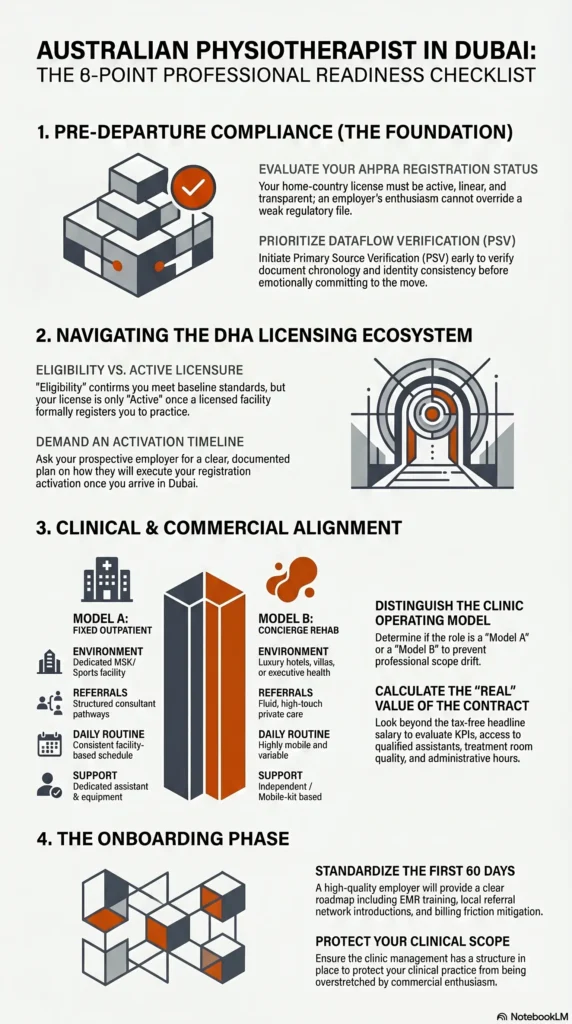
An Australian physiotherapist Dubai private clinic move can work exceptionally well, provided the role is structurally clean, transparent, and operationally viable from day one.
Dubai highly rewards Western-trained clinicians who can navigate the licensing ecosystem, integrate quickly into premium clinical environments, and manage a clear scope of practice. While this sounds obvious on paper, many commercial offers arrive wrapped in polished recruitment language long before the practical, compliance-led questions are truly answered.
For an Australian-trained physiotherapist, the right international move is never simply the one with the most attractive headline. It is the position where Ahpra status, DHA sequence, clinic operating model, and package design all align seamlessly. A serious Dubai career transition must be evaluated as both a clinical and a commercial decision simultaneously.
This master guide outlines exactly what top-tier candidates must check before they sign a contract.
Why the Australian Physiotherapist Dubai Private Clinic Route Excels
Australian physiotherapy training carries immense clinical credibility across the Gulf Cooperation Council (GCC). However, institutional credibility alone does not guarantee a seamless relocation.
A successful Dubai outcome depends entirely on whether your current registration story is stable, whether the private clinic defines your daily role properly, and whether the employer treats licensing as an integral part of the hire rather than an administrative detail to be tidied up after arrival.
Understanding this wider operational logic is exactly why analyzing the DHA Physiotherapist Licensing: 2026 Elite Path serves as an essential starting point. It frames Dubai healthcare hiring correctly: not as a rushed CV submission, but as a compliance-driven process that protects your deployability, professional scope, and long-term career trajectory.
1. Align Ahpra Registration with Gulf Licensing Expectations
The first critical check does not happen in the United Arab Emirates. It happens in Australia.
Before taking any Dubai private clinic conversation too far, evaluate your professional profile through the lens of home-country clarity. An employer may sound enthusiastic on an initial interview call, but your compliance file must stand up to strict regulatory scrutiny. This requires active registration status, coherent employment dates, a readable practice history, and absolute transparency regarding where your clinical practice has sat in recent years.
This is precisely where the Ahpra Register of practitioners becomes a foundational element of your file, and why reviewing Home-Country Licence Status in GCC Hiring: 5 Filters Elite Employers Use Before They Promise a Start Date is highly relevant to Australian candidates. In premium Gulf recruitment, a candidate’s file often weakens under regulatory review long before the interview process concludes.
Key Takeaway: A serious candidate is not only clinically exceptional; their background is entirely transparent, linear, and easy to verify on paper.
2. Differentiate Dubai Eligibility from an Active DHA Licence
This distinction is one of the most vital reality checks in any Australian physiotherapist Dubai private clinic move.
The Dubai Health Authority’s (DHA) official registration framework confirms that obtaining “Eligibility” simply verifies that a professional meets the baseline requirements for the applied position, allowing them to join the Dubai Medical Registry. However, this eligibility must be formally activated by a licensed healthcare facility before clinical practice can legally begin.
Why does this matter commercially?
Because many candidates hear they are “approved” and assume they can immediately begin patient care upon landing. In reality, the more sophisticated question to ask an employer is whether the clinic understands the activation sequence and holds a credible plan to execute it. A serious employer will clearly outline your expected registration pathway, the activation timeline, and how your clinical start-up phase will be managed. (For a comparative look at regional licensing adjustments, you can also review the Irish Physiotherapist Abu Dhabi Private Clinic: 7 Strong 2026 Licensing Rules).
3. Prioritize DataFlow Verification Early in the Process
An unstructured private clinic often leaves Primary Source Verification (PSV) until after a candidate is emotionally committed to the move. Elite clinics do the exact opposite.
Experienced healthcare employers understand that document chronology, employment certificates, registration proof, and identity consistency dictate whether an international relocation remains straightforward or becomes highly disruptive. This is why the guidelines in DataFlow and PSV for Gulf Licensing: A Clear Workflow for Western-Trained Clinicians should be studied early in your decision-making process.
The DataFlow verification sequence for the Dubai Health Authority is uncompromising. The practical lesson for any clinician is simple: if a clinic focuses solely on start dates and headline figures while ignoring the quality of your compliance dossier, it is moving loosely rather than efficiently.
4. Evaluate the Clinic Model to Prevent Scope Drift
Not every Dubai private clinic role shares the same operational structure.
-
Model A (Fixed Outpatient): A disciplined musculoskeletal (MSK) and sports-rehab environment backed by consultant referrals, dedicated assistant support, and structured outpatient pathways.
-
Model B (Concierge Rehab): A fluid model focused on executive health, luxury hotel visits, villa-based care, or blended concierge rehabilitation.
Both setups can be financially and professionally viable, but they represent entirely different daily realities.
Reviewing the framework in Medical Concierge in Dubai and Abu Dhabi: A Clear Guide for Western-Trained Clinicians helps candidates distinguish a dedicated clinic role from a highly fluid private-care model. While some physiotherapists thrive in a flexible concierge setting, others find that unexpected scope drift leads to professional frustration.
Before signing a contract, ask the clinic management directly:
-
Is this role primarily based within a fixed clinic facility?
-
Are home or villa visits occasional, or are they a structural requirement of the contract?
-
Is the patient caseload primarily focused on sports, post-op rehab, women’s health, neuro, or general MSK?
-
What are the primary internal and external referral streams into the service?
5. Assess the £ Contract Beyond the Headline Salary
A premium Dubai offer should never be judged solely by the tax-free monthly figure.
A strategic evaluation looks at the operational realities: what does the package actually purchase once your schedule, patient volumes, administrative hours, transport requirements, weekend rosters, and KPIs are factored in? A contract that looks excellent via email can quickly lose its appeal if the clinic expects constant, uncompensated flexibility without providing the underlying infrastructure to support it.
Utilizing the analytical approach in Tax-Free Salary in the Gulf: Reading the Real Numbers as a Western-Trained Clinician allows you to calculate the true value of an offer. For physiotherapists, long-term satisfaction typically hinges on quiet operational details:
-
Access to qualified assistant support and dedicated treatment rooms.
-
High-quality rehabilitation equipment and modern documentation systems.
-
Realistic KPI metrics that prioritize patient outcomes over volume.
6. Demand Clarity on Your First 60 Days Onboard
Your initial two months in the UAE will reveal whether an employer understands staff retention or merely focuses on recruitment volumes.
A sophisticated private clinic should be able to outline your onboarding phase with absolute clarity. You should know exactly which electronic medical record (EMR) systems you will utilize, who will introduce you to the local referral network, how patient billing friction is mitigated, and who protects your clinical scope when commercial enthusiasm attempts to stretch it.
The principles detailed in The First 60 Days in a Gulf Private Hospital: A Clear Plan for Western-Trained Clinicians apply directly to the private clinic sector. Early operational structure remains one of the clearest indicators of long-term employer quality and workplace stability.
Summary: The Standard Worth Using
The most successful international healthcare relocations are rarely rushed out of urgency. They are executed out of absolute structural clarity.
For an Australian physiotherapist, a move to a Dubai private clinic becomes exceptionally attractive once the registration sequence, verification file, clinical service model, financial package, and onboarding roadmap have all been thoroughly verified.
Medical Staff Talent operates exclusively within this structured segment of the healthcare market. We manage permanent placements for Western-trained Doctors, Physiotherapists, and Nurses across premium private hospitals, elite private clinics, royal households, and UHNW family care throughout the Gulf region. In these environments, the ultimate quality of your career move is determined by operational structure long before you arrive.
To explore whether a current Gulf opportunity is genuinely structured for a secure, long-term career move, you can Send Your CV for Confidential GCC Placements or Contact Us directly for a discreet consultation.