

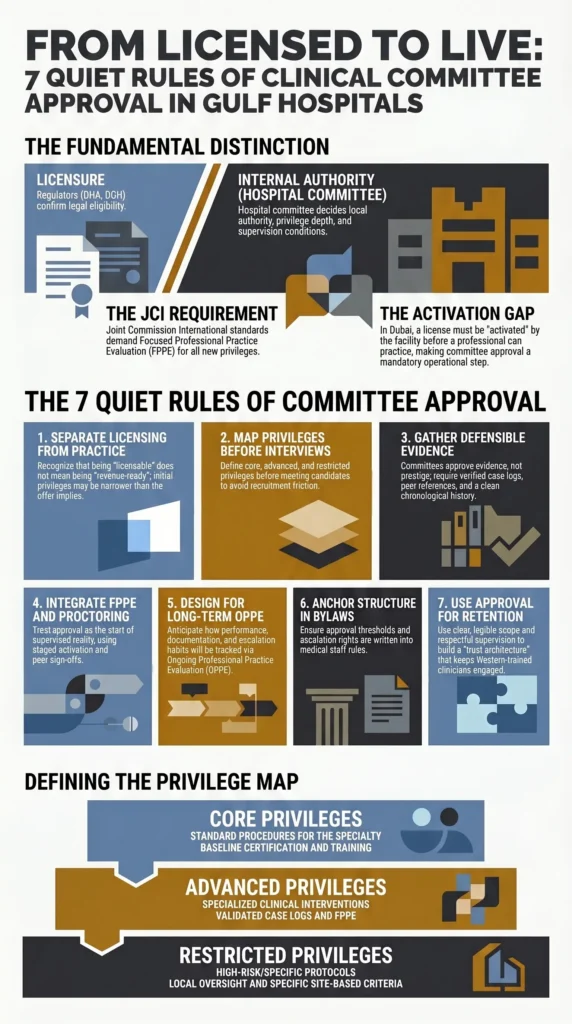
Committee approval in Gulf private hospitals is often the hidden checkpoint between a licensable clinician and a safe, revenue-ready start. This guide explains how elite employers structure privileging, FPPE, and governance so Western-trained hires can go live without avoidable delay, ambiguity, or authority drift.
Why licensing, privileging, and governance must align before a premium clinical hire becomes safe, trusted, and commercially operational.
Committee approval in Gulf private hospitals is one of the least understood stages in elite hiring. A clinician may be licensable, document-complete, and commercially attractive, yet still not be ready to practise the full scope sold during recruitment. That gap is where premium hires either become stable long-term assets or quiet governance problems.
The reason is simple: hospital quality frameworks do not treat licensure as the end of risk control.
Key Regulatory Context: Joint Commission International (JCI) hospital standards explicitly include healthcare practitioner privileging and credentialing. New privileges require Focused Professional Practice Evaluation (FPPE), and Ongoing Professional Practice Evaluation (OPPE) is the tracking mechanism after those privileges are granted.
In Dubai, the DHA registration route makes this distinction visible: registration confirms requirements, but the facility must actively activate the licence before the professional can practice. Therefore, understanding that licensing is not the same as committee approval is fundamental to operational readiness.
Why Committee Approval in Gulf Private Hospitals is Not an Admin Step
In elite private healthcare, committee approval is where the employer translates a promising CV into defensible authority. It answers the real operational question: What exactly can this doctor, nurse, or physiotherapist do here, under our standards, with our patient mix, and from which date?
That is why clinical licensing strategies should sit upstream of committee review, not downstream of an emotional offer. Abu Dhabi’s DOH Professional Qualification Requirements (PQR) remain a documentary base for licensure assessment, but that assessment still does not define the final internal scope a private hospital will allow on day one. Before jumping into onboarding, employers must verify whether the file will survive committee review.
The 7 Quiet Rules of Clinical Committee Approval
1. Separate Licensure from Internal Authority
Strong employers never tell themselves that “licensed” means “fully live.” They know a regulator confirms legal eligibility, while the hospital decides local authority, privilege depth, supervision conditions, and committee confidence.
This matters especially in revenue-sensitive service lines. A consultant pain physician, robotic surgeon, advanced practice nurse, or rehab lead may be clinically excellent and still need narrower initial privileges than the offer language implied. The expensive mistake is discovering that only after relocation.
2. Define the Privilege Map Before Interviews Become Emotional
Most committee friction starts earlier than employers think—specifically, when the role is advertised too broadly.
Before interviews progress, the hospital should define core privileges, advanced privileges, restricted privileges, and the evidence required for each. Utilizing a structured approach to committee approval in Gulf private hospitals keeps scope, committee logic, and onboarding inside one coherent system rather than three disconnected conversations.
-
Core Privileges: Standard procedures matching the specialty baseline.
-
Advanced Privileges: Specialized interventions requiring validated case logs.
-
Restricted Privileges: High-risk protocols requiring specific local oversight.
3. Ask for Evidence the Committee Can Actually Defend
A good committee does not approve prestige; it approves evidence. This means gathering:
-
Recent and verified case volumes.
-
Clear, readable peer and employer references.
-
Detailed procedure logs where relevant.
-
Consistent title history and current good standing.
-
A clean chronological file that matches the exact scope the hospital plans to activate.
A famous training background may open the discussion, but it cannot replace a defendable documentary trail. A refined private hospital already knows what its committee will ask. A weaker one interviews first, falls in love with the profile, and only later discovers that the evidence does not comfortably support the promised scope.
4. Build FPPE and Proctoring into the Approval Path
Committee approval should never be treated as the final gate. It is simply the start of supervised reality.
This is why mapping out privileges that still require structured committee approval matters so much. The Joint Commission’s position is clear: FPPE is required for all newly requested privileges, with no exemption based on board certification, experience, or reputation.
In practical terms, even a highly respected Western-trained hire may still require supervised cases, peer sign-off, or staged activation of advanced procedures. Private hospitals that explain this early usually retain trust.
5. Treat OPPE and Reprivileging as Day-One Design Choices
A sophisticated committee does not think only about initial approval. It thinks about what happens after month three, month nine, and year two.
Employers must design the pathway keeping in mind what the committee should anticipate after go-live. OPPE is designed to identify professional practice trends that may affect quality and safety.
\Consequently, the committee’s initial approval should anticipate the long-term impact of first committee approval regarding how performance, documentation, escalation habits, and case utilization will later be reviewed.
6. Put the Committee Architecture into Bylaws and Offer Design
A hospital cannot expect a calm committee pathway if its governance language is invisible. The approval structure should be anchored in written medical staff rules, approval thresholds, and escalation rights.
Reviewing how committee authority should be written ensures that your internal guidelines remain bulletproof. If the bylaws are weak, committee approval becomes personality-driven. If the bylaws are clear, the hospital protects both patient safety and physician credibility.
7. Use Committee Approval to Protect Retention, Not Only Compliance
The strongest employers do not use committee approval as a brake; they use it as a trust architecture.
A Western-trained consultant, nursing leader, or physiotherapy specialist is more likely to stay when scope is legible, supervision is respectful, and progression criteria are written. They are less likely to stay when authority feels political, variable, or dependent on informal favor.
Aligning Your Recruitment Pipeline
This is exactly where Medical Staff Talent fits. We recruit Western-trained Doctors, Physiotherapists, and Nurses for Private Hospitals, Private Clinics, Royal Households, and UHNW/UHNWI Families across Dubai, Abu Dhabi, Riyadh, and Doha.
In private hospital mandates, that means aligning the shortlist not only to licensure and market fit, but to committee-ready evidence, privilege realism, and a safer go-live sequence from the outset. A structured committee-ready activation pathway becomes especially valuable when the employer wants search, documentation, governance, and onboarding to move together rather than fragment under time pressure.
Final Thought
Committee approval in Gulf private hospitals should never appear for the first time after the contract is signed. By then, it is already too late.
The real work starts earlier. Define scope before interview theatre begins. Build the evidence file before verbal excitement outruns documentary truth. Connect committee approval to FPPE, OPPE, bylaws, and later reprivileging. Then the hire has a far better chance of becoming what premium private healthcare actually needs: safe, trusted, revenue-aligned, and durable.
That is the quiet difference between a clinician who is merely licensable and a clinician who can truly go live.
Contact Us: For a confidential discussion about recruiting Western-trained clinicians whose licence, privileges, and committee pathway will align cleanly from the outset, Contact Us.