

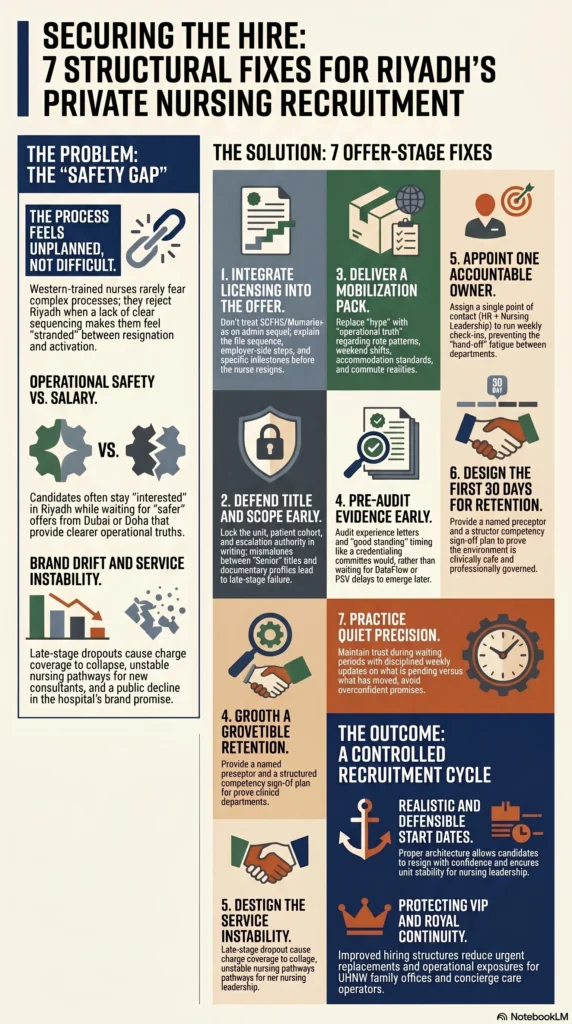
Western-Trained Nurse Recruitment in Riyadh is Won or Lost After the Offer is Signed
Private hospitals and premium clinics in Riyadh can interview exceptionally well, present a highly competitive financial package, and still lose an elite nurse before day one.
Sometimes the candidate disappears quietly. More often, they remain outwardly “interested” while systematically stretching onboarding timelines—until they suddenly accept a competing offer in Dubai, Abu Dhabi, or Doha.
This is not a sourcing or a volume problem. It is a governance and deployment problem. For high-stakes environments like the ICU, Emergency Department, operating theatres, VIP inpatient wards, oncology infusion units, and senior charge roles, a late-stage dropout does more than leave a vacancy—it threatens clinical stability and institutional reputation.
The Core Friction: The Offer Feels Confident, but the Start Date Feels Unsafe
Western-trained nurses rarely reject an opportunity in Riyadh because they fear administrative processes. They reject it because the process appears fragmented and unplanned.
-
The Employer’s Perspective: “We extended the offer, they accepted—the hire is done.”
-
The Candidate’s Perspective: “I am about to resign from a highly regulated, stable Western healthcare system, and I feel completely stranded between my resignation and my Saudi visa activation.”
In Saudi Arabia, this professional anxiety almost always centres on the Saudi Commission for Health Specialties (SCFHS) classification and the registration pathways via the Mumaris+ portal. If an employer cannot explain the precise verification sequence calmly, transparently, and professionally, top-tier candidates will naturally protect their careers by choosing a regional competitor who can.
Internal Alignment Reference: For internal teams managing these pipelines, the SCFHS defines Mumaris+ as its unified practitioner portal on its official SCFHS Digital Platforms Page. Candidates must directly interact with this system via the main Mumaris+ Sign-In Portal.
Why Onboarding Vulnerability Cripples Riyadh’s Private Healthcare Market
Riyadh’s premium private healthcare sector is no longer competing solely on the basis of state-of-the-art facilities. The true competitive battlefield is service-line reliability and patient experience.
When a specialized, Western-trained nurse pulls out weeks before their scheduled arrival, the operational fallout cascades rapidly:
-
Premium Inpatient Experiences Fluctuate: VIP floors and dedicated concierge care units suffer from inconsistent service delivery.
-
Clinical Governance Weakens: Charge nurse coverage and crucial preceptorship/mentorship capacity collapse.
-
Consultant Onboarding Stalls: Newly arrived international consultants are integrated into unstable, rotating nursing pathways, increasing clinical risk.
-
Brand Equity Drifts: The premium promise made to patients begins to erode—first quietly behind the scenes, then publicly.
For Royal households, ultra-high-net-worth (UHNW) family offices, and specialized concierge care operators, the stakes are even higher. A single late-stage dropout compromises strict operational continuity, absolute discretion, and family confidence.
To mitigate this, sophisticated healthcare employers look beyond simple CV sourcing; they invest heavily in recruitment architecture.
What Elite Employers Get Right: 7 Offer-Stage Fixes to Protect the Hire
1. Treat the SCFHS Pathway as Part of the Offer—Not an Admin Sequel
If your offer letter is legally definitive but your licensing narrative is vague, you create an operational vacuum that regional competitors will exploit. Top employers explain the regulatory journey in plain language, establishing clear accountability:
-
What is required from the nurse: Precise document formats, clinical experience letters, and Certificates of Good Standing.
-
What the hospital owns: The exact operational sequence, internal processing timelines, and dedicated corporate owners.
-
Potential bottlenecks: How minor title mismatches, missing clinical evidence, or verification queries are proactively managed.
-
The resignation milestone: The exact compliance threshold the nurse must cross before handing in their notice at their current hospital.
Strategic Asset: If your HR or clinical leadership team requires an objective, Saudi-specific licensing framework, align your offer conversations with our dedicated regulator-first briefing on the SCFHS Mumaris+ Western-Trained Licensing Edge.
2. Defend Title and Scope Before Naming the Start Date
A high percentage of late-stage recruitment failures stem from a downstream mismatch between clinical reality and recruitment marketing. For example, a hospital briefs a role as a “Senior ICU Nurse,” the candidate’s documented Western profile reads “Staff Nurse,” but internal recruiters continue to sell the senior title to close the candidate. When the reality of SCFHS classification arrives, the mismatch creates immediate friction.
Western-trained nurses are intensely protective of their professional identity, scope of practice, and long-term career positioning.
-
The Fix: Lock down the precise clinical unit, patient cohort, charge responsibilities, and escalation authority in writing before the offer letter is issued.
Risk Mitigation: To audit your internal processes for similar structural risks across the GCC, review our executive brief on managing Scope of Practice Mismatch in GCC Hiring.
3. Build an Operational “Mobilisation Pack”
Elite candidates do not look for marketing hype; they demand operational clarity. A rigorous mobilisation pack must address their practical reality with absolute transparency:
-
The exact roster patterns, weekend rotations, night shifts, and internal swap protocols.
-
The exact standard of accommodation, realistic commute logistics, and explicitly what utilities or amenities are covered.
-
Clear family-status implications (schooling, visas, healthcare coverage, if applicable).
-
The exact probation criteria, KPIs, and clinical performance expectations.
-
A named clinical peer or leader who will meet them during their first week.
4. Pre-Audit Clinical Credentials Like a Governance Committee
Document friction is the primary catalyst for post-offer dropouts. Unclear employer stamps, gaps in employment history, or ambiguously worded references cause immediate delays during primary source verification. Even if licensing isn’t the final gate for arrival, candidates know that verification delays push back their operational start date.
Verification Standards: Background checks rely on rigorous verification frameworks. The standard model for primary source verification in the Gulf region is handled by specialized verification bodies like the DataFlow Group.
-
The Fix: Cultivate the discipline to audit the candidate’s entire primary source verification (PSV) file before they emotionally commit to the move. Do not wait for a verification body to uncover a compliance gap weeks down the line.
Operational Insight: For a practical operational breakdown of how to proactively control start-date drift caused by background verification, share this briefing with your HR team to mitigate DataFlow Delays in GCC Hiring.
5. Assign a Single Accountable Journey Owner
When recruitment hands off to onboarding, onboarding hands off to licensing, and licensing assumes the clinical unit has prepared for arrival, candidate confidence breaks down.
-
The Fix: Assign a single corporate owner—ideally a joint bridge between HR and senior nursing leadership—to maintain a unified narrative. This individual runs structured weekly check-ins, confirms document milestones, and aligns the clinical unit for day one.
6. Design the First 30 Days as a Retention Lever, Not an Orientation
Western-trained nurses evaluate international moves through a lens of clinical safety. They want to know if they will be thrown into unsafe staffing ratios or if their clinical escalation rights will be respected.
-
The Fix: Provide a structured, highly visible 30-day integration plan. This must include supervised clinical go-live periods, a clear competency sign-off cadence, and a designated senior buddy or preceptor.
7. Communicate with Quiet, Disciplined Precision
The most common cause of top-tier candidate dropouts isn’t the duration of administrative delays—it is corporate silence. When waiting for visa or verification steps to clear, implement a disciplined, weekly communication cadence: “Here is what advanced this week, here is what is currently pending, and here is what we require from you next.”
Where the Process Breaks Most Often (How to Fix It Upstream)
In premium Gulf hiring, the vulnerabilities are highly predictable:
-
HR commits to a definitive start date before the candidate’s credential file is clinically defensible.
-
Nursing leadership meets the candidate too late in the process, leaving clinical expectations unaligned.
-
Accommodation, stipend specifics, and roster clarity arrive only after the candidate has resigned.
-
Licensing conversations are outsourced to generic corporate reassurance rather than precise milestones.
To address these vulnerabilities before extending an offer, healthcare facilities must optimize their initial evaluation structures. Implementing tactical process controls early protects the final deployment stage, as detailed in our guide to Interview Design for Western-Trained Hires.
Anatomy of a Failed ICU Hire: A Riyadh Case Study
A prominent private hospital in Riyadh planned a critical care expansion to cater to an influx of premium patients. They selected an exceptional, UK-trained ICU nurse with flawless credentials and references. The financial package was generous, and the interview process was highly professional.
However, the hire failed weeks before deployment due to three avoidable structural gaps:
-
Ambiguous Scope: The senior expectations (such as charge nurse coverage and clinical preceptorship) were verbally implied but never structurally defined in writing.
-
Unchecked Credentials: The nurse’s primary file was not pre-audited. Downstream, her UK experience letters lacked the highly specific unit-scope vocabulary required by licensing authorities, stalling the file.
-
Shifting Realities: The exact roster pattern and weekend commitments were explained informally during an interview, then revised on paper later.
Confronted with this operational ambiguity, the nurse quietly accepted a competing offer from a health system in Abu Dhabi. She didn’t choose the alternative because Riyadh was unattractive; she chose it because the competing employer presented a highly disciplined operational sequence and a transparent first-30-days deployment plan.
The takeaway is clear: Elite niches consistently choose the employer who makes career transition risk feel entirely controlled.
The Strategic Return on Process Governance
When you architect the post-offer stage with clinical and operational precision, your recruitment metrics shift fundamentally:
-
Start dates become realistic, predictable, and entirely defensible.
-
Nursing leadership protects unit stability and maintains safe staffing models.
-
Candidates commit deeper, resign from their current roles with absolute confidence, and resist late-stage counter-offers.
-
Onboarding transforms from an administrative scramble into an elite retention tool.
-
The hospital’s premium patient experience and brand equity remain entirely secure.
Where Medical Staff Talent Protects Your Hire
Medical Staff Talent operates exclusively within the governance-sensitive segment of Western-trained nurse recruitment across Riyadh, Dubai, Abu Dhabi, and Doha. We recognize that for premium healthcare brands, securing elite talent requires far more than managing a high volume of CVs.
We design bespoke search architectures that combine robust sourcing with rigorous credential pre-auditing, absolute licensing realism, and retention-first onboarding structures. By aligning clinical sourcing directly with operational deployment, we ensure that your critical hires arrive on time, fully compliant, and operationally ready.
-
To discover how our full-cycle recruitment architecture protects your premium service lines, review our end-to-end framework for Full-Cycle Recruiting Services.
-
To discuss a sensitive or urgent senior vacancy on a confidential basis, connect directly with our executive team via our Contact Us page.