

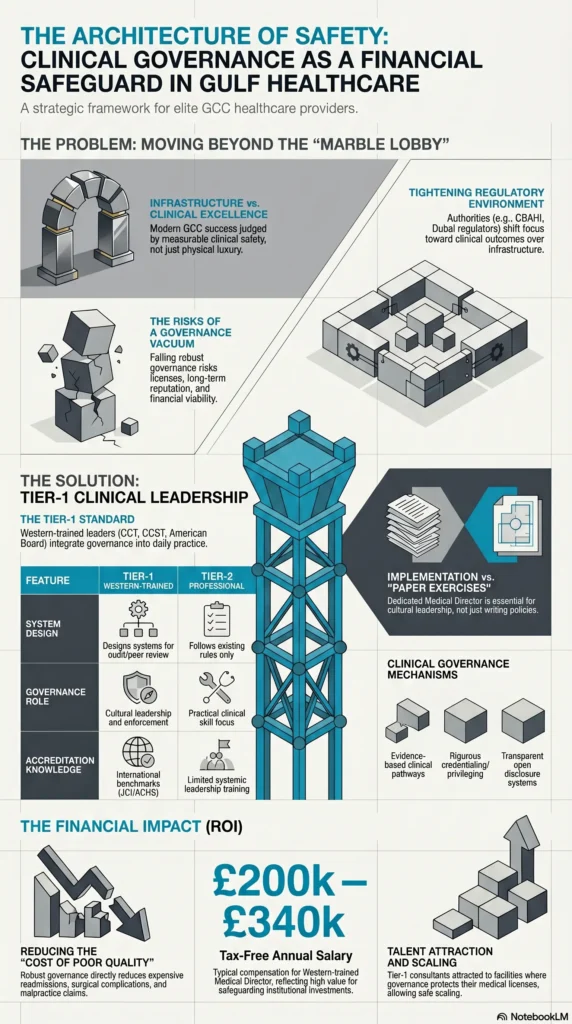
In the rapidly evolving landscape of the GCC, private healthcare facilities are no longer judged solely by the marble in their lobbies or the concierge services they provide. For the modern CEO, Board of Directors, or Royal Family Office, the true metric of success has shifted toward private hospital operational excellence and clinical safety.
At the heart of this shift is Clinical Governance in Gulf Private Healthcare. It is the invisible framework that ensures high standards of care, but more importantly, it is the ultimate strategy for healthcare risk mitigation in the GCC. Without it, a facility is not just risking patient safety—it is risking its license, its reputation, and its financial viability.
The ROI of Tier-1 Clinical Leadership
Clinical governance is often viewed as a regulatory burden, but in the elite private sector, it is a powerful ROI driver. When a facility secures a Western-trained Medical Director, they are investing in a culture of accountability that directly impacts the bottom line.
Tier-1 leadership ensures that clinical pathways are evidence-based, reducing the “cost of poor quality” such as readmissions, surgical complications, and malpractice claims. In cities like Dubai and Riyadh, where the market is hyper-competitive, clinical excellence is the only sustainable differentiator. Understanding Medical Staff Bylaws GCC is the first step in establishing this elite framework.
Why Western-Trained Expertise is the Standard
The demand for medical recruitment in Riyadh and across the UAE has surged for professionals who understand the nuances of international accreditation, such as Joint Commission International (JCI) or ACHS. A Western-trained Medical Director brings a foundational understanding of:
-
Audit and Monitoring: Implementing systems that catch clinical drift before it becomes a liability.
-
Credentialing and Privileging: Ensuring every doctor operating in the facility is strictly vetted against international benchmarks.
-
Open Disclosure: Managing clinical incidents with a level of transparency that protects the institution’s long-term reputation.
Securing this level of Tier-1 clinical leadership requires a specialized approach, often moving beyond traditional databases into the realm of Executive Search for Western-Trained Medical Directors in Dubai.
Risk Mitigation as a Growth Strategy
In the Gulf, the regulatory environment is tightening. Authorities are increasingly focused on clinical outcomes rather than just infrastructure. Robust clinical governance provides the “safety net” that allows a facility to scale safely.
Whether it is a specialized longevity clinic or a multi-disciplinary hospital, the implementation of GCC Clinical Governance standards is what allows an organization to attract the world’s best consultants. Tier-1 doctors rarely join facilities where they feel their own licenses are at risk due to poor institutional oversight. This is particularly true when facilities are looking at Medical Director Recruitment GCC to lead their expansion.
Frequently Asked Questions
1. How does clinical governance differ between Tier-1 and Tier-2 professionals?
Tier-1 professionals (those with CCT, CCST, or American Board certification) are trained in systems where clinical governance is embedded in daily practice. They don’t just “follow” rules; they design the systems for audit, peer review, and incident reporting. Tier-2 professionals may have the clinical skill but often lack the systemic leadership training required to build a governance framework from scratch. For more details on these requirements, see our guide on how to hire a Medical Director for a private hospital in Dubai.
2. Can a private clinic implement Western governance without a Medical Director?
While policies can be written by consultants, a Western-trained Medical Director is essential for enforcement and cultural leadership. Without a dedicated clinical leader, governance often becomes a “paper exercise” that fails to protect the facility during a real clinical crisis or a strict audit by the Saudi Central Board for Accreditation of Healthcare Institutions (CBAHI).
3. What is the typical salary for a Western-trained Medical Director in the Gulf?
For a Medical Director at a Tier-1 private facility in Riyadh or Dubai, compensation packages typically range from £200,000 to £340,000 per annum, tax-free. This often includes executive benefits such as housing allowances, premium family healthcare, and performance bonuses tied to both clinical quality and operational efficiency.
Secure Your Clinical Future
Building a world-class institution requires more than just hiring doctors; it requires the architecture of safety. At Medical Staff Talent, we specialize in the executive search of Western-trained leaders who define the future of Gulf healthcare.
Is your facility protected? Contact us today to discuss your clinical leadership requirements.