

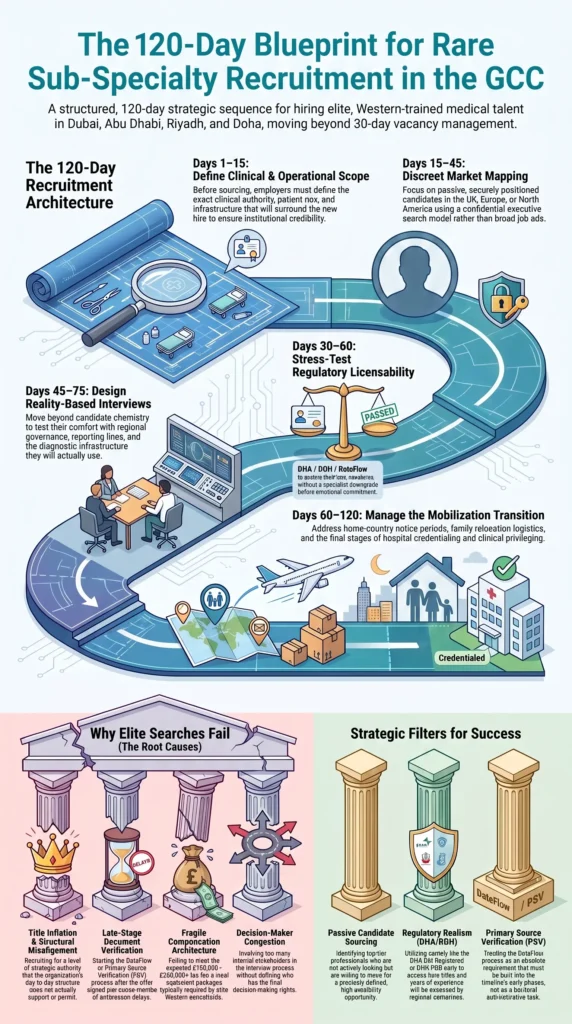
Rare sub-specialty recruitment in the Gulf Cooperation Council (GCC) is seldom delayed by a simple lack of market interest. More often, the process stalls because private employers mistakenly start their hiring clock at the interview stage rather than at the foundational phase of search design.
For private hospitals, elite clinics, royal households, and Ultra-High-Net-Worth (UHNW/UHNWI) medical environments across Dubai, Abu Dhabi, Riyadh, and Doha, managing a scarce talent search requires a precise architectural blueprint, not a short-term vacancy-management exercise.
When searching for highly specialized, Western-trained consultant physicians, nursing directors, or clinical rehabilitation leads, assuming a premium clinician can be secured using mass-market timelines is the quickest way to break your recruitment pipeline. To succeed, these complex mandates must be planned as a strategic 120-day sequence rather than a 30-day hope.
Why Elite Gulf Healthcare Searches Stall
A recruitment mandate does not become “rare” simply because an internal HR team labels it urgent. True scarcity occurs when a role combines high clinical specialization, major commercial weight, strict governance sensitivities, and the absolute requirement for discreet market handling.
This operational reality applies directly to:
-
Consultant Physicians with highly narrow, niche sub-specialty service-line profiles.
-
Nursing Leaders headhunted to stabilize premium, high-volume inpatient teams.
-
Rehabilitation Leads tasked with building advanced musculoskeletal (MSK) or specialized recovery programmes from scratch.
When an institution enters the market for these elite positions, the first scarce hire often defines the long-term credibility of an entire clinical department. This is why mapping your search within a wider structural framework—as detailed in our Clinical Service Line Recruitment GCC: 2026 Playbook—is essential before reaching out to the market.
The 120-Day Architecture: Phase by Phase
Days 1 to 15: Define the Role That Can Actually Be Filled
The initial phase of rare sub-specialty recruitment focuses entirely on clinical and operational definition, not sourcing.
While an organization may state an immediate need for an oncology leader, fertility specialist, sleep physician, consultant anaesthetist, or premium rehab lead, the critical underlying operational questions must be answered first:
-
What exact clinical and financial authority will this individual hold?
-
What specific patient mix and case volume will they realistically manage?
-
What infrastructure, multi-disciplinary teams, and regional support will surround them?
-
What is the true internal culture and long-term commercial ambition of the hiring institution?
Highly qualified, Western-trained candidates detect operational ambiguity instantly. If reporting lines are blurred, the clinical scope is artificially inflated, or the position is entangled in unresolved internal politics, elite talent will quietly withdraw from the process. The search fails not because the global talent pool is small, but because the initial brief lacks institutional credibility.
Days 15 to 45: Map the Market with Extreme Discretion
In this phase, many private healthcare employers mistake broad market visibility for genuine candidate reach.
The top tier of rare sub-specialty professionals are almost exclusively passive candidates. They are securely positioned in top-tier institutions in the UK, Europe, or North America, highly compensated, and exceptionally selective about regional relocation. Broad, public job advertisements generate high volumes of unqualified CVs, but they rarely solve a sensitive, premium search.
This is exactly where understanding Executive Search vs Recruitment Agency in GCC Healthcare: 5 Critical Risks becomes relevant. Some roles need volume reach; rare roles require access, persuasion, calibration, and total confidentiality.
When a mandate is commercially sensitive and the shortlist must survive licensing, governance, and relocation scrutiny, it becomes an executive search problem rather than a standard agency exercise. For a deeper look into this dynamic, review how elite providers manage confidentiality in Executive Search in the Gulf: When Private Hospitals Need More Than Standard Recruitment.
A high-calibre shortlist at this tier is not a collection of actively looking job seekers. Instead, it is a curated group of vetted professionals whose training, seniority, projected regulatory licensability, cultural alignment, and genuine motivation for moving to the Gulf have survived deep, initial scrutiny.
Days 30 to 60: Stress-Test Regulatory Licensability Before Chemistry Wins
A major financial and operational risk in GCC clinical recruitment is falling in love with a candidate’s clinical chemistry before their professional file has been verified against regional regulatory frameworks.
Before the preferred candidate becomes emotionally committed, the search must move from interest to harsh regulatory realism. Employers must implement early filtering protocols, such as those outlined in our guide on Home-Country Licence Status in GCC Hiring: 5 Filters Elite Employers Use Before They Promise a Start Date, to evaluate the following:
-
Does the candidate’s clinical title translate cleanly to regional licensing categories without a specialist downgrade?
-
Does their home-country regulatory standing fully support the specific role under discussion?
-
Will their complete career documentation withstand primary source verification?
-
Is the internal HR team promising a mobilization date that the local regulatory sequence cannot physically support?
To mitigate these risks early on, employers should realign their screening processes with a comprehensive GCC Consultant Licensing: 7 Critical Rules to Avoid a Costly Specialist Downgrade.
Official regional pathways strictly reinforce this requirement. For example, Dubai Health Authority’s DHA Get Registered Portal makes clear that registration confirms a professional’s specific category, title, and specialty, which must then be formally activated by a licensed facility into an active practicing license. Similarly, Abu Dhabi’s Department of Health outlines rigid framework guidelines in the DOH PQR Portal to dictate how clinical titles and consecutive years of experience are assessed.
Because self-reported credentials are never enough for premium compliance, the DataFlow Group Primary Source Verification (PSV) process remains absolute. Document readiness, verification history, and absolute title alignment must be built directly into the early stages of your timeline before interviews become emotionally binding.
Days 45 to 75: Design Interviews That Test Operating Reality
When premium recruitment mandates fail at the interview stage, it is rarely because the candidate lacks clinical competence. It is usually because the employer’s interview panel inadvertently reveals that the organization is still improvising its operational strategy.
Top-tier Western-trained consultant physicians, nursing leaders, and physiotherapy heads do not evaluate a career move based on the financial package alone. They look for clear indicators that the employer deeply understands the clinical realities required to keep the department stable.
The interview phase should explicitly test operating reality, governance maturity, and reporting clarity over simple candidate chemistry. For a step-by-step breakdown of how to structure these high-level interactions, consult our framework on Interview Design for Western-Trained Hires: 7 Quiet Rules for Gulf Private Hospitals.
For scarce mandates, your interview process should actively evaluate:
-
Real-world case mix, diagnostic infrastructure, and patient referral streams.
-
Reporting clarity, escalation pathways, and operational autonomy.
-
Leadership expectations that extend beyond standard clinical duties.
-
Comfort with institutional governance, strict documentation, and multi-disciplinary standards.
Elite candidates are rarely questioning whether they can perform the job; they are evaluating whether you have built an environment where they can practice safely, grow commercially, and protect their professional reputation.
Days 60 to 120: Acceptance is Only the Beginning of Mobilization
A signed offer letter or contract signature is a major milestone, but it is not the finish line. In premium Gulf healthcare environments, a hire is only truly successful when the professional is fully credentialed, licensed, deployed, and operationally live.
The final phase of the architecture manages the delicate transition from contract signature to physical onboarding, capturing:
-
Complex home-country notice periods and professional transition timelines.
-
Family relocation logistics, including spouse career tracks and school enrollments.
-
Local hospital credentialing committees and clinical privileging steps.
This backend sequence is why building a airtight operational framework matters, as explored in Credentialing and Privileging GCC: 4 Critical Rules for Elite Hiring. Furthermore, for leadership-heavy mandates where authority, governance, and institutional credibility matter together, this process should be approached with the same discipline found in Medical Director Recruitment GCC: Strategic Clinical Leadership.
What Usually Breaks the Timeline?
When rare recruitment pipelines collapse, the root causes are often subtle, quiet, and entirely preventable:
| The Root Cause | The Operational Consequence |
| Title Inflation | The advertised role suggests a level of senior clinical or strategic authority that the actual day-to-day organizational structure does not support. |
| Late-Stage Verification | Commencing the DataFlow or PSV process after an offer is extended, rather than during the initial shortlist design, causing months of delay. |
| Decision-Maker Congestion | Involving too many internal stakeholders in the interview loop without defining clear, final decision rights. |
| Fragile Package Architecture | Relying on compensation structures that attract initial attention but fail to account for tax-free expectations or protect long-term retention. Elite Western consultants typically require highly structured packages frequently ranging from £150,000 to £250,000+ tax-free equivalents annually. |
| Premature Start Dates | Selling an unrealistic mobilization date before the licensing, privileging, or onboarding sequences have been verified. |
A Structured Approach to Elite Talent Acquisition
The most successful private healthcare providers in Dubai, Abu Dhabi, Riyadh, and Doha no longer treat the recruitment of rare sub-specialties as a speed race. Instead, they treat it as a disciplined sequencing exercise.
They thoroughly define operational scope prior to market outreach, select targeted search models over generic recruitment agency volume, integrate regulatory verification into the initial candidate assessment, and view onboarding as a core part of the talent architecture.
For organizations looking to integrate these moving parts into a single, cohesive strategy, partnering with a full-service advisor can dramatically eliminate vacancy risks. Learn how this unified approach functions by visiting our dedicated Full Cycle Recruiting Service page.
Partnering with Medical Staff Talent
Medical Staff Talent operates exclusively within the premium segment where clinical specialization, regulatory complexity, and commercial sensitivity meet.
We partner with Private Hospitals, Premium Clinics, Royal Households, and UHNW/UHNWI Families to identify and secure elite, Western-trained Doctors, Physiotherapists, and Nurses across Dubai, Abu Dhabi, Riyadh, and Doha.
For highly complex, scarce mandates, our work goes far beyond introducing candidates. We work closely with leadership teams to refine the operational brief, maintain strict market discretion, stress-test primary source documentation early, and manage the delicate cross-border relocation process to ensure your premium hire arrives cleanly, deploys safely, and stays long-term.
Conclusion
Rare sub-specialty recruitment in the GCC does not accelerate by putting more pressure on the global market. It accelerates by applying more structure to your internal process. Employers who meticulously plan the first 120 days secure talent more cleanly, reduce candidate drop-out rates, and establish highly sustainable clinical service lines.
For private hospitals, premium clinics, royal households, and family offices planning a scarce Western-trained hire, the safest first move is a discreet scoping conversation before outreach begins. Contact our team directly through our Contact Us page to align your strategy.