

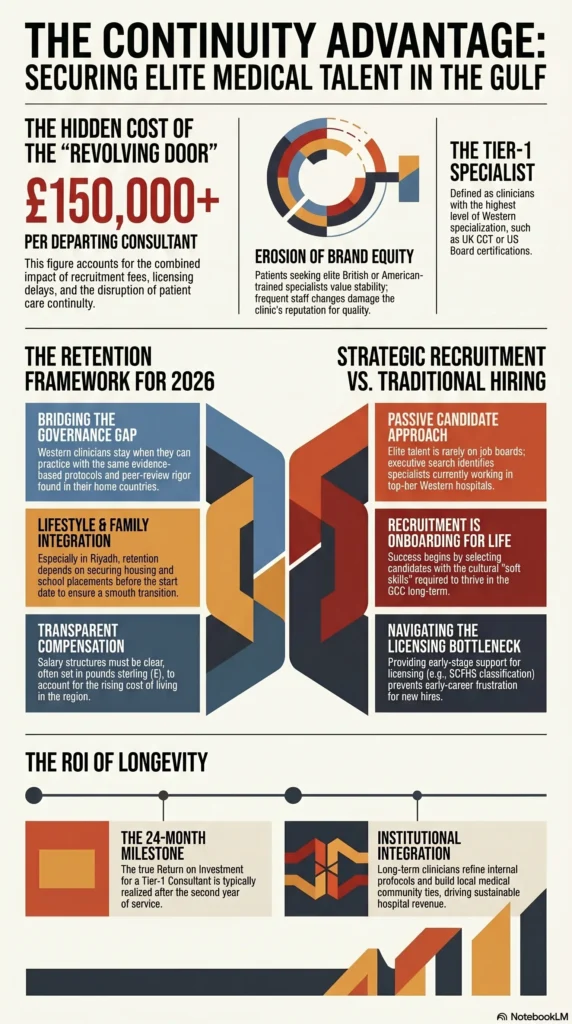
High turnover in Gulf private healthcare isn’t just an HR headache; it is a silent revenue killer. For elite clinics in Dubai and flagship hospitals in Riyadh, the departure of a Tier-1 Consultant often results in a loss exceeding £150,000 when factoring in recruitment fees, licensing delays, and the disruption of patient trust.
In the competitive landscape of Western-trained medical recruitment in the Gulf, the true “luxury” for a provider isn’t the marble lobby—it’s the doctor who stays for five years instead of fifteen months.
The Cost of the “revolving Door” in GCC Healthcare
When a Western-trained specialist leaves prematurely, the clinical governance of the institution takes a hit. Patients who seek out a specific British-trained surgeon or an American-board-certified pediatrician value continuity. If that face changes every year, the brand equity of the clinic erodes.
For private healthcare entities, especially those serving UHNW families or royal households, stability is the ultimate hallmark of quality.
Strategic Insight: Retention begins during the search. Using a specialized Healthcare Executive Search in Qatar or Dubai ensures that the candidate isn’t just qualified on paper, but possesses the cultural “soft skills” required to thrive in the GCC long-term.
Key Factors Driving Retention in 2026:
-
Clinical Governance GCC: A robust framework that allows Western doctors to practice with the same rigor they experienced in the UK, Europe, or North America.
-
Tier-1 Consultant Recruitment Dubai: Moving beyond “headhunting” to “onboarding for life.”
-
Transparent Compensation: Clear structures in pounds sterling (£) that account for the rising cost of living in the region.
Why Riyadh Private Healthcare Staffing is Pivotal
Saudi Arabia’s Vision 2030 has shifted the center of gravity toward Riyadh. However, the challenge for Riyadh private healthcare staffing is unique. Unlike the established expat hubs of Dubai, Riyadh requires a deeper level of “lifestyle integration.”
Providers that succeed in retaining Western talent focus on:
-
Family Transition Support: Ensuring schools and housing are secured before the start date.
-
Licensing Clarity: Avoiding the “licensing bottleneck” that often sours a new hire’s first 90 days.
Related reading: [Recruiting Western-Trained Doctors in the Gulf: Navigating Licensing and Retention]
Clinical Governance: The Anchor of Continuity
A common reason Western-trained clinicians return home is the “governance gap.” If a Tier-1 Consultant feels that clinical standards are secondary to commercial targets, they will leave.
Maintaining Clinical Governance in GCC facilities isn’t just about safety; it is a retention tool. Western clinicians are trained to thrive in environments with clear peer reviews, evidence-based protocols, and transparent clinical pathways.
Internal Resource: [Beyond the Boardroom: How Clinical Governance in Gulf Private Healthcare Protects the Bottom Line]
Executive Search vs. Traditional Recruitment
In the Gulf, standard recruitment agencies often play a numbers game. For elite providers, this is a dangerous strategy. Healthcare Executive Search in Qatar, the UAE, and KSA requires a “passive candidate” approach. The best doctors aren’t looking at job boards; they are currently working in top-tier Western hospitals and need to be convinced that the move to the Gulf is a career-building step, not just a financial one.
The ROI of Longevity
When a provider invests in a Tier-1 Consultant, the ROI is realized after year two. By then, the clinician has established a loyal patient base, integrated into the local medical community, and likely helped refine internal protocols.
Internal Resource: [The ROI of Western Talent: Why Elite Recruitment Drives Hospital Revenue]
Conclusion: Building a Legacy, Not Just a Staff Roster
The “Continuity Advantage” is a strategic choice. It requires moving away from transactional hiring and toward a model of partnership. By focusing on Western-trained medical recruitment in the Gulf with an eye on long-term retention, providers can secure their position as leaders in a crowded market.
If you are seeking to stabilize your clinical leadership, explore our Licensing support and [Executive Search services to ensure your next hire is your best hire.
FAQ’s
Q: Why is turnover so high for Western-trained doctors in the Gulf? A: Often, it is due to a mismatch in cultural expectations or a lack of robust clinical governance. Bridging this gap is essential for long-term retention.
Q: What is the difference between Tier-1 and Tier-2 Consultants in GCC recruitment? A: This usually refers to the country of training and the specific board certifications held, with Tier-1 typically representing the highest level of Western specialization (e.g., UK CCT, US Board).
Q: How can hospitals in Riyadh improve retention? A: Focus on early-stage licensing support (e.g., SCFHS classification) and providing a lifestyle package that supports the consultant’s family.