

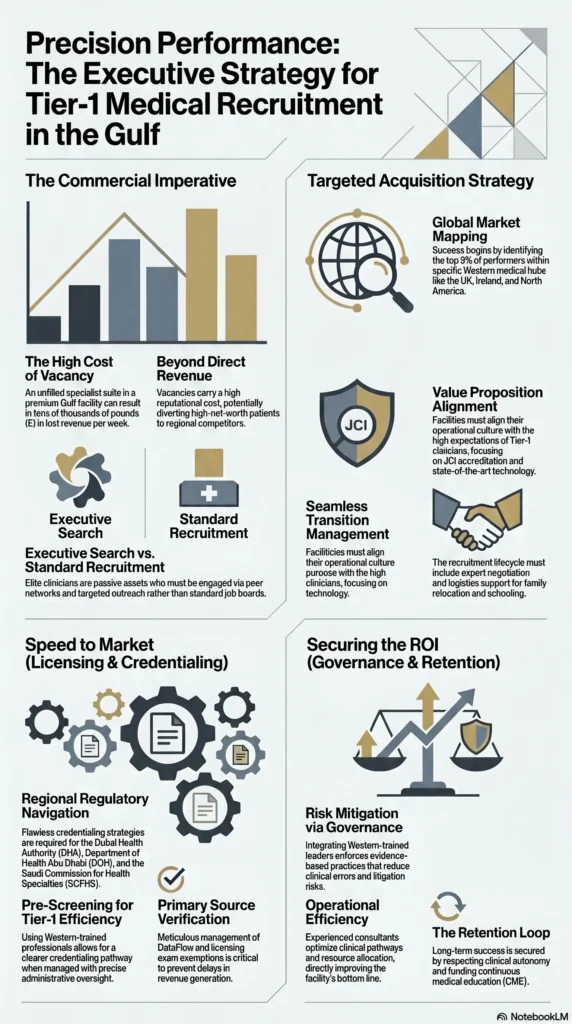
In the highly competitive private healthcare markets of Dubai, Riyadh, and Doha, securing top-tier clinical talent is no longer merely an HR function—it is a critical commercial imperative. For elite healthcare providers, UHNW investors, and hospital CEOs, the foundation of market dominance relies on Western-trained medical recruitment in the Gulf.
Acquiring Tier-1 medical consultants from Western systems (such as the NHS in the UK, the HSE in Ireland, or top board-certified practitioners from North America) ensures clinical excellence, robust governance, and immediate patient trust. This strategic guide explores the executive frameworks required to attract, license, and retain these elite practitioners, ensuring a maximum return on your healthcare investment.
The Financial Reality of Elite Gulf Private Healthcare Staffing
The cost of an unfilled executive clinical vacancy is substantial. In premium Gulf facilities, a vacant specialist suite can easily equate to tens of thousands of pounds sterling (£) in lost revenue per week, not accounting for the reputational cost of diverting UHNW patients to competitors.
Standard recruitment methodologies often fail in this high-stakes environment because they treat elite physicians as active job seekers rather than passive, highly valued assets. Gulf private healthcare staffing must be executed as an executive search operation. To secure the highest caliber of Western-trained talent, hospitals must present:
-
Uncompromising Clinical Standards: Top-tier physicians want to work in JCI-accredited facilities with state-of-the-art technology.
-
Transparent Financial Packages: Remuneration must be highly competitive, strictly tax-free, and comprehensively structured to support international relocation.
-
Clear Career Trajectories: Candidates require a definitive path toward clinical leadership and governance roles.
Navigating Medical Licensing GCC: Speed to Market
One of the most significant bottlenecks in healthcare talent acquisition Dubai and the wider region is the licensing process. Whether navigating the Dubai Health Authority (DHA), Department of Health Abu Dhabi (DOH), or the Saudi Commission for Health Specialties (SCFHS), executive recruitment demands a flawless credentialing strategy.
Delays in credentialing mean delayed revenue. A premier recruitment strategy involves pre-screening Western candidates strictly against the specific tiering requirements of the destination country. Because the focus is exclusively on Western-trained professionals, the credentialing pathway is often clearer, but it still requires meticulous administrative oversight to ensure that primary source verification (DataFlow) and licensing exams (or exemptions) are handled with precision.
Clinical Governance Middle East: Protecting the Investment
Attracting talent is only the first step; safeguarding clinical quality is what sustains profitability. Robust clinical governance Middle East relies heavily on the leadership of Tier-1 medical consultants who bring established, evidence-based practices from strictly regulated Western environments.
Integrating Western-trained physicians into your leadership team achieves three critical objectives:
-
Risk Mitigation: They naturally enforce international standards of patient safety, drastically reducing the risk of clinical errors and subsequent litigation.
-
Reputation Management: UHNW patients actively seek out Western-trained specialists, viewing their presence as a hallmark of premium care.
-
Operational Efficiency: Experienced consultants streamline clinical pathways, reducing length of stay and optimizing resource allocation, directly impacting the bottom line.
Executive Strategy for Healthcare Talent Acquisition in Dubai & Beyond
To capture the attention of Tier-1 medical consultants, your recruitment partner must speak their language. Passive candidates are rarely browsing standard job boards; they are engaged through peer networks, academic reputations, and discreet, targeted outreach.
An effective talent acquisition strategy includes:
-
Market Mapping: Identifying the top 5% of performers in specific Western medical hubs.
-
Value Proposition Alignment: Ensuring the operational culture of your Gulf facility aligns with the expectations of an elite Western clinician.
-
Seamless Transition Support: Managing the entire lifecycle of the move, from contract negotiation in pounds sterling (£) to family relocation logistics and schooling.
If your facility requires bespoke, executive-level staffing solutions, you can explore our dedicated services at https://medicalstafftalent.com/full-cycle-recruiting-service/
Sustaining the ROI: Retention of Western-Trained Clinicians
The ultimate measure of success in Western-trained medical recruitment in the Gulf is retention. High turnover rates erode patient confidence and incur massive replacement costs. Elite facilities must foster an environment that respects clinical autonomy and funds ongoing continuous medical education (CME).
By treating the recruitment of Western medical staff not as a transactional hire, but as a strategic partnership, Gulf healthcare facilities can secure their position at the pinnacle of global private healthcare.
For highly targeted executive search and strategic talent acquisition tailored to elite healthcare facilities in the GCC, contact our specialized team directly at https://medicalstafftalent.com/contact.