
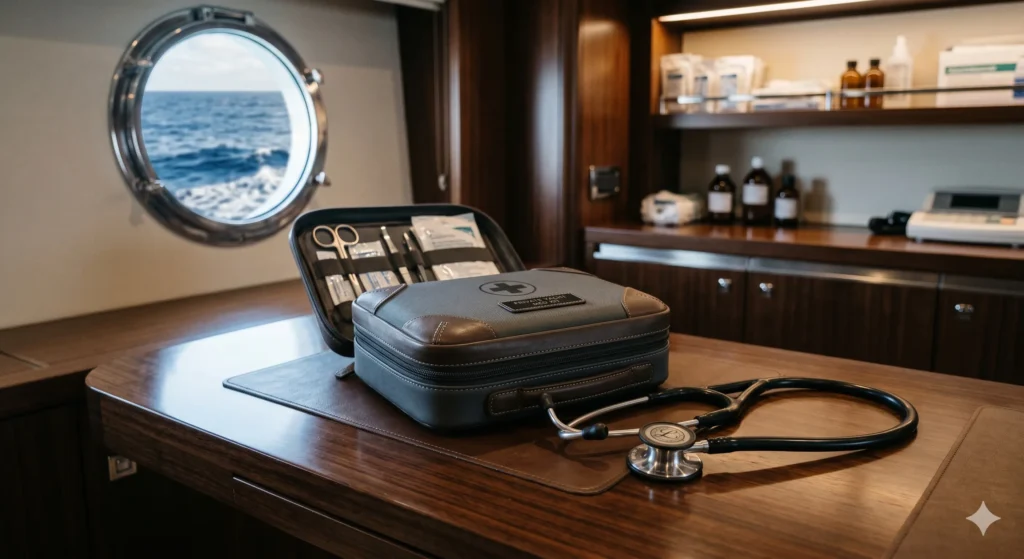
Maritime & Superyacht Medical Staffing for Owners, Captains and Family Offices
Private yacht physicians, nurses and physiotherapists for private owners and their families — Mediterranean summers, Gulf winters and world itineraries — placed under strict confidentiality and vetted for the one competence that matters at sea: independent judgement.
The niche the mainstream agencies never entered
Crew agencies place deck and interior. Medical recruiters place into hospitals. The clinician who provides continuous care to a principal aboard a private vessel falls between the two — which is why the market for them has remained almost entirely unserved, and why Medical Staff Talent entered it. We place UK & European-trained physicians, nurses and physiotherapists aboard private yachts for owners and their families, working directly with the owner’s representative, the captain, the chief of staff or the family office. We currently hold live mandates across all three disciplines at sea.
Absolute Discretion
We Do Not Name Vessels, Principals or Itineraries
Before, during or after a mandate
Vessel medical provision is commissioned quietly and rarely advertised. Every maritime mandate is routed confidentially: the vessel and the owner are never named in a listing, candidates are approached individually and briefed only after a non-disclosure agreement is executed, and the household sees a short, verified shortlist. The full standard is set out in Confidentiality, NDAs and Vetting.
Start a Confidential Conversation →Why the appointment is different
The clinician is the entire service. No colleague, no on-call registrar, no radiology. Every decision is made alone, at sea, sometimes hours from definitive care. The competence required is not seniority — it is independent judgement under genuine constraint, and the ability to stabilise, communicate with shore-based telemedical advice and organise an evacuation when one is needed.
The treatment room moves. Manual therapy on a vessel underway is a different technical proposition. Equipment must be secured, technique adapted, and the clinician has to be as comfortable with the environment as with the intervention.
Proximity is total. The clinician lives alongside the principal and the family. Professional composure is a continuous requirement, not one held for a consultation. Clinicians who cannot sustain that boundary do not last a season, and we screen for it explicitly.
Confidentiality is absolute. These appointments are governed by strict non-disclosure. The nurse or physician who joins the vessel sees the family at closer quarters than anyone on the household staff ashore, and is vetted accordingly.
The three maritime appointments
| Appointment | What the clinician carries | Typical mandate |
|---|---|---|
| Private yacht physician | Sole clinical responsibility for the owner, family and guests; the onboard medical suite; emergency stabilisation; coordination with shore-based telemedical advice and evacuation | Season or year-round; often the family’s travelling physician ashore as well as afloat |
| Private yacht nurse | Continuous one-to-one care, medication management, chronic condition monitoring, care of children or an elderly principal aboard | Mediterranean summer, Gulf winter, or a world itinerary; frequently the household’s private duty nurse ashore |
| Private yacht physiotherapist | Manual therapy, rehabilitation, performance and longevity programmes from a bespoke onboard suite | Season-based, often paired with a residential appointment between seasons |
Ongoing opportunities for each discipline are listed as standing mandates: private yacht doctor, private yacht nurse and private yacht physiotherapist — Mediterranean summer, Gulf winter.
Seasons, rotation and how the engagement is structured
Most private-yacht medical appointments follow the owner’s calendar rather than a charter schedule: a Mediterranean season from late spring to early autumn, a Gulf or Red Sea winter, and transits or world itineraries in between. The engagement is structured around that calendar using the same deployment models we apply ashore — set out in the seven deployment models private families use for their clinicians — and three of them recur at sea.
- Fixed-Term Contract for the season — typically three to five months aboard, with a defined start and end port.
- Rotational — two clinicians alternating on a rota for year-round or long-itinerary vessels, so the household is never without medical cover and no single clinician is aboard indefinitely.
- Travelling · Accompanying the Family — the household’s own physician, nurse or physiotherapist joins the vessel for the season and returns to the residence between seasons. This is the model most private families prefer, because the clinician already knows the principal.
Accommodation, subsistence and travel to and from the vessel are provided throughout. Rest periods, shore leave and the arrangements for the clinician’s own family are agreed at mandate stage rather than negotiated aboard.
Flag state, medical stores and telemedical support
The regulatory baseline for medical care aboard is set by the flag state and, for vessels to which it applies, by the Maritime Labour Convention 2006, whose Standard A4.1 requires ships carrying one hundred or more persons and ordinarily engaged on international voyages of more than three days to carry a qualified medical doctor, and requires other vessels to carry at least one seafarer trained in medical first aid or medical care and to have access to radio or satellite medical advice. Most private yachts fall below the doctor-carriage threshold; the physician or nurse an owner retains is therefore a private decision about the standard of care the family wants, not a statutory minimum — which is exactly why the appointment should be specified with care. The clinician works alongside the vessel’s medical stores, its telemedical assistance service and its emergency evacuation plan, and we expect the candidate to be fluent in all three. Registration is a separate question: the clinician holds a current UK or European registration, and where the vessel’s season is spent in Gulf waters with time ashore, the relevant Gulf licence position is confirmed in advance rather than assumed. Medical Staff Talent advises on that sequence; the regulator issues the licence. See VIP yacht nursing recruitment and maritime governance for the governance detail.
How we vet a clinician for sea
- Registration and primary source verification — GMC, NMC, HCPC or the European equivalent, confirmed at source; DataFlow verification where a Gulf licence will be needed.
- Emergency competence — current advanced life support (and paediatric life support where children are aboard), demonstrable emergency, critical-care or pre-hospital experience for physicians and nurses.
- Maritime readiness — STCW basic safety training and a seafarer medical certificate (ENG1 or equivalent) in place or scheduled before joining; prior sea time is an advantage, not a prerequisite.
- References on conduct at close quarters — taken verbally, with specific questions on discretion, boundaries and composure in a private or residential setting.
- NDA before the brief — the vessel and the owner are disclosed only after it is signed.
The family office version of the full verification standard is set out in Vetting a Private Medical Team: The Family Office Checklist.
Packages
Maritime mandates are quoted tax-free, typically from £60,000 to £110,000 for nursing and physiotherapy appointments and materially higher for physician mandates carrying sole clinical responsibility, which are benchmarked against the private and concierge physician bands set out in How Much Does a Private Doctor Cost in the Gulf?. Accommodation, subsistence and travel are provided throughout. Season length and rotation vary by vessel and are agreed at mandate stage; a search fee applies to the mandate (see Executive Search Fees for Private Families and Family Offices).
For owners, captains and family offices
A brief takes one conversation: the vessel’s size and itinerary, who is aboard and for how long, any known medical needs, the discipline required and whether the clinician should also serve the household ashore. We do not publish mandates that identify a vessel or a principal, and we work directly with owners’ representatives, captains, chiefs of staff and family offices. The process from brief to first day aboard mirrors the household process described in The Confidential Hiring Process for Private Families; the wider practice is set out on Medical Staffing for Private Families and Family Offices.
Start a confidential conversation
For clinicians
Register confidentially or see current maritime mandates. For the full picture of demand, seasons and packages, see our guides to doctor jobs aboard private superyachts, VIP private yacht nursing in the Mediterranean, private yacht physiotherapy for private family households and private yacht medical staffing for Gulf private families.
Frequently Asked Questions
Does a private yacht have to carry a doctor?
Under the Maritime Labour Convention 2006, the doctor-carriage requirement applies to ships carrying one hundred or more persons on international voyages of more than three days; other vessels must carry a seafarer trained in medical care and have access to telemedical advice. Most private yachts sit below that threshold, so retaining a physician or nurse is the owner’s decision about the standard of care aboard, not a statutory minimum. Flag-state rules apply to the specific vessel.
What does a yacht nurse or physiotherapist cost for a season?
Maritime nursing and physiotherapy mandates are typically packaged at £60,000–£110,000 tax-free on an annual basis and pro-rated to the season, with accommodation, subsistence and travel provided. Physician mandates carrying sole clinical responsibility are materially higher and benchmarked against private physician bands.
Can the household’s own nurse or physician join the vessel for the season?
Yes, and it is the arrangement most private families prefer. The travel commitment is written into the appointment as a Travelling · Accompanying the Family term, with the clinician’s registration position confirmed for the waters and ports the vessel will use.
What maritime certificates does the clinician need?
STCW basic safety training and a seafarer medical certificate such as the ENG1 are expected before joining, alongside a current professional registration and advanced life support. Prior sea time is an advantage rather than a requirement; independent clinical judgement is the competence we select for.
Is the mandate kept confidential?
Yes. We never name a vessel, an owner or an itinerary, before, during or after a mandate. Candidates are approached individually and learn the vessel’s identity only after signing a non-disclosure agreement.
Companion Guide
Placement Inside a Private Family Residence Runs on Different Rules
Protocol, confidentiality and NDA standards, and the pathways that lead into private family residences. Yacht managers, captains and family offices introducing an owner on their behalf will find how we work with them on our Referral & Introduction Partners page.
Download the Private Family Companion Guide →