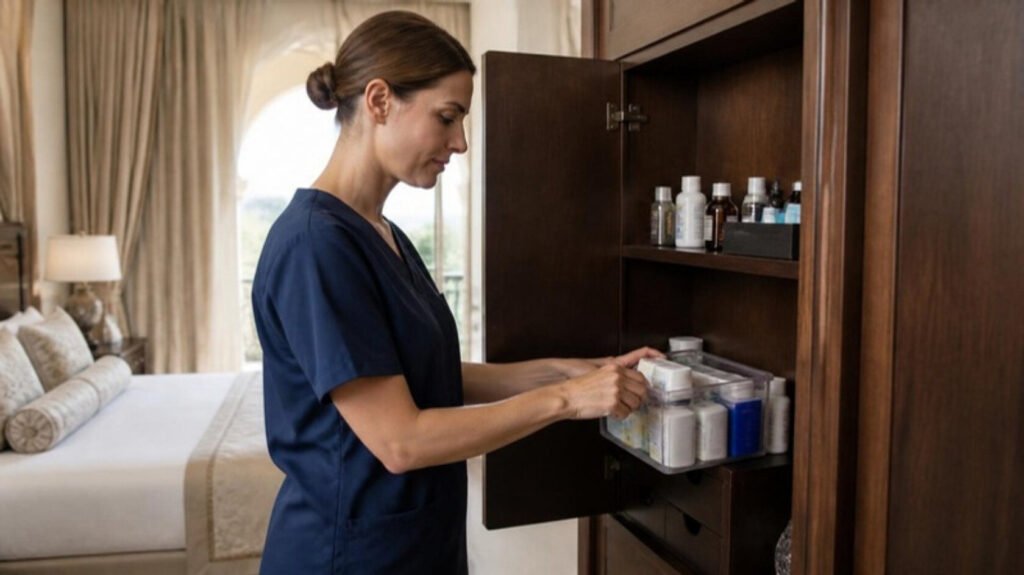
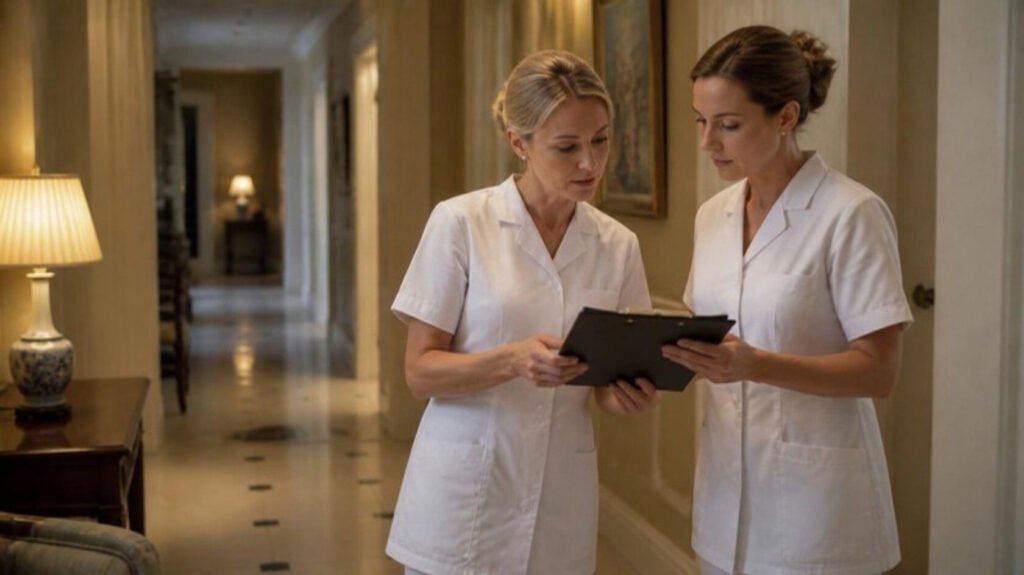
When a private family asks for a private duty nurse, what it is really asking for is continuity. The principal, a newborn, an elderly relative recovering from surgery: none of them experiences the rota. They experience whether the person at the bedside at four in the morning knows exactly what happened at four in the afternoon. In a private residence, that knowledge travels in one place only: the handover between the nurses of the family’s nursing team.
This article is about that moment. How the nursing team itself is organised is covered in our guide to how private nursing teams work: rotas, handover and rest, and what a principal’s office should provide is set out in our note on planning a private nursing team. Here we focus on what passes between one nurse and the next at every change of shift, what a well-run household expects of it, and what Western-Trained nurses considering an appointment in Saudi Arabia, the United Arab Emirates or Qatar should be ready for.
“In a residence there is no ward sister, no night coordinator and no second opinion down the corridor. The handover is the only system the household has. If it is casual, the care is casual, however gifted the nurses are.”
David Vilchez, Founder & CEO, Medical Staff Talent
Why the handover carries more weight in a residence
A household nurse is never placed alone: a single nurse “always available” is never rested, has no one to escalate to, and leaves the principal with a stranger when annual leave or illness arrives. Nursing teams are usually structured like this: 3 nurses alternating 12-hour daily shifts so that one can have a day off, or 4 nurses for 8-hour daily shifts, also allowing one to take a day off. Every appointment is permanent, live-in and single-status, with annual leave, as set out in our guide to the permanent, live-in model private families use for their clinicians.
That structure means two or three handovers every twenty-four hours, and a nurse returning from a day off who has missed a full day of the patient’s life. In a hospital, gaps are caught by the ward around the nurse. In a residence, nothing catches them except the record and the conversation at the bedside.
- Knowledge must not sit in one head. Each nurse in the team needs the patient’s baseline, the care plan and the household’s routines, so that continuity survives leave, illness and resignation.
- The return from a day off is the riskiest handover. The returning nurse needs the last twenty-four hours, not the last twelve. A good team writes for the nurse who was not there.
- The household changes as much as the patient. Visitors, travel and a move between residences can matter as much as a change in observations.
What a good handover contains
Most Western-Trained nurses will know a structured handover tool such as SBAR (Situation, Background, Assessment, Recommendation) from hospital practice. The principle carries into a residence unchanged. What changes is the content: a household handover covers the patient, but also the household around the patient.
The clinical core
- Current condition and any change since the last handover, set against the patient’s documented baseline.
- Observations taken, with times and values, and anything outside the agreed parameters.
- Medicines given, withheld or refused, checked against the medication record, never from memory.
- Feeding, sleep, elimination, mobility and pain, as relevant to the patient.
- Anything escalated to the physician, the answer received, and what remains open.
The household layer
- Changes to the family’s schedule: visitors, travel, events, a move between residences.
- Instructions received from the family or the private office, recorded exactly as given and by whom.
- Stock levels of consumables and medicines, and anything that needs reordering through the private office.
- Any concern about confidentiality, security or staff conduct that the incoming nurse needs to know.
The day-off catch-up
- A short written summary of the full period the returning nurse missed, not only the last shift.
- Any change to the care plan agreed with the physician while the nurse was off duty.
- Any change in the household: new staff, a change of residence, upcoming travel.
The standard that holds it together
The handover is written first and spoken second. The spoken handover happens face to face, ideally at the bedside, and both nurses sign the record. Professional regulators across the UK, Europe, Australia, New Zealand, the United States and Canada already require clear and accurate records (in the UK, the NMC Code); a well-run household simply makes that standard non-negotiable at every changeover. Where the records are held, and by whom, is settled by the family’s own office and advisers before the first shift; they are never the private property of any one nurse.
| Moment | What the outgoing nurse provides | What the incoming nurse confirms |
|---|---|---|
| Routine change of shift | Written record of the shift, then a bedside briefing | Patient seen, medication record checked, record signed |
| Return from a day off | Summary of the full period missed, plus care-plan changes | Questions asked before taking over, record signed |
| Before travel or a move between residences | Medicines and equipment list, travel plan, escalation contacts at the destination | Kit checked against the list, contacts confirmed |
| After an escalation | What was escalated, to whom, the answer and what remains open | Open items taken over by name |
Working as one team across the handovers
A nursing team works only if the nurses trust each other’s judgement. That is not left to chance. When we shortlist for a team appointment, we look at the team as well as the individuals: comparable clinical depth, compatible communication styles, and a shared understanding of where their scope ends and the physician’s begins.
- Agree the care plan, then follow it. Nurses improvising in different directions is worse than one. Disagreements go to the physician, not into divergent practice.
- Never hand over a problem you have not named. If something feels wrong but you cannot yet say why, say exactly that. A colleague cannot watch for what they have not been told.
- Protect each other’s rest. The off-duty nurse is off duty, and the nurse on a day off is genuinely off. A household that routinely wakes the resting nurse has a structure problem, and it should be raised with the private office, calmly and early.
- Speak with one voice to the family. Families notice inconsistency immediately. Agree within the team how updates are given and by whom.
Picture a team of three nurses caring for an elderly relative after a hip operation. The nurse returning from a day off finds a two-paragraph summary of the previous twenty-four hours, a note that the physician has reduced one medicine, and a reminder that the family moves to its second residence in two days. The bedside handover takes ten minutes and the returning nurse starts the shift with nothing to guess. That is the standard a household should expect.
What households should put in the brief
- The handover standard: written and verbal, where it takes place, and who signs.
- How the day-off catch-up is recorded for the returning nurse.
- The escalation route: the named physician, and what happens out of hours.
- Where clinical records are held, and by whom.
- How leave, training and illness are covered within the nursing team.
Households and their advisers can find the wider framework on our private family and family office medical staffing page, and the reasoning behind team size in our guide to reading a private duty nursing brief correctly.
For nurses: the package and the life around the handover
Nursing packages start from €5,000 a month. Live-in accommodation is free, with your own private quarters in the residence, medical insurance is covered (professional indemnity insurance is not included), and flights and travel are always paid for by the family. The salary is agreed directly between the family and the clinician; each clinician should take advice from their own tax adviser on whether the income is taxable in their circumstances.
Families look for nurses who can start within six weeks, have full flexibility, and are able to relocate alone and travel worldwide with the family at any time. Emergency experience is desirable. If you would like to be considered together with a trusted colleague, tell us when you apply: each application is still assessed individually, and the team is ultimately agreed with the household.
Where Medical Staff Talent fits
We identify, verify and introduce Western-Trained nurses to private families in Saudi Arabia, the UAE and Qatar, and with the family across Europe and on international travel. Medical Staff Talent introduces and verifies clinicians. The engagement is contracted directly between the family and the clinician, and all local arrangements (visa, licensed entity, coordination with local clinics) remain with the family’s own office and advisers.
Are you a private duty, neonatal or critical care nurse considering a household appointment? Send us your CV in confidence through our CV form.
Frequently asked questions
How is a private nursing team usually structured?
Nursing teams are usually structured like this: 3 nurses alternating 12-hour daily shifts so that one can have a day off, or 4 nurses for 8-hour daily shifts, also allowing one to take a day off.
How long should a handover between nurses take?
Long enough to be complete. For a stable patient a structured bedside handover may take a short time; after an eventful shift, a day off or before a move between residences it will take longer. What matters is that it is written first, spoken face to face, and signed by both nurses.
What does a nurse returning from a day off need?
A written summary of the full period missed, any change to the care plan agreed with the physician, and any change in the household’s schedule, followed by a bedside handover before taking over.
Can I apply together with a trusted colleague?
Yes. Tell us you would like to be considered together, and we will assess you both. Each application is still assessed individually, and the team is ultimately agreed with the household.
What happens if the nurses disagree about care?
Clinical disagreements are escalated to the household’s named physician rather than resolved by divergent practice. A good care plan and a clear escalation route make this rare.
Further reading: How private nursing teams work | Neonatal and paediatric private duty nursing | Private duty nurse for a private family
For Family Offices & Chiefs of Staff
Commissioning a Private Medical Appointment for a Household?
The Household Medical Commissioning Brief sets out how to appoint a private clinical team without exposing the principal: the permanent, live-in model in which clinicians travel continuously with the family, verification and references, how private nursing teams are organised, and a twelve-point commissioning checklist. It names no family and no residence.