By David Vilchez, Founder & CEO, Medical Staff Talent
When a private family in Saudi Arabia, the UAE or Qatar asks us for a sports physiotherapist, the brief rarely mentions a professional team or a competition calendar. It describes people. A principal in his fifties who plays padel four evenings a week and wants his shoulder to keep up. A wife who rides and has started to feel her lower back after long hacks. A son who sails and trains in the gym between regattas. And, almost always, an older relative who simply wants to stay mobile, steady on her feet and independent.
This article is written for UK & European-trained physiotherapists, and osteopaths, with a sports background who want to understand what a sports physiotherapist private family Gulf appointment really involves. It covers the clinical scope families ask for, how the day is organised, what families require, the salary band and how an introduction happens.
Medical Staff Talent in one line: Exclusively sourcing UK & European-trained Private & Concierge Physicians, Physiotherapists & Osteopaths, and Private & Maternity Nurses for Private Families across the GCC.
Why sports physiotherapy matters in a private family household
Many principals in the region are genuinely active. Padel and tennis are played most evenings, golf fills the cooler months, and riding, sailing and structured gym training are part of family life. These are amateur athletes with demanding schedules, long flights and little patience for an injury that keeps them off court for six weeks.
What they want is not a rehabilitation service that appears after something breaks. They want a clinician who knows how their bodies move, notices small changes early and keeps them playing. The same household usually includes parents or grandparents for whom the goal is different but the method is similar: keep joints moving, keep balance sharp, keep falls away. A physiotherapist who lives with the family and travels with them can offer that continuity in a way no outpatient appointment can.
The clinical scope: manual therapy, movement and injury prevention
The briefs we receive for this profile are remarkably consistent. The core of the role is hands-on and movement-based, with strength and conditioning a smaller part of the work.
Manual therapy
- Soft tissue release for the forearms, hips, calves and thoracic spine that padel, golf and tennis load day after day.
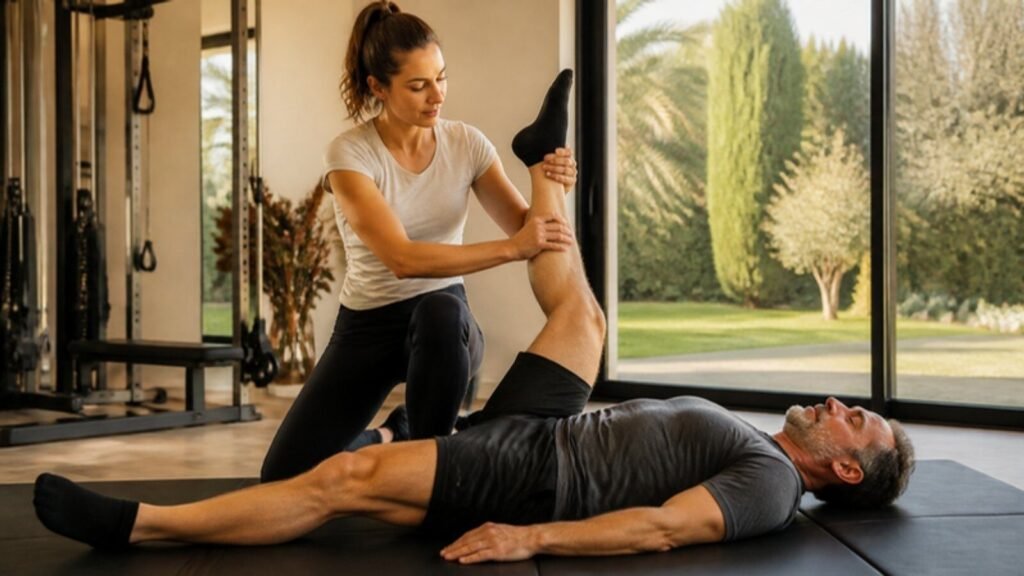
- Assisted stretching, often daily, before play or after travel.
- Joint mobilisation for shoulders, hips, thoracic spine and ankles, always within your training and the patient’s informed consent.
Movement and control
- Active mobility work so that range gained on the mat is owned in movement.
- Neuromuscular techniques for movement control: timing, sequencing and stability under load.
- Breathing and core control, particularly for golfers and riders and for principals who carry stress in the neck and back.
- Proprioception and balance training, from single-leg work for a tennis player to falls prevention for an older relative.
Assessment and prevention
- Movement analysis and biomechanical assessment: the golf swing, the padel overhead, the rider’s position, the gait of an older family member.
- Corrective exercise built on what the assessment shows, kept short enough to be done consistently.
- Injury prevention planned around the family’s sporting season and travel.
Strength and conditioning, in proportion
Families do ask for strength work, and you should be comfortable programming it. But it is a smaller part of the role. If the household already has a personal trainer, your job is to guide what they do, not to replace them. Clinicians whose main interest is high-volume conditioning tend to be happier in a performance gym.
Profiles that fit well include sports and MSK physiotherapists from professional or semi-professional clubs, national sports institutes, private sports clinics and manual therapy practices; physiotherapists with postgraduate training in manual therapy, sports physiotherapy or movement analysis; and osteopaths with solid sports and exercise experience. You can read more about how we assess these profiles on our Physiotherapists and Osteopaths pages.
What the day looks like inside a residence
Picture a physiotherapist joining a family in Dubai whose principal plays padel most evenings and whose mother, in her late seventies, has had two near-falls in the past year. A typical day might run like this:
- Early morning: mobility and breathing session with the principal before his working day, in the gym of the residence.
- Mid-morning: balance and proprioception programme for his mother, followed by a short walk together in the garden.
- Midday: notes, programme updates and a check-in with the family’s physician or household manager.
- Late afternoon: soft tissue release and assisted stretching before padel; a quick look at a new movement pattern on video.
- Evening: brief recovery work after play, or a session with another family member who is training for a sailing event.
A few weeks later the family leaves for the summer in Europe. The programme continues in a villa, at a golf resort, on a yacht, with the essentials packed in a single case. This is a hypothetical example, but it reflects the rhythm of the work: one-to-one time, continuity and constant movement between residences and countries.
Flights and travel are always paid for by the family. A strict NDA covers the family, the residence and your movements.
Sports physiotherapy at home versus in a clinic
| Sports or MSK clinic | Private family residence in the Gulf | |
|---|---|---|
| Caseload | Many patients a day, often first presentations | A few people in one household, known in depth |
| Focus | Treating injuries once they happen | Prevention, movement quality and keeping people active |
| Session length | Fixed slots | As long as the plan requires, often twice a day |
| Manual therapy | Squeezed between assessment and exercise | Central to the role, delivered daily |
| Setting | Treatment room and clinic gym | Private gym, treatment room, court, pool or garden |
| Team | Clinic colleagues | Family physician, nurses, trainer, household team |
| Travel | None | Part of the role, wherever the family goes |
| Confidentiality | Standard clinical confidentiality | Strict NDA covering family, residence and movements |
Searching for sports physiotherapist jobs in Dubai, Saudi Arabia or Qatar
If you search for sports physiotherapist jobs in Dubai, physiotherapist jobs in Saudi Arabia with a private family or a manual therapy physiotherapist role in Qatar, you will mostly find clinic and club vacancies. Private family appointments are rarely advertised in the usual places. Families value discretion, and they usually reach clinicians through a small number of trusted introductions. That is why a clear, well-structured CV that states your manual therapy and movement skills matters more than the number of applications you send.
For a closer look at how these posts are set up, see how families structure a permanent private physiotherapist appointment. If your interest also extends to pelvic and postnatal care, our article on women’s health physiotherapist jobs with private families covers that counterpart role.
What families require from every clinician
Whatever the specialty, families apply the same conditions, and we apply them to every candidate:
- Start within about six weeks of an offer.
- Total flexibility on hours and destinations. The family’s diary sets the pattern.
- Relocate alone and travel with the family. Every role is live-in and single-status, so a partner or children do not relocate with you. Once in post, you travel continuously with the family across several countries.
- A physiotherapy or osteopathy qualification obtained in the UK or Europe, with valid registration in the country where you trained. What counts is where you trained, not your nationality.
Fluent English for daily clinical work is expected. Arabic is an advantage in some households but not a requirement. For a frank account of the living arrangements, read what live-in and single-status really involve.
Remuneration
As a market reference, physiotherapists and osteopaths in private family appointments earn from £60,000 a year gross, depending on experience. Years of practice, the depth of your manual therapy and sports training, and the complexity of the brief all shape the final figure.
These are permanent roles with annual leave; the contract is renewed each year, and accommodation in or right next to the residence is provided free of charge. Flights and travel are always paid for by the family, and medical insurance is covered; professional indemnity insurance is not included. The salary is agreed directly between the family and the clinician; each clinician should take advice from their own tax adviser on whether the income is taxable in their circumstances.
Who this work suits
It suits experienced physiotherapists who love hands-on work, who read movement well and who enjoy keeping a small group of people active over years rather than treating many people once. It suits clinicians who are comfortable as the only physiotherapist in the house, who adapt easily to a new gym, court or hotel room, and who keep their own professional development going without a department around them.
It does not suit clinicians who need a fixed timetable, who draw their energy from a large team, or whose personal commitments make relocating alone impractical. That is not a criticism; it simply means a clinic or club role is the better fit.
How the introduction works
Medical Staff Talent introduces and verifies clinicians. The engagement is contracted directly between the family and the clinician, and all local arrangements (visa, licensed entity, coordination with local clinics) remain with the family’s own office and advisers.
In practice, you send your CV through our confidential form. We read it personally, speak with you, verify your qualification, registration and references at source, and introduce you to a family only when a brief matches your experience, and only with your agreement. We never name a family publicly and never share your profile without your consent. In your CV, list your manual therapy and sports courses, the sports and populations you have worked with, and the assessment tools you use.
Frequently asked questions
Do I need elite sport experience?
No. Experience with professional athletes helps, but families are mostly active amateurs and older relatives. Solid sports and MSK experience, strong manual therapy skills and a clear approach to movement and prevention matter more.
Is the role mostly strength and conditioning?
No. The core is manual therapy, assisted stretching, mobility, movement control, balance and injury prevention. Strength and conditioning is a smaller part of the role, often in coordination with a personal trainer.
How much does a sports physiotherapist earn with a private family?
As a market reference, from £60,000 a year gross, depending on experience. Accommodation is free, flights and travel are paid for by the family, and medical insurance is covered. The salary is agreed directly between the family and the clinician.
Can osteopaths apply?
Yes. UK & European-trained osteopaths with sports, exercise and movement experience are considered for these briefs on the same terms as physiotherapists.
Can my partner relocate with me?
No. Every role is live-in and single-status: the clinician relocates alone and lives in, or right next to, the family’s residence.
Is Medical Staff Talent my employer?
No. Medical Staff Talent introduces and verifies clinicians. The engagement is contracted directly between the family and the clinician, and all local arrangements remain with the family’s own office and advisers.
Apply in confidence
If you are a UK or European-trained physiotherapist or osteopath with a sports and manual therapy background, can start within about six weeks, and are ready to relocate alone and travel with a family, we would like to hear from you. Send us your CV in confidence.