
Private Yacht Physiotherapy: The 2026 Guide for UK & European-Trained Clinicians Working at Sea
A great deal has been written about private duty nursing aboard superyachts. Almost nothing has been written about physiotherapy at sea — despite the fact that, in the mandates we handle for Gulf principals, the physiotherapist is frequently the clinician who travels, and the nurse the one who does not.
The reason is structural. A principal in their seventies with a spinal fusion, a chronic hip, or a post-stroke gait deficit does not stop needing rehabilitation because the household has moved aboard for the summer. Continuity of a rehabilitation programme is harder to interrupt than continuity of medication oversight — a missed six weeks of loaded, progressive work costs measurable function. Households that understand this build the physiotherapist into the travel plan.
This guide sets out what the role actually involves, the three regulatory layers a clinician must satisfy, what the work pays, and the questions worth asking before signing.
The seasonal architecture nobody explains in the advert
Gulf household mandates with a maritime component almost never describe a life at sea. They describe a calendar.
The pattern is consistent enough to plan around: the vessel operates the Mediterranean through the European summer, then the household returns to its principal residence — Dubai, Abu Dhabi, Riyadh, Jeddah or Doha — for the Gulf winter season. The clinician travels with the family — one of the seven deployment models private families use for their clinicians. Some mandates add Caribbean or Red Sea legs; a number now include Saudi Arabia’s western coastline as the Kingdom’s own luxury marine infrastructure matures.
You are not being recruited to work on a yacht. You are being recruited into a household that happens to spend part of its year at sea. That distinction governs your contract, your licensing obligations, and your life.
The practical consequence is that a maritime physiotherapy role is a relocation decision, not a seasonal adventure. For most of the year you will be practising ashore in the Gulf, under a Gulf health regulator, living in the principal’s compound or in accommodation the household provides. The Mediterranean months are the exception, not the substance.
What the clinical work actually is
The scope is narrower and deeper than hospital practice, and the constraints are physical rather than administrative.
- Daily one-to-one sessions with a single principal, occasionally extending to a spouse or an elderly parent within the same household.
- Programme continuity across environments — the same progressive plan delivered in a residence, a treatment room ashore, and a converted space aboard.
- Manual therapy and neuromuscular work as the primary modality, since heavy rehabilitation equipment rarely survives the space constraints of even a large vessel.
- Mobility and falls risk management in an environment that moves — decks, companionways, and swell introduce hazards no clinic protocol anticipates.
- Longevity and performance work for younger principals: strength maintenance, movement quality, and recovery around a demanding travel schedule.
- Documentation and handover to the household’s wider medical team, often including a private physician and a private duty nurse.
What it is not: you are not the vessel’s medical officer. That is a separate function, and conflating the two is one of the more common misunderstandings we correct at brief stage.
The three regulatory layers
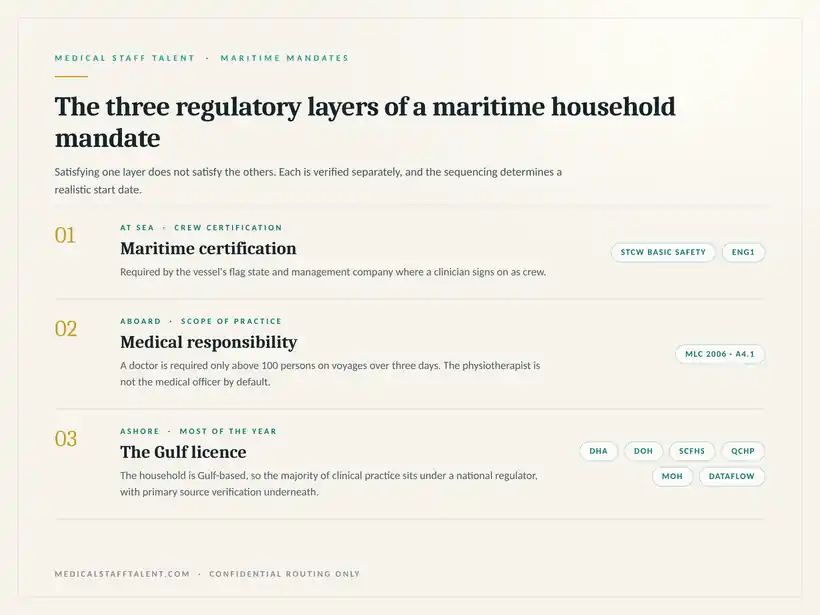
This is where most candidates — and a fair number of recruiters — get it wrong. A maritime household role sits inside three distinct regulatory frames, and satisfying one does not satisfy the others.
Layer one: maritime crew certification
If you are signed on as crew, the vessel’s flag state and management company will generally require two documents before you set foot aboard:
- STCW Basic Safety Training — a short course covering personal survival techniques, fire fighting and prevention, elementary first aid, personal safety and social responsibility, and security awareness. Certification is typically valid for five years, after which a refresher in fire fighting and sea survival is required.
- ENG1 seafarer medical certificate — a fitness-for-sea-service examination issued by an approved doctor, assessing hearing, sight and colour vision alongside general fitness. Validity is usually up to two years.
Whether these are mandatory depends on how the vessel is registered and operated. Commercially registered yachts available for charter fall within the scope of the Maritime Labour Convention, 2006; privately used pleasure vessels generally do not. In practice, most professionally managed superyachts apply the standard regardless, and a clinician holding both documents is materially easier to place. Confirm the position with the vessel’s management company before assuming either way.
Layer two: who carries medical responsibility
Under Standard A4.1 of the Maritime Labour Convention, a ship must carry a qualified medical doctor where it carries 100 or more persons and is ordinarily engaged on international voyages of more than three days’ duration. Private yachts almost never meet that threshold. Where no doctor is carried, the vessel must have either a seafarer in charge of medical care and the administration of medicines, or a seafarer competent to provide medical first aid — with training meeting STCW requirements.
A physiotherapist is not that person by default. If a contract implies otherwise — if you are expected to hold the medical chest, manage emergencies, or act as the responsible person for medical care — that is a scope-of-practice question to resolve in writing before you accept, not a detail to discover at sea.
Layer three: the Gulf licence that governs most of your year
Because the household is Gulf-based, the majority of your clinical practice will take place ashore under a national regulator: DHA in Dubai, DOH in Abu Dhabi, SCFHS in Saudi Arabia, QCHP in Qatar. Primary source verification through Dataflow sits underneath all of them.
The maritime component does not exempt you from this, and the sequencing matters: licensing and mobilisation timelines are what determine your realistic start date, not the summer season. We set out the comparative pathways in the complete GCC medical licensing comparison, and the physiotherapy-specific route in DHA Physiotherapist Licensing: 2026 Elite Path. Structured guidance on the process is available through our Gulf healthcare licensing support.
What the work pays
Maritime household mandates price against the mandate, not a departmental grade — which is why they sit at the top of the physiotherapy range. All figures below are in Pounds Sterling, tax-free, and indicative.
| Setting | Indicative Range (Tax-Free, £) |
|---|---|
| Private duty physiotherapist, single principal (shore-based) | £55,000 – £90,000 |
| VIP one-to-one care with travel component, including Mediterranean yacht season | £60,000 – £110,000 |
Two things distinguish these packages from a hospital offer. First, accommodation, meals, transport and travel are typically bundled into the arrangement rather than itemised as allowances — which makes headline-to-headline comparison against a hospital base salary misleading in both directions. Second, the variance within the band is driven almost entirely by scope: number of principals, travel intensity, on-call expectation, and whether the role carries any supervisory responsibility over a wider wellness team.
Full comparative benchmarks across hospital, boutique clinic and private duty settings are set out in Physiotherapy Salary Benchmarks in the Gulf.
The constraints candidates underestimate
Space
Even on a 70-metre vessel, the treatment area is a converted cabin, a gym shared with crew and guests, or a section of deck. Plate-loaded equipment and plinths with hydraulic height adjustment are the exception. Clinicians who rely on apparatus struggle; clinicians whose hands are their instrument do not.
Proximity
You live where you work, alongside the household and the crew, for the duration of the season. There is no commute, and no boundary the commute used to create. The clinicians who thrive in these mandates are the ones who are comfortable being present without being visible.
Confidentiality
Every mandate of this type carries a non-disclosure agreement, and it is not decorative. Nothing about the principal, the household, the vessel, its movements or its guests is shareable — including with family, and including in anonymised form. This constraint outlasts the contract.
Isolation from professional community
Single-clinician practice means no departmental peer review, no corridor consultation, no informal second opinion. CPD obligations for licence renewal continue regardless, and need to be planned around a travel schedule rather than fitted into one.
What households actually screen for
Clinical credentials get you considered. They rarely get you selected. In our experience of these mandates, the differentiating factors are consistently behavioural:
- Discretion as a demonstrated habit, not a stated value — evidenced by how a candidate discusses previous private clients, which is often the single most revealing question in the process.
- Calm, complete record-keeping that a private physician can pick up without explanation.
- Cultural fluency with Gulf household norms — hierarchy, gender considerations around treatment, prayer times, Ramadan scheduling, and the rhythm of a household that operates late.
- Adaptability without complaint, since itineraries change at short notice and a session moves or disappears accordingly.
- Language, where Arabic is a genuine differentiator and English fluency is assumed.
The most technically accomplished physiotherapist we have ever interviewed for a maritime mandate was declined at final stage. The household’s concern was not clinical. It was that he talked, at length and with enthusiasm, about a previous client.
Seven questions to resolve before you sign
- Which regulator, and who manages the licence? Confirm the emirate or jurisdiction of the principal residence and where responsibility for Dataflow and registration sits.
- What is the annual itinerary? Months at sea, months ashore, and the notice period for changes.
- What is my scope of practice aboard? Explicitly, in writing, and explicitly excluding responsibility for medical care beyond your registration.
- What equipment will exist, and who procures it? A budget line for a portable plinth and resistance apparatus is a reasonable ask, and a household’s response is diagnostic.
- What are the accommodation arrangements ashore and aboard? Crew cabin, guest cabin, and residence provision are three materially different propositions.
- What is the leave structure? Continuous seasons without rotation are common and should be priced accordingly.
- Is the contract permanent, and with whom? Household, family office, and vessel management company are different counterparties with different security.
The wider evaluation framework — session structure, autonomy, contract terms — is set out in Evaluating a Physiotherapy Job Offer in the Gulf. The structural comparison against hospital work is in Private Duty Physiotherapy vs. Hospital-Based Roles.
Is this the right move for you
Maritime household physiotherapy suits a specific clinician: senior enough to work without supervision, manual enough to work without apparatus, temperamentally suited to a single long-term therapeutic relationship, and genuinely comfortable inside a private environment where discretion is the price of entry.
It does not suit clinicians who need caseload variety, departmental structure, a defined end to the working day, or a professional community around them. Neither profile is better. They are different careers, and the offer letter will not tell you which one you are being offered.
For the parallel nursing pathway, see Private Yacht Medical Staffing. For the employer-side view of how these mandates are constructed, see Maritime Medicine Recruitment GCC.
Confidential representation
We source UK & European-trained physiotherapists exclusively for Private Families across the GCC — including the maritime mandates described here. Representation is confidential, and no profile is shared with any principal without explicit consent.
Review current scope and settings at Physiotherapists, or register directly through the confidential candidate portal.
All figures are indicative, tax-free, and subject to negotiation based on seniority, setting and specific mandate. They do not constitute an offer or guarantee of compensation. Regulatory requirements described here are summarised for orientation and vary by flag state, vessel registration and jurisdiction — confirm your position with the relevant authority, the vessel’s management company, and the applicable health regulator. Last reviewed August 2026; scheduled for review February 2027.
Companion Guide
Placement Inside a Private Family Runs on Different Rules
Protocol, confidentiality and NDA standards, and the pathways that lead into private family residences.
Download the Private Family Companion Guide →Commissioning on behalf of a household? Family offices and chiefs of staff can request The Household Medical Commissioning Brief. Advisers introducing a principal: Referral & Introduction Partners.