
By David Vilchez, Founder, Medical Staff Talent
→ Sports Physiotherapist (Manual & Movement Therapy) — Private Family, Dubai
Most families think about confidentiality once, at the moment a clinician signs a non-disclosure agreement. The document is filed, and the office moves on. Yet in a private residence the clinician is the person who knows more about the family’s health than anyone outside the medical circle, sees the household at its most private, and travels with the family to places it would rather nobody knew it had been. A signature on the first day is necessary. It is not, on its own, a confidentiality arrangement.
This article is for family offices, chiefs of staff and household managers who want confidentiality in private medical care to work in practice. It covers the three layers that matter: the agreement, the records and the circle of people who need to know. It complements our page on confidentiality, NDAs and vetting, which describes how we protect the family during the search itself.
Why medical confidentiality is different in a household
Western-Trained clinicians already work under a professional duty of confidentiality. The General Medical Council, for example, publishes detailed guidance on confidentiality for doctors, and the nursing, physiotherapy and osteopathy regulators set equivalent standards. That duty is the foundation. A household adds things the professional codes were not written for:
- The clinician lives where they work. They see conversations, visitors and family matters that have nothing to do with the patient.
- Many people are nearby. Household staff, drivers, protection officers and other advisers each have a legitimate reason to know some things and no reason to know others.
- Information travels. The family moves between residences and countries, and so do the notes.
- The relationship ends. Confidentiality must outlast the appointment by many years.
Layer one: the agreement
The NDA a clinician signs should be written for the household, not adapted from a commercial template. In our experience, effective agreements share a few features.
What a household NDA should cover
- Scope. Health information, and also the family’s identity, residences, travel, guests, security arrangements and private life.
- Channels. Social media, personal messaging, photographs, conversations with friends and family at home, and future publications or interviews.
- Duration. Obligations that continue after the appointment ends.
- Professional carve-outs. Clear provision for the disclosures a clinician is professionally obliged to make, and for sharing clinical information with the family’s physician and specialists. An agreement that appears to forbid proper clinical communication creates risk for the patient.
- Return of material. What happens to notes, devices and documents when the appointment ends.
The agreement should be drafted by the family’s own advisers. Tone matters as much as content: experienced clinicians sign willingly when the document reads as a clear statement of how the household works, and hesitate when it reads as a threat.
Nursing teams, under the same terms
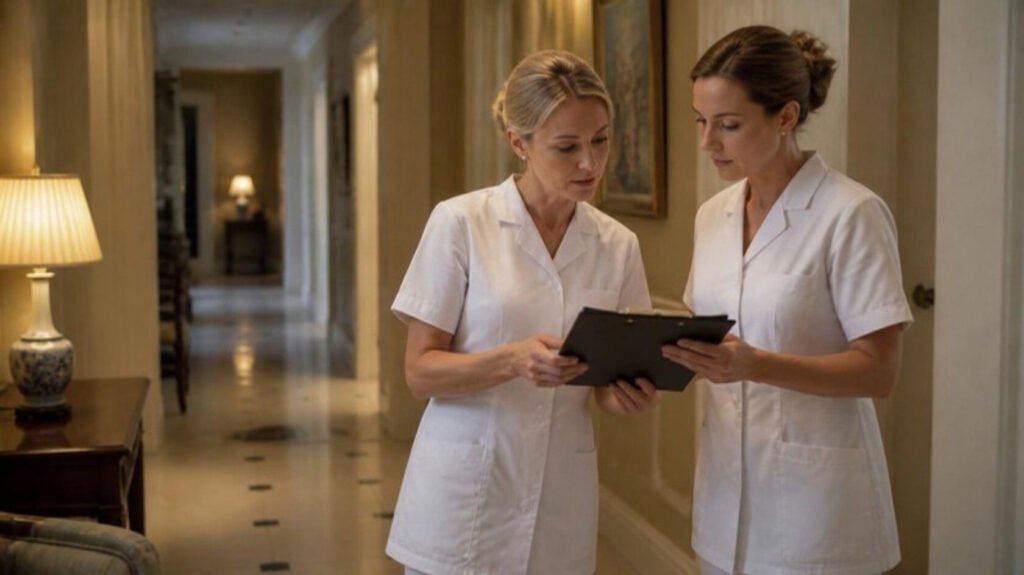
Private and maternity nurses are always appointed as a team of three or four who alternate shifts, each bound by a strict NDA on identical terms. What they share at handover stays within the clinical relationship.
Layer two: the records
Clinicians are required to keep clear and accurate records. In a household, the question is not whether records exist but where they live, who can read them and what happens to them later.
| Question | Decision to make at the outset |
|---|---|
| Where are records held? | A single agreed location, physical or digital, under the household’s control |
| Who can read them? | The treating clinicians and the family’s physician; others only with the patient’s agreement |
| How do they travel? | A concise clinical summary travels with the clinician; the full record stays secure |
| Which devices are used? | Devices supplied or approved by the household, not personal phones for clinical notes |
| What happens at the end? | A handover to the successor or the family’s physician, and return of material |
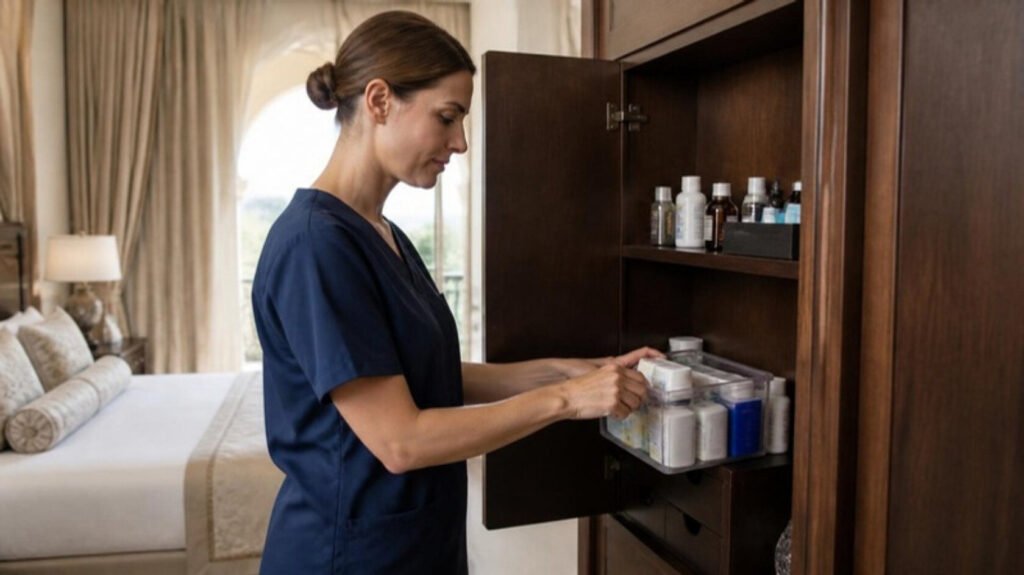
Two practical points come up repeatedly. First, personal messaging apps are where most leaks begin: a photograph of a medication box sent to a colleague for advice, a voice note to a specialist. The household should provide a secure alternative. Second, the end of the appointment is the moment of greatest risk, because notes and devices are easily forgotten when someone leaves. Agree the exit arrangements on the first day.
Layer three: need-to-know
The clinician is not the only person in the household who handles health information. Drivers know which clinic was visited. Protection officers know when the principal is unwell. Household staff notice medication deliveries. Confidentiality is a household discipline, not a clinical one.
Mapping the circle
A useful exercise for the chief of staff is to draw the circle explicitly:
- Inner circle: the patient, the treating clinicians, the family’s physician and the family members the patient chooses.
- Operational circle: the chief of staff or household manager, who needs to know enough to plan but not the clinical detail.
- Logistical circle: drivers, protection, travel and household staff, who need to know only where and when.
Each circle receives only what it needs. The clinician should know who sits in which circle, so that they are never placed in the position of deciding alone whether a household colleague is entitled to an answer.
“Clinicians do not leak information because they are careless. They leak it when nobody has told them who is allowed to know. Draw the circle, and most of the risk disappears.”
David Vilchez, Founder, Medical Staff Talent
Guests, visitors and the wider family
Some of the most delicate moments for a clinician have nothing to do with records. A guest at dinner asks how the principal is feeling. A relative who is not in the inner circle asks the nurse directly about a test result. A member of another household’s staff, travelling with visiting friends, strikes up a conversation about the family’s plans. A clinician who has not been briefed must improvise, and improvisation is where discretion fails.
The office can prevent most of this with a short, agreed form of words the clinician may use (“I’m afraid I can’t discuss that; the family’s office will be happy to help”), a clear statement of which family members the patient has authorised to receive clinical information, and a named person in the office to whom any enquiry is referred. Clinicians welcome this: it protects them as much as the family.
Confidentiality when the family travels
Travel multiplies the exposure. Hotels, aircraft, yachts and rented villas bring new staff, new networks and new devices. Before each trip, the office should confirm how the clinician’s notes travel, which channel is used for clinical communication abroad, and how medicines and medical equipment are packed so that they do not advertise the family’s health to everyone who handles the luggage.
Confidentiality during the search
Discretion starts long before the clinician arrives. A search that names the family, circulates a detailed brief widely or approaches the same clinicians through several agencies at once undermines confidentiality before anyone has signed anything. We describe how a search can be run without exposing the family in our step-by-step guide to the confidential hiring process for private families. Where the request comes through a household staffing firm, concierge or private-client adviser, confidential routing through a single intermediary helps further; see our page for referral and introduction partners.
A confidentiality checklist for the office
- A household NDA drafted by the family’s advisers, covering health, identity, residences, travel and private life.
- Professional carve-outs that allow proper clinical communication.
- A single agreed location for records, under the household’s control.
- Approved devices and a secure channel for clinical communication.
- A written map of who may know what.
- Agreed exit arrangements: handover, return of material, continuing obligations.
- A named person in the office the clinician can ask when unsure.
How the engagement works
Medical Staff Talent introduces and verifies clinicians. The engagement is contracted directly between the family and the clinician, and all local arrangements (visa, licensed entity, coordination with local clinics) remain with the family’s own office and advisers.
Our part is to run the search discreetly, verify each clinician’s registration, references and clinical history, and introduce candidates who understand and accept the household’s confidentiality terms. The confidentiality agreement itself is between the family and the clinician. You can read more about the nurses we introduce on our Private & Maternity Nurses page.
Frequently asked questions
Is a professional duty of confidentiality not enough?
It is the foundation, but it was written for clinical settings. A household NDA adds the family’s identity, residences, travel and private life, and clarifies how information is handled in a home with many people in it.
Who should draft the NDA?
The family’s own advisers. It should read as a clear statement of how the household works, include professional carve-outs for proper clinical communication, and continue after the appointment ends.
Can clinicians use their own phones for notes?
It is better that they do not. The household should provide or approve devices and a secure channel for clinical communication, so that notes and images never sit in personal messaging apps.
What happens to records when the clinician leaves?
They should be handed over to the successor or the family’s physician, and all material and devices returned, according to exit arrangements agreed at the start of the appointment.
Do all the nurses in a team sign the same NDA?
Yes. Nurses are always appointed as a team, and all are bound by the same strict confidentiality terms.
Discuss a requirement in confidence
If your office is reviewing how confidentiality works around a private clinician, or preparing for a new appointment, contact David Vilchez to discuss the requirement in confidence.