By David Vilchez, Founder & CEO, Medical Staff Talent
→ Sports Physiotherapist (Manual & Movement Therapy) — Private Family, Dubai
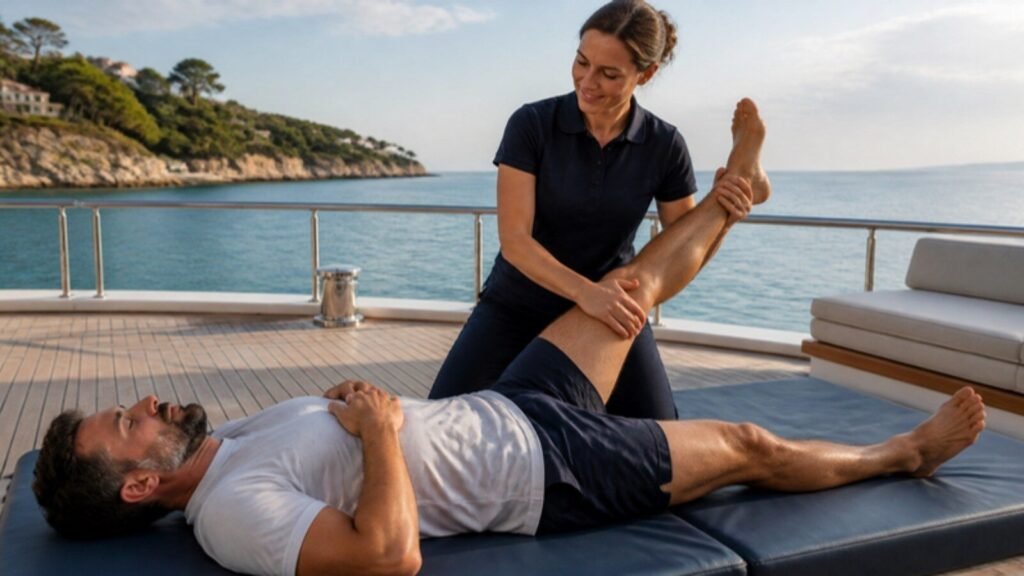
Many private families in Saudi Arabia, the UAE and Qatar have water close at hand. A family villa in Riyadh may have a shaded outdoor pool, a larger residence in Doha an indoor pool kept warm all year, and a home in Abu Dhabi a private stretch of beach. When the family travels, the water travels with them: hotel pools in London and Geneva, a summer house on the Mediterranean, sometimes a yacht.
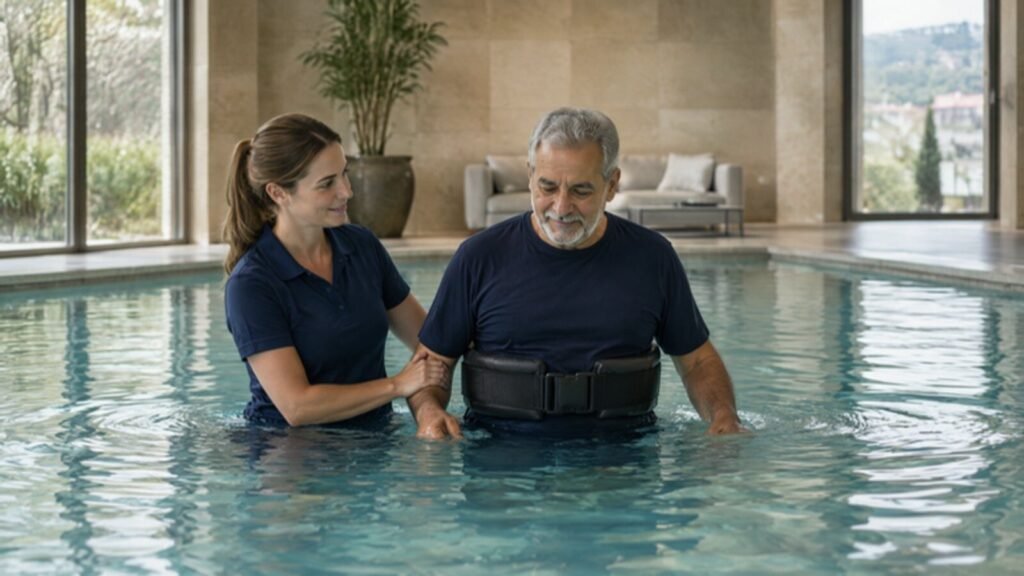
For a sports physiotherapist living with the family, that water is one of the most useful rehabilitation tools in the house. Used well, a pool lets a principal recovering from surgery move earlier and with more confidence, gives an older relative a safe place to walk without fear of falling, and offers athletic family members a recovery session that feels nothing like hard work.
Used badly, it is also a place where things can go wrong quickly. This guide looks at how a Western-Trained sports and manual therapy physiotherapist thinks about hydrotherapy in a private residence: why water helps, how to keep it safe, where it fits in the family’s week, what equipment is worth having, and how to work with the family’s doctor and household around it.
Why water helps
Water changes the way the body experiences load. Three properties do most of the work.
Buoyancy. The deeper someone stands, the less of their body weight passes through the hips, knees and spine. That means a person who finds walking on land painful or tiring can often walk, step and balance in the pool with far less discomfort. For someone returning from injury or surgery, it can allow earlier, gentler loading, but only when the surgeon or the family’s doctor agrees that the wound and the joint are ready.
Resistance. Water resists movement in every direction, and the resistance rises with speed. A slow movement is easy; a fast one is demanding. That makes it simple to grade an exercise without adding weights, and it lets the physiotherapist build strength and control through ranges of movement that might be too uncomfortable on land.
Warmth and pressure. A comfortably warm pool can help muscles relax and make movement feel easier, and the gentle pressure of the water around the legs and trunk is something many people find reassuring.
None of this replaces land-based rehabilitation. Water is a bridge: a way to start sooner, to keep moving when land work is limited, and to rebuild confidence before the work moves back onto firm ground, where everyday life and sport actually happen.
Safety first
In a private residence, the physiotherapist is often the person who sets the standard for how the pool is used in a clinical context. A few principles matter more than any exercise.
- Medical clearance. Nobody starts pool sessions after surgery, illness or injury without clearance from the surgeon or the family’s doctor. Open wounds, infection, certain heart, lung or skin conditions and continence issues are all reasons to ask first. The physiotherapist raises the question; the doctor decides.
- Water temperature. A pool that is pleasant for a swim may be too cool for a slow rehabilitation session, and a very warm pool can be tiring or unsuitable for some people. The physiotherapist agrees a sensible temperature with the household and checks it before each session.
- Slips and access. Most incidents happen getting in and out, not in the water. Non-slip surfaces, a handrail or steps, a towel and robe within reach and someone to help on the way out are basic, not optional.
- Supervision and agreed arrangements. The clinician is never alone in the water with a vulnerable person (an older relative, a child, someone with limited mobility) without arrangements agreed with the family in advance. That may mean a family member, a nurse or another member of staff present on the poolside, and it always means knowing exactly who will help in an emergency.
- Emergency readiness. A current first aid qualification, a clear plan for getting someone out of the water and knowing how to reach the family’s doctor or emergency services are part of the role.
Typical uses in a private family
- After knee or hip surgery. When the surgeon approves pool work, walking, gentle range of movement and balance in water can help a principal or relative regain confidence while land-based strength work builds alongside it.
- Back pain. For someone whose back is irritable on land, the pool can be a calmer place to move, with progressions carried back onto the mat and into the gym as symptoms settle.
- Older relatives’ mobility. Many families ask the physiotherapist to help grandparents stay active. Supported walking, balance work and simple strengthening in shallow water can be a sociable, enjoyable part of the week, always with someone present and with the doctor’s agreement.
- Athletes’ recovery sessions. Family members who play padel, tennis, football or ride competitively often enjoy a light pool session the day after a match or a long training block: easy movement, mobility and a change of environment.
- The heat months. From late spring to early autumn, outdoor training in the Gulf becomes difficult for much of the day. An indoor or shaded pool lets the family keep moving when the sun makes outdoor work unwise. Our article on training and recovery in Gulf heat covers that season in more detail.
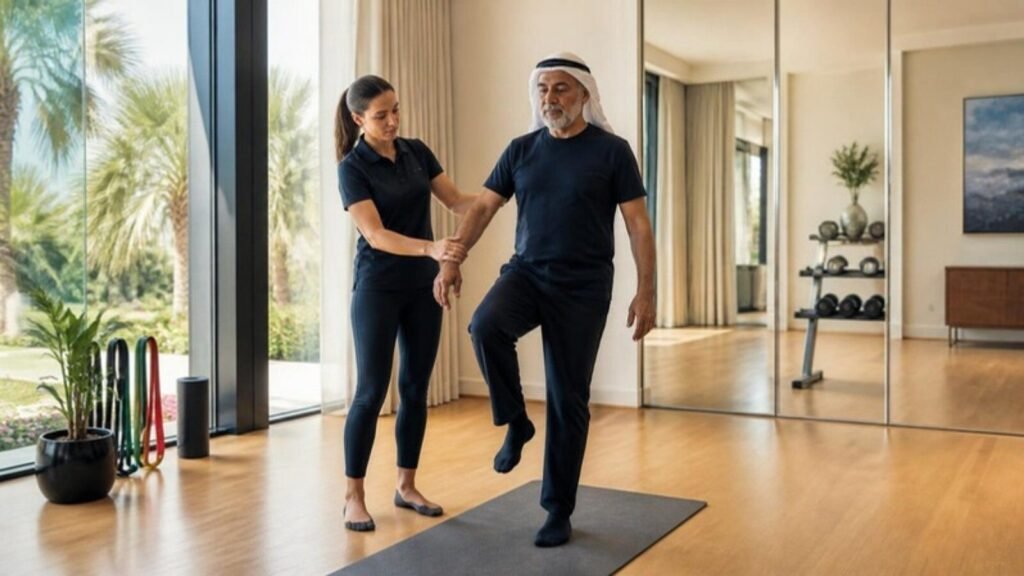
In every case, hydrotherapy is one tool within a wider programme. The physiotherapist’s job is to decide when the water helps, when it is time to move on, and how pool sessions connect with strength, mobility and sport-specific work on land.
Equipment worth having
A private pool rarely comes equipped for rehabilitation, so the physiotherapist usually puts together a small kit, agreed with the family’s office.
- Flotation belts for deep-water running and supported work.
- Noodles and floats for balance, support and gentle resistance.
- An aquatic step for step-ups and controlled loading in shallow water.
- Resistance gloves and paddles to grade upper-body and trunk work.
- Ankle cuffs or buoyancy dumbbells for added resistance or support.
Much of this packs flat and travels easily. When the family moves between homes or abroad, a belt, gloves and a few floats fit into the same bag as the portable treatment kit. Our article on the portable clinic for travelling physiotherapists explains how to build a kit that goes everywhere the family goes.
Travelling, hotel pools and the sea
A family that spends summer in Europe or winter in the mountains will not always have its own pool. The physiotherapist adapts.
Hotel pools can work well, but they are public spaces. Sessions are planned around quiet hours, with the same attention to privacy that applies everywhere else in the role. On a yacht or at a beach house, the sea may be tempting, but open water is a different environment: currents, waves, temperature and access all change the picture. Sea sessions happen only when conditions are genuinely safe, with the family’s agreement and proper supervision; otherwise the work moves to a pool or onto land.
Long-haul flights add their own strain. A short, easy pool session after arrival can be a pleasant way to loosen up and reset, alongside the other strategies in our article on travel recovery after long-haul flights.
A hypothetical case
Picture a grandfather in a family based in Doha who has recently had a hip replacement. The surgeon has set out precautions and the family’s doctor oversees his general health. In the first phase, the physiotherapist works on land within those limits, helping him walk with confidence around the residence.
When the surgeon agrees that the wound has healed and pool work is appropriate, sessions move into the family’s indoor pool. A family member or nurse is present on the poolside each time, and the household has agreed how he will get in and out safely. He starts with supported walking in chest-deep water, then gentle balance and leg exercises, enjoying a freedom of movement he has not felt for months.
As his confidence and strength improve, and with the surgeon’s and doctor’s agreement at each step, the balance shifts: fewer pool sessions, more strength and walking work on land, and eventually a short walk with the family in the garden in the cooler evening air. The water was a bridge, not the destination.
Working with the doctor and the household
Hydrotherapy in a private home involves more people than a clinic session. The surgeon and the family’s doctor make the medical decisions. The physiotherapist applies the rehabilitation, observes the response and reports back through the agreed channel. Nurses, carers or family members may be present for supervision. Pool and maintenance staff look after the water, and the house manager or family office coordinates timings and equipment.
Clear roles prevent misunderstandings. The physiotherapist does not change medical restrictions, does not run sessions that have not been cleared and keeps reports short, factual and discreet. If a personal trainer or swimming coach also works with the family, the physiotherapist agrees with them who does what, so that rehabilitation and training complement each other. Our article on working alongside the family’s personal trainer, coach and doctor goes into this in more depth.
Discretion matters here as much as anywhere. A pool is a private space, and a family member in rehabilitation may feel vulnerable. Professional dress, careful scheduling and complete confidentiality are part of the job.
Who we look for
We look for Western-Trained sports and manual therapy physiotherapists, trained in the UK, Europe, Australia, New Zealand, the United States or Canada. What counts is where you trained, not your nationality.
The roles are permanent, live-in and single-status: you relocate alone and travel with the family between their homes and abroad. Experience with elite athletes, professional teams or high-profile clients is a strong advantage, and hydrotherapy or aquatic rehabilitation experience is valued by families with pools at home.
The salary is from £60,000 a year gross, depending on experience, with free private accommodation, flights and travel paid, and medical insurance covered. Professional indemnity insurance is not included. The salary is agreed directly between the family and the clinician; each clinician should take advice from their own tax adviser on whether the income is taxable in their circumstances.
Medical Staff Talent introduces and verifies clinicians. The engagement is contracted directly between the family and the clinician, and all local arrangements (visa, licensed entity, coordination with local clinics) remain with the family’s own office and advisers.
See the current sports physiotherapist role, and for further reading, our article on discretion with high-profile clients.
Frequently asked questions
Do I need hydrotherapy experience?
It is an advantage rather than a requirement. Experience of aquatic rehabilitation in a hospital, sports club or private practice shows that you understand both the benefits and the safety demands of working in water, but a strong sports and manual therapy background matters most.
Is hydrotherapy the main part of the role?
No. Hydrotherapy is one tool among many. The role covers the family’s sport, rehabilitation and recovery needs on land and in water, and pool sessions are used when they genuinely help, always with medical clearance from the surgeon or the family’s doctor.
Who can apply?
Western-Trained physiotherapists with a degree from the UK, Europe, Australia, New Zealand, the United States or Canada and current registration in the country where they trained. What counts is where you trained, not your nationality.
What is the salary?
From £60,000 a year gross, depending on experience, with free private accommodation, flights and travel paid, and medical insurance covered; professional indemnity insurance is not included. The salary is agreed directly between the family and the clinician; each clinician should take advice from their own tax adviser on whether the income is taxable in their circumstances.
Send your CV in confidence
If you are a Western-Trained sports physiotherapist who knows how to use water as part of rehabilitation, send your CV in confidence. Every CV is read personally.
Send your CV in confidence