By David Vilchez, Founder & CEO, Medical Staff Talent
→ Sports Physiotherapist (Manual & Movement Therapy) — Private Family, Dubai
A private family based in Saudi Arabia, the United Arab Emirates or Qatar can spend a winter between Riyadh and Dubai, a spring in London, a summer on the Mediterranean and an autumn somewhere else entirely. Every move means hours of sitting, dry cabin air, a new time zone and, very often, a demanding first day on arrival. For the sports physiotherapist who travels with the family, travel recovery is not an occasional extra. It is one of the most visible parts of the job.
This article explains what travel recovery looks like when one physiotherapist looks after one family on the move: how the work is planned before, during and after a journey, how it adapts to each family member, and what families look for in the clinician who leads it. For the wider picture of the role, see our guide to sports physiotherapist jobs with private families in the Gulf.
Why travel recovery matters so much in a private household
Most physiotherapists meet a patient after the problem has appeared: the stiff back three days after a flight, the calf that tightened on a long drive. In a travelling household, you are there before, during and after the journey. That changes the work. Instead of treating the consequences of travel, you can plan for them, and the family feels the difference on the first morning in a new city.
Principals rarely have a quiet arrival. A long flight may be followed by meetings, a family event or a round of golf the next morning. Children are expected at school or in training. Older relatives may find long periods of sitting harder each year. A physiotherapist who keeps everyone comfortable and moving through these transitions quickly becomes one of the most trusted members of the household staff.
Before the journey: preparation that takes minutes
Good travel recovery starts the day before departure. None of it needs to be elaborate, and most of it fits into a normal session.
- A short pre-travel session. Mobility for the hips, thoracic spine and ankles, and light soft tissue work for anyone carrying a recent niggle, so that nobody boards the aircraft already stiff.
- A plan for the flight. A few simple movements each person can do in their seat or in the cabin, agreed in advance so that nobody has to think about it on board.
- Sensible training timing. Hard training sessions are usually kept away from the day of a long journey, with lighter mobility and control work instead.
- The travel kit. A portable treatment table where the family travels with one, resistance bands, a massage ball, a foam roller if space allows, and anything specific to an individual programme. Our guide to the travelling physiotherapist’s portable clinic goes through the full kit.
- Coordination. A brief word with the house manager or travel team about arrival times, the residence or hotel layout and when sessions can realistically take place on the first day.
Our hypothetical diary of a travelling physiotherapist’s week shows how this preparation fits around the rest of the household’s routine.
During the journey: small, regular movement
On a private or commercial flight, the physiotherapist is rarely treating anyone. The role is quieter: reminding people to move, keeping simple routines going and noticing who is uncomfortable. Typical elements include:
- Ankle circles, calf pumps and gentle knee and hip movements in the seat, repeated regularly.
- Standing and walking in the cabin when it is safe and permitted to do so.
- Gentle neck, shoulder and thoracic mobility, especially for those working on a laptop.
- Slow, relaxed breathing during long stretches of sitting or before trying to sleep.
- Reminders about hydration, without turning the flight into a lecture.
The physiotherapist also manages their own recovery. You arrive with the family and are expected to work, so your own movement, rest and hydration on board are part of doing the job well.
After arrival: the first 24 to 48 hours
The first day or two after a long journey is where the physiotherapist adds most value. The aim is simple: help each person feel loose, comfortable and ready for whatever the family has planned, without tiring anyone further.
A short arrival session
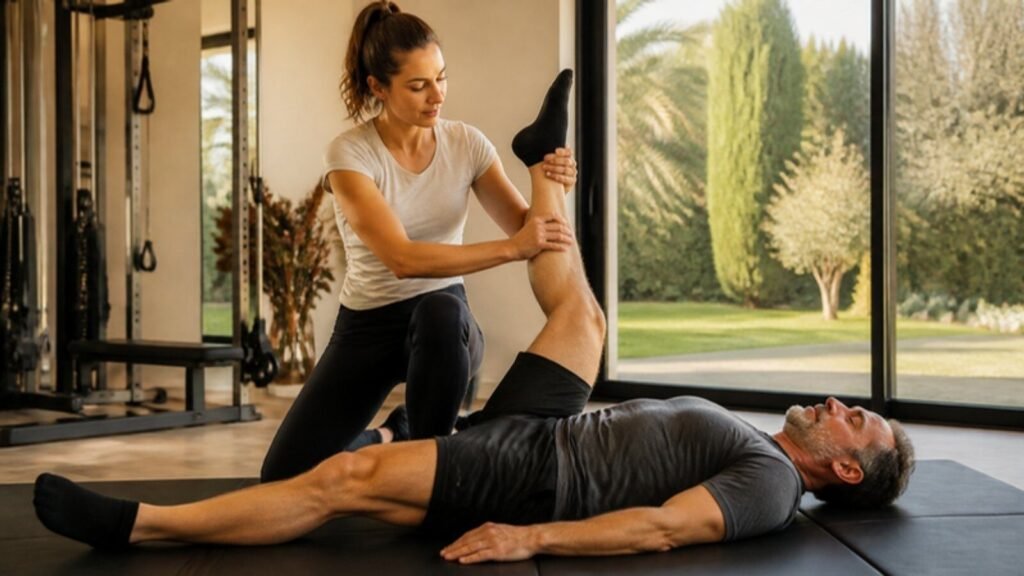
Soon after arrival, a short session of gentle mobility, light soft tissue release and assisted stretching helps the body recover from hours of sitting. It is usually brief and calm rather than intense. Our article on assisted stretching and mobility programmes for busy principals describes how these short sessions are built.
Movement in daylight
Where the calendar allows, a walk or a light outdoor session at a suitable time of day helps people settle into the new rhythm. The physiotherapist does not give medical advice on sleep or time-zone adjustment, but can schedule movement sensibly and keep evening sessions calm. Back in the Gulf, timing also has to respect the climate; see training and recovery in Gulf heat.
A gradual return to training
For active family members, the first session back is usually lighter, with full training rebuilt over the following days. This is especially important before sport: a principal who plays padel or golf the morning after a long-haul flight benefits from a careful warm-up and realistic expectations. See our article on injury prevention for active private families for how this fits into a wider plan.
Breathing and down-regulation
A few minutes of slow, guided breathing at the end of the day is a simple way to close a demanding travel day. Our article on breathing and core control programmes in private practice covers this in more depth.
Adapting travel recovery to each family member
The table below is illustrative, not a prescription. Each plan depends on the individual assessment, on any advice from the family’s own doctors and on the travel schedule.
| Family member | Typical concern after travel | Emphasis | Usual format |
|---|---|---|---|
| Principal with meetings on arrival | Stiff back and neck, little time | Thoracic and hip mobility, light soft tissue work | Short session soon after arrival and a calm close to the day |
| Active adult with sport planned | Feeling heavy or tight before playing | Progressive warm-up, mobility, lighter first session | Pre-sport preparation, training rebuilt over a few days |
| Teenager in regular training | Missed sessions and disrupted routine | Simple mobility and control, kept enjoyable | Brief sessions around school and training |
| Older family member | Stiffness and less confidence after long sitting | Gentle mobility, walking, balance | Unhurried, seated and standing exercises |
| Family member recovering from an injury | Keeping progress on track while travelling | Continuity of the rehabilitation plan | Adapted sessions with portable equipment |
A typical case: the golf trip after a long flight
Picture a principal in his fifties who flies from Riyadh to Europe overnight and has a round of golf with business guests the following morning. He has a history of lower back stiffness after long journeys.
The physiotherapist plans ahead. The day before departure, they do a short mobility and soft tissue session and agree a few seated movements for the flight. On arrival, they give him twenty minutes of gentle hip and thoracic mobility and assisted stretching, then leave him to rest. The next morning, before golf, they run a progressive warm-up focused on rotation and hip movement, and suggest a few easy practice swings before the first tee. After the round, a short recovery session closes the day. This is a hypothetical example, but it reflects the kind of quiet, well-timed work families value.
Knowing the limits of the work
Travel recovery supports comfort, mobility and performance. It is not a substitute for medical advice. Some travellers have personal risk factors for problems linked to long journeys, and some symptoms after a flight need prompt medical attention, such as unexplained pain or swelling in one leg or sudden breathlessness. A good physiotherapist knows these warning signs, says so plainly and discreetly when something does not look right, and makes sure the family’s own medical advisers are involved without delay.
The same applies to claims. Avoid promising that a routine will prevent jet lag or guarantee performance. Explain what you are doing, keep it simple and let steady results speak for themselves.
What families look for in the physiotherapist
- Strong manual therapy skills: soft tissue release, joint mobilisation and assisted stretching that can be delivered in a hotel suite as easily as in a treatment room.
- Sound exercise prescription and the judgement to scale a session up or down according to how the person feels after a journey.
- Calm organisation: packing the right kit, adapting to unfamiliar spaces and fitting around an unpredictable calendar.
- Clear communication with the principal, the house manager and, where relevant, the family’s own doctors.
- Experience with elite athletes, professional teams or high-profile clients, which is a major advantage: team physiotherapists already know how to manage recovery around travel.
If you have worked with a club or national team, our article on moving from club or national-team physiotherapy to a private family explains which skills transfer most directly, and our guide to working alongside the family’s personal trainer, coach or doctor covers how travel plans are shared with the rest of the team.
Requirements and conditions of the role
- A physiotherapy degree from the UK, Europe, Australia, New Zealand, the United States or Canada, with current registration in the country of training. What counts is where you trained, not your nationality.
- Strong manual therapy, exercise prescription and movement control skills; experience with elite athletes, professional teams or high-profile clients is a major advantage.
- Availability to start within about six weeks and total flexibility.
- Willingness to live with the family and travel with them continuously across several countries. The role is live-in and single-status: you relocate alone, and partners or children do not relocate with you.
- Fluent English and complete discretion.
The package:
- Salary from £60,000 a year gross, depending on experience.
- Free private accommodation.
- Flights and travel paid by the family.
- Medical insurance covered. Professional indemnity insurance is not included.
- A permanent position with annual leave.
The salary is agreed directly between the family and the clinician; each clinician should take advice from their own tax adviser on whether the income is taxable in their circumstances.
Medical Staff Talent introduces and verifies clinicians. The engagement is contracted directly between the family and the clinician, and all local arrangements (visa, licensed entity, coordination with local clinics) remain with the family’s own office and advisers.
The current opening is our sports physiotherapist job with a private family. You can read about the first months in the role in your first 90 days in a live-in physiotherapist role, and see all our physiotherapy roles on the physiotherapists page.
Frequently asked questions
How often does the family travel?
Continuously. Once in post, you travel with the family across several countries, so planning recovery around journeys is a regular part of the week rather than an occasional task.
Do I treat people during the flight?
Rarely. On board, the role is mostly about simple movement reminders and noticing who is uncomfortable. Most of the hands-on work happens before departure and after arrival.
What equipment travels with me?
Usually a compact kit: resistance bands, a massage ball and, where the family travels with one, a portable treatment table. The exact kit depends on the family and on each person’s programme.
Who can apply?
Physiotherapists with a degree from the UK, Europe, Australia, New Zealand, the United States or Canada and current registration in the country of training. What counts is where you trained, not your nationality.
What is the salary?
From £60,000 a year gross, depending on experience, with free private accommodation, flights and travel paid and medical insurance covered. Professional indemnity insurance is not included.
Is the role permanent?
Yes. It is a permanent, live-in position with annual leave, and you travel continuously with the family across several countries.
Send your CV in confidence
If keeping one family comfortable and moving wherever they travel appeals to you, send your CV in confidence. Every CV is read personally.
Send your CV in confidence