
By David Vilchez, Founder & CEO, Medical Staff Talent
→ Sports Physiotherapist (Manual & Movement Therapy) — Private Family, Dubai
Picture the diary of a principal in a private family in Riyadh, Dubai or Doha. Board meetings that run for three hours. A working lunch, then calls in the car between the office and the residence. A night flight to London on Tuesday, a day of meetings in Geneva, then back to the Gulf for the weekend. In between, the family, guests, prayers, sport when there is time, and often not enough sleep.
Back and neck problems thrive in that kind of life. They rarely arrive as a dramatic injury. More often they build slowly: a stiff neck after a week of video calls, a low back that complains after every long flight, a shoulder that aches by the end of a day in the car. And the people who live this way are usually the last to make time for treatment.
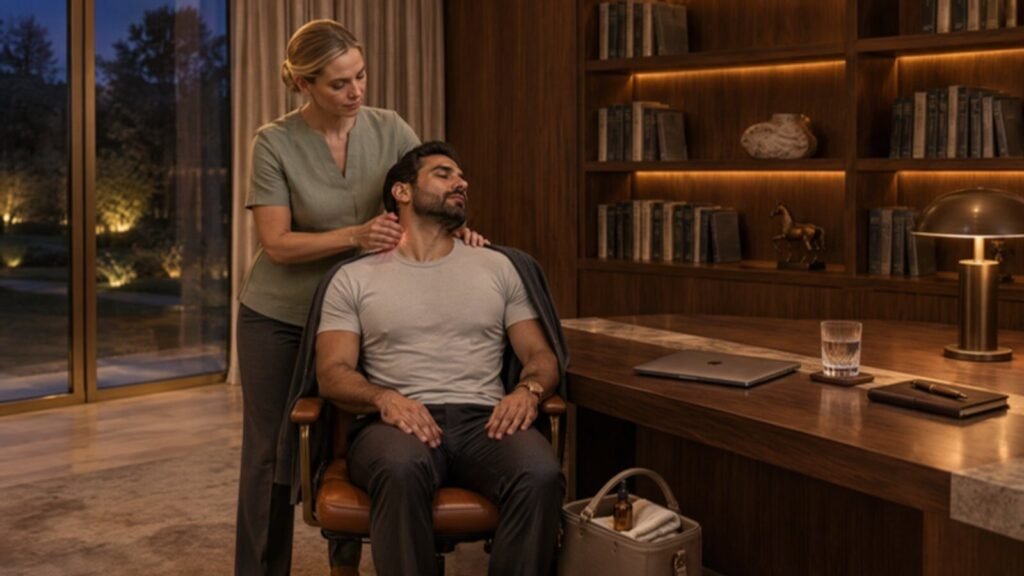
For a sports and manual therapy physiotherapist who lives with a private family, this is one of the most valuable parts of the role. The work is not about a single heroic intervention. It is about fitting skilled care into the gaps of a demanding schedule, between the office, the jet and the car, so that the principal keeps moving well, sleeps better and arrives at the next meeting without pain dictating the day.
Why busy principals develop back and neck problems
There is rarely one cause. Most of the time, several ordinary factors stack up over weeks and months.
- Long periods of sitting. Meetings, desk work, flights and car journeys can add up to most of the waking day. The body adapts to the positions it spends time in, and long, unbroken sitting tends to leave the hips, upper back and neck stiff and the supporting muscles underused.
- Screens and phones. Hours spent looking down at a phone or across at a laptop on a low table put steady load on the neck and upper back.
- Travel. Long-haul flights, time zone changes, unfamiliar beds and heavy bags all add strain, often in the same week.
- Stress. Pressure and long working hours change how people hold themselves, how they breathe and how well they recover. Tension in the neck and shoulders is a familiar companion of a difficult negotiation.
- Sleep. Short or broken sleep lowers tolerance to pain and slows recovery, and pain in turn disturbs sleep.
Most back and neck pain in people like this is common, mechanical and manageable. But the physiotherapist always keeps an eye open for anything that does not fit the pattern. New or unusual symptoms, such as pain spreading into an arm or leg with numbness or weakness, pain that wakes someone at night and does not ease, general unwellness, or pain after a fall, are passed promptly to the family’s doctor. Diagnosis, investigations and medication are the doctor’s decisions; the physiotherapist’s role is to notice, report through the agreed channel and work within the medical plan.
Short sessions that fit a diary
A principal will rarely give a physiotherapist an uninterrupted hour every day. The skill lies in using ten, fifteen or twenty minutes well.
A typical week might include several short blocks rather than one long session:
- A morning mobility routine of ten minutes before the first meeting, working through the hips, upper back and neck, often combined with a few minutes of relaxed breathing.
- A short strength block two or three times a week, focused on the trunk, hips and upper back, built around exercises that need little equipment and can be done in a dressing room, a hotel suite or the residence gym.
- A brief treatment session of soft tissue work and joint mobilisation in the evening, when the day’s meetings are over and there is time to unwind.
- A pre-flight session on travel days, so that the principal boards the aircraft moving freely rather than already stiff.
Consistency matters more than length. Fifteen focused minutes five days a week usually achieves more than an occasional long session squeezed in when the pain becomes impossible to ignore.
The workspace, the jet and the car
A large part of back and neck care happens outside the treatment room. The physiotherapist looks at the places where the principal actually spends the day, and suggests practical changes in agreement with the household and the office.
The office. Chair height and support, the position of screens, a laptop raised to eye level for long calls, a headset rather than a phone held to the ear, and a standing option for part of the day. Small things, such as placing the water and the printer a short walk away or taking calls while standing, add movement without adding time.
The aircraft. On a private jet, the physiotherapist can suggest a supportive cushion or lumbar roll, a neck support for sleeping, a seat position that allows the legs to move, and short walks and simple stretches during the flight. On commercial flights, the same principles apply within the limits of the cabin.
The car. For principals who spend hours being driven, the rear seat matters as much as an office chair: seat angle, lumbar support, a stable surface for papers or a tablet, and pauses on longer journeys where possible. For those who drive themselves, seat and steering wheel position make a noticeable difference.
Manual therapy and exercise together
Principals often enjoy hands-on treatment, and it has a real place: soft tissue release for tight neck and shoulder muscles, joint mobilisation for a stiff upper back or low back, and assisted stretching after a long day of sitting. Many people feel noticeably easier after a good session.
The lasting change, though, usually comes from combining that hands-on work with active exercise. Manual therapy can open a window in which movement feels easier; corrective exercise, strength work for the trunk and hips, movement control and breathing practice help the body keep that freedom. The physiotherapist explains this simply and without lecturing: the treatment table helps, but the five minutes of exercise afterwards and the short routine the next morning are what make the difference last.
Travel days
Travel days are where many back problems flare, and where good planning helps most. The physiotherapist agrees a simple routine with the principal: mobility before leaving, movement and hydration during the flight, and a short session after arrival to reset after hours in the same position. Our article on travel recovery after long-haul flights looks at this in more detail.
When the family travels, the physiotherapist travels too, and needs to be able to treat in a hotel suite, a guest house or a holiday home. A folding couch, a few bands, a massage tool and a mat cover most needs. Our guide to the portable clinic for travelling physiotherapists explains how to put together a kit that goes wherever the family goes.
Working with the doctor and the trainer
A busy principal is often looked after by several people. The family’s doctor oversees health and makes the medical decisions. A personal trainer may run gym sessions. A coach may lead tennis or golf. Assistants and the family office manage the diary.
The physiotherapist fits into that team with clear roles. Medical questions go to the doctor. Training load is agreed with the trainer so that a heavy gym session does not land on the morning before a long flight when the back is already irritable. Updates are short, factual and shared only through the agreed channel. Our article on working alongside the family’s personal trainer, coach and doctor covers this collaboration in more depth.
Discretion and boundaries
Treating a principal means seeing them tired, in pain and away from their public role. Complete confidentiality is non-negotiable: nothing about their health, schedule, travel or household is discussed with anyone outside the agreed circle, and never on social media.
Boundaries matter too. The physiotherapist is flexible with timing but keeps the work professional, respects the principal’s privacy and the household’s routines, and knows when to step back. Our article on discretion with high-profile clients looks at this side of the role.
A hypothetical case
Picture a principal in Riyadh in his fifties with recurring low back pain that flares before and after long-haul flights. He travels to London and New York several times a season, and by the second day of each trip he finds it hard to sit through meetings. The family’s doctor has reviewed him and found nothing that needs further investigation, and is happy for physiotherapy to go ahead.
The physiotherapist starts with an assessment of how he moves, sits and sleeps, and looks at his office chair, the rear seat of his car and the seat he uses on the family’s aircraft. With the household’s agreement, a lumbar support goes into the car and a cushion onto the jet, and his laptop is raised for long calls.
The plan is built around his diary: a ten-minute mobility routine each morning, two short strength sessions a week in the residence gym, soft tissue work and joint mobilisation on the evening before a flight, simple movements during the flight and a short session in the hotel suite after arrival. The trainer adjusts gym sessions in the days before travel.
Over the following months, the flares become shorter and less frequent. He still travels as much as ever, but he now knows what to do when his back stiffens, and the long flights stop shaping his week.
Who we look for
We look for Western-Trained sports and manual therapy physiotherapists, trained in the UK, Europe, Australia, New Zealand, the United States or Canada. What counts is where you trained, not your nationality.
The roles are permanent, live-in and single-status: you relocate alone and travel with the family between their homes and abroad. Experience with elite athletes, professional teams or high-profile clients is a strong advantage, and solid musculoskeletal outpatient experience with back and neck problems is highly valued.
The salary is from £60,000 a year gross, depending on experience, with free private accommodation, flights and travel paid, and medical insurance covered. Professional indemnity insurance is not included. The salary is agreed directly between the family and the clinician; each clinician should take advice from their own tax adviser on whether the income is taxable in their circumstances.
Medical Staff Talent introduces and verifies clinicians. The engagement is contracted directly between the family and the clinician, and all local arrangements (visa, licensed entity, coordination with local clinics) remain with the family’s own office and advisers.
See the current sports physiotherapist role, and for further reading, our article on training and recovery in Gulf heat.
Frequently asked questions
Is the role only for the principal?
Usually not. The principal may be the reason the family first looks for a physiotherapist, but the role normally covers the whole family: spouses, children in sport, older relatives and sometimes guests, always within the arrangements agreed with the family’s office.
Do I need musculoskeletal outpatient experience?
It is a strong advantage. Experience of assessing and treating back and neck problems in an outpatient, private practice or sports setting gives you the clinical reasoning this work needs, alongside a solid sports and manual therapy background.
Who can apply?
Western-Trained physiotherapists with a degree from the UK, Europe, Australia, New Zealand, the United States or Canada and current registration in the country where they trained. What counts is where you trained, not your nationality.
What is the salary?
From £60,000 a year gross, depending on experience, with free private accommodation, flights and travel paid, and medical insurance covered; professional indemnity insurance is not included. The salary is agreed directly between the family and the clinician; each clinician should take advice from their own tax adviser on whether the income is taxable in their circumstances.
Send your CV in confidence
If you are a Western-Trained sports and manual therapy physiotherapist who can fit skilled back and neck care into a demanding schedule, send your CV in confidence. Every CV is read personally.
Send your CV in confidence