By David Vilchez, Founder & CEO, Medical Staff Talent
→ Sports Physiotherapist (Manual & Movement Therapy) — Private Family, Dubai
Australian physiotherapists and osteopaths have a reputation that travels: strong sports medicine, hands-on manual therapy and the habit of working independently. Private families in Saudi Arabia, the UAE and Qatar increasingly ask for exactly that profile. The role, though, is not a Gulf clinic or a club contract. It is a permanent, live-in appointment with one family, where you are the clinician the household relies on, wherever the household happens to be.
This guide is for physiotherapists with a sports or manual therapy background, and for osteopaths, who trained in Australia and are registered with AHPRA. It explains what changes, what families require, what the package looks like, and what to settle in Australia before you resign.
Medical Staff Talent in one line: Exclusively sourcing Western-Trained Private & Concierge Physicians, Physiotherapists & Osteopaths, and Private & Maternity Nurses for Private Families across the GCC.
Why families ask for Australia-trained clinicians
Families who commission a private physiotherapist or osteopath are buying judgement they cannot inspect directly. An Australian degree, a registration that can be checked on the public AHPRA register, and experience with athletes, sporting clubs or high-performance programmes give a family’s office something concrete to verify. Many principals ride, play polo, golf, ski, train daily or are recovering from surgery, and they want someone who can assess, treat and build a programme without a department behind them.
A private family is not a clinic or a club
Caseload. In private practice or a club you may see a full list every day. In a household your caseload is one family, sometimes one person. The work is deeper: daily follow-through on rehabilitation, prevention, performance and recovery.
Clinical autonomy. You are usually the only clinician in the residence. You decide the programme, and you recognise early when a sports physician, surgeon or imaging is needed and coordinate with the family’s office.
Documentation. There is no clinic software following the patient. Your own precise, confidential notes are the continuity of care when the family moves between residences or countries.
Clinic or club vs private family practice in the Gulf
| Aspect | Private practice or club in Australia | Private family practice in the Gulf |
|---|---|---|
| Caseload | Full daily list or a squad | One family, often one principal patient |
| Team | Practice colleagues or a performance staff | Usually you alone, with the household team |
| Autonomy | Practice protocols, head physio or medical lead | High; you decide when to involve outside specialists |
| Hours | Booked appointments, game days | Available when the family needs you |
| Where you live | Your own home | In the family’s residence, accommodation fully free |
| Travel | Away fixtures at most | Travel with the family is part of the work |
| Confidentiality | Professional and privacy obligations | The same, plus a strict NDA |
Travel with the family
From the day you start, you travel with the family. A household based in Riyadh, Abu Dhabi or Doha may spend the summer in Europe, move between residences, fly privately or spend weeks on a yacht. Flights and travel are always paid for by the family, and the family arranges the visas for international travel. Travel is not a holiday: it is the same standard of care in a different setting.
Moving on your own
Every role is live-in and single-status. Many of the clinicians who ask us about these roles are women relocating alone, and the questions are the right ones: your own private quarters within the residence, the household’s security arrangements, privacy, and protected rest. Ask about each of them at interview; a well-run household will answer clearly. For more, see what a live-in, single-status appointment means and your first 90 days as a live-in physiotherapist.
Discretion and NDAs
Every appointment comes with a non-disclosure agreement. No photographs of the residence, the aircraft or the family, no social media references to where you are or whom you work for, and no conversations about the household with friends or former colleagues.
What private families require from day one
- Start within about six weeks. Check your notice period and any club or practice commitments before you apply.
- Total flexibility. Schedules follow the family, not a booking system.
- Relocate alone and travel with the family at any time.
- Fluent English, as families and their offices work in English.
Leaving Australia well: what to settle before you go
The points below summarise official sources at a high level. They are not legal or tax advice, and rules change: confirm your own position with the body concerned and your own adviser.
Your AHPRA registration
Physiotherapists are registered by the Physiotherapy Board of Australia and osteopaths by the Osteopathy Board of Australia, both through Ahpra. Each board publishes a recency of practice standard and offers non-practising registration. Whether to keep general registration while you work abroad, and what a later return to practice in Australia would require, is something to check against your board’s current standards before you leave.
Your tax residency
The Australian Taxation Office applies residency tests based on your circumstances, not only on the number of days you spend in Australia. Ties you keep, such as a home, a partner or financial interests, can matter. Confirm your position with the ATO and your own tax adviser before you go.
Superannuation, Medicare and pensions
Your superannuation stays in your fund while you are away. Medicare eligibility, and residence requirements for the Age Pension, are set out by Services Australia; check how a long period overseas affects you, and whether any international social security agreement applies, before you leave.
Your registration while you are away. Read how to keep your home registration through years with one family. Practising while you travel. What you may do clinically depends on the country you are in with the family: see what you can and can’t do, country by country.
What families ask for
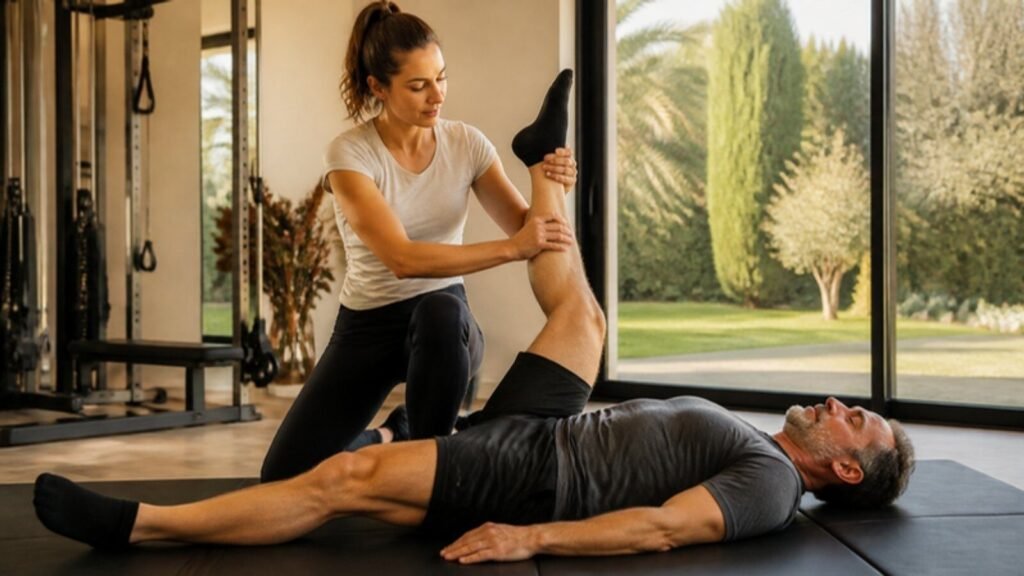
Physiotherapists & Osteopaths. Sports physiotherapy, manual therapy, post-surgical and musculoskeletal rehabilitation, injury prevention and performance work are what families most often ask for. Experience with elite athletes or high-profile clients is a strong advantage, not a requirement. See what a sports physiotherapist does for a private family.
The package
- Physiotherapists & Osteopaths: from £60,000 a year gross, depending on experience.
- Permanent role with annual leave.
- Accommodation in the residence, fully free.
- Flights and travel always paid for by the family.
- Medical insurance covered. Professional indemnity insurance is not included.
The salary is agreed directly between the family and the clinician; each clinician should take advice from their own tax adviser on whether the income is taxable in their circumstances.
The honest trade-offs
- Availability. You are available when the family needs you.
- Living where you work. Switching off takes discipline.
- Time off on the family’s timetable. Annual leave is real, but planned around the family’s calendar.
- Professional isolation. No practice meetings; you keep your own skills current.
- Distance. Australia is a long way from the Gulf and from a European summer.
Picture a sports physiotherapist trained in Melbourne, eight years into club and private practice work, single, and tired of twenty-minute appointments. In a private household she would follow one principal’s knee rehabilitation every day, build a strength programme around the family’s summer in Europe and run her own schedule. This is a hypothetical profile.
How the introduction works
Medical Staff Talent introduces and verifies clinicians and advises on the licensing and relocation route. The engagement is contracted directly between the family and the clinician, and all local arrangements (visa, licensed entity, coordination with local clinics) remain with the family’s own office and advisers. We are not the employer, and your CV is never sent to a family without your agreement.
Frequently asked questions
Should I keep my AHPRA registration?
That depends on your plans to return. The Physiotherapy Board and the Osteopathy Board publish recency of practice standards and offer non-practising registration. Check the current standard for your profession before you leave.
Is sports experience essential?
No. Sports physiotherapy and manual therapy are what families most often ask for, and experience with elite athletes or high-profile clients is a strong advantage, but solid musculoskeletal and rehabilitation experience is the foundation.
Can my partner come with me?
No. Every role is live-in and single-status, and you travel with the family at any time.
What is the pay?
Physiotherapists and osteopaths start from £60,000 a year gross, depending on experience, with free accommodation, flights and travel paid, and medical insurance covered. Professional indemnity insurance is not included. The salary is agreed directly between the family and the clinician.
How much will I travel?
From the day you start, you travel with the family between their residences and abroad, often to Europe in summer. Travel is part of the work.
Is Medical Staff Talent my employer?
No. Medical Staff Talent introduces and verifies clinicians. The engagement is contracted directly between the family and the clinician.
Apply in confidence
If a permanent, live-in role with one private family in Saudi Arabia, the UAE or Qatar fits the next stage of your career, send your CV through our website form. Every conversation is confidential.
Sources: Ahpra; Physiotherapy Board of Australia; Osteopathy Board of Australia; Australian Taxation Office; Services Australia.