By David Vilchez, Founder & CEO, Medical Staff Talent
→ Sports Physiotherapist (Manual & Movement Therapy) — Private Family, Dubai
Most clinicians in Croatia who write to us picture a hospital in Riyadh, Dubai or Doha: a large department, a familiar hierarchy, a contract with an institution. Our appointments are something else entirely. They are permanent, live-in roles with one private family in Saudi Arabia, the UAE or Qatar, where you are the clinician the household relies on, wherever the family happens to be.
This article is for nurses, physiotherapists, osteopaths and doctors trained in Croatia and working in the HZZO system or in private practice who want to understand, precisely and without gloss, what changes when you leave a public post for a single household, and what to settle at home before you go.
Medical Staff Talent in one line: Exclusively sourcing Western-Trained Private & Concierge Physicians, Physiotherapists & Osteopaths, and Private & Maternity Nurses for Private Families across the GCC.
Why a private family is a different decision from a Gulf hospital
A hospital post abroad is still institutional medicine: rosters, departments, managers, a nursing or medical director, colleagues on every corridor. A private family appointment has none of that architecture. There is one household, one principal patient or a small number of family members, and one standard: the family’s confidence in you. There is no department to absorb a difficult day and no switchboard between you and the people you care for.
That is why we ask clinicians to treat this as a change of profession as much as a change of country. The clinical skills are the same; the setting, the expectations and the rhythm of life are not.
From an HZZO ward or clinic to one household: caseload, clinical autonomy, documentation
In Croatia, most clinicians work in hospitals, health centres and other providers contracted by the Croatian Health Insurance Fund (Hrvatski zavod za zdravstveno osiguranje, HZZO). Your day is shaped by lists, referrals, shift patterns and the pace of a public system.
In a private household, the caseload shrinks to one person or a few, and continuity of care becomes the whole job. You know your patient’s history in detail, you see subtle changes early, and you are expected to act on them with judgement. Clinical autonomy is real: you plan the day’s care, anticipate needs before travel, and coordinate with the family’s own doctors and specialists when they are involved. Documentation matters even more than at home, because you are often the only continuous clinical record the family has. Clear, precise notes, kept confidentially, are part of the service.
HZZO vs private family practice in the Gulf
| Aspect | HZZO ward or clinic | Private family practice in the Gulf |
|---|---|---|
| Caseload | Many patients per shift or clinic list | One principal patient or a small number of family members |
| Team | Department, colleagues, supervisors on site | You, often a second clinician, and the family’s household staff |
| Clinical autonomy | Defined by protocols and hierarchy | High: you plan and adapt care day to day |
| Documentation | Institutional systems | Your own precise, confidential records |
| Hours | Scheduled shifts and on-call | Set around the family’s timetable, with wide availability |
| Where you live | Your own home | In the family’s residence, accommodation fully free |
| Travel | Rare, and your own | Frequent, with the family, as part of the role |
| Confidentiality | Professional secrecy | Professional secrecy plus a strict NDA |
Travel with the family
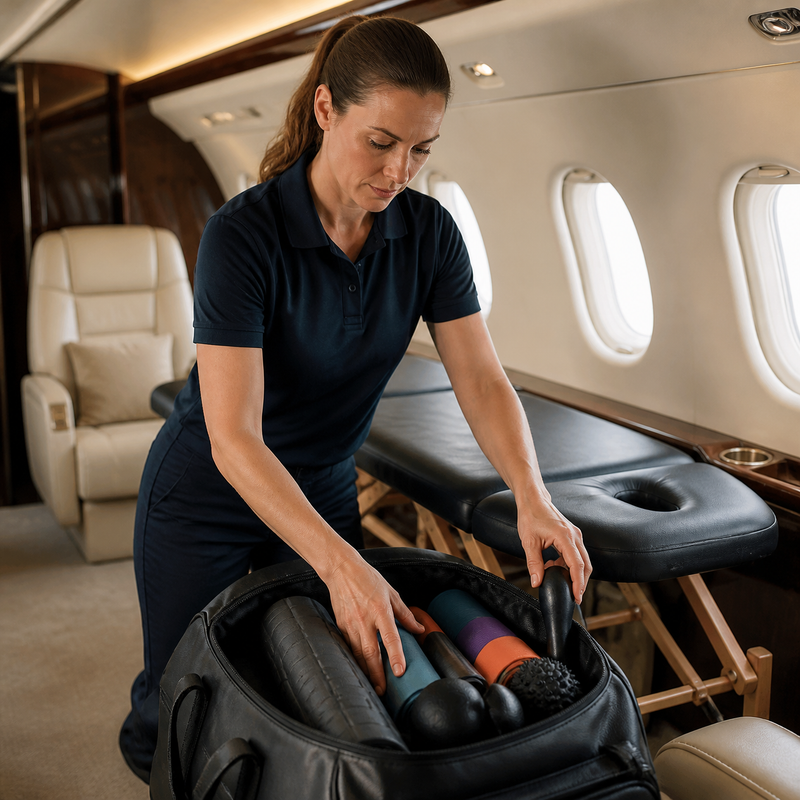
Families in the Gulf move. Summers are often spent in Europe, and the household may travel by private jet or spend weeks on a yacht. When the family travels, you travel. The family arranges and pays the visas for international travel. It is important to be clear about this from the outset: travel is work. Airports, new residences and changing time zones are part of the role, and your patient’s care continues throughout.
Discretion and NDAs
Every appointment comes with a non-disclosure agreement. You do not discuss the family, their health, their homes or their movements, with anyone, in any form, including social media. Croatian clinicians already work under professional secrecy; in a private household, discretion extends to everything you see and hear. Discretion is the foundation of a long appointment.
What private families require from day one
Three conditions apply to every role we handle:
- Start within about six weeks. Families usually need someone soon. Check your notice period now, and if you are in a public post, find out whether your employer would consider unpaid leave (see below).
- Total flexibility. The family’s plans change, sometimes at short notice, and your days change with them.
- Relocate alone and travel with the family at any time. Every role is live-in and single-status. You live in the family’s residence and go where the family goes.
Leaving HZZO well: what to settle before you go
The points below are drawn from official Croatian sources. They are a starting point, not advice for your situation, and each should be confirmed with the body named or with your own adviser.
Unpaid leave and your public post
The Croatian Labour Act (Zakon o radu) provides that an employer may approve unpaid leave at the worker’s request, and that during unpaid leave the rights and obligations arising from the employment relationship are suspended, unless a law provides otherwise. It is the employer’s decision, not an automatic right, so raise it early with your employer and check your collective agreement. Confirm with your employer and the Labour Act text / your own adviser.
Keeping your registration: doctors (Hrvatska liječnička komora)
The Hrvatska liječnička komora renews a doctor’s licence where the prescribed continuing medical education points have been collected: at least 120 points in six years. The renewal request must be submitted at least one month before the licence period ends, and once a licence has expired it can be renewed only after a prior check of competence. If you plan to return to practice in Croatia, keep your CPD and membership in order while abroad. Confirm with the Hrvatska liječnička komora / your own adviser.
Keeping your registration: nurses (Hrvatska komora medicinskih sestara)
The Hrvatska komora medicinskih sestara publishes the forms for renewing the approval for independent practice, and for suspending (mirovanje) and reactivating membership. Before you leave, ask the Chamber which option suits a period working outside Croatia and how it affects your licence cycle. Confirm with the Hrvatska komora medicinskih sestara / your own adviser.
Keeping your registration: physiotherapists (Hrvatska komora fizioterapeuta)
According to the Hrvatska komora fizioterapeuta, the licence runs in six-year cycles and is not renewed automatically. Physiotherapists need 120 CPD points over six years, with at least 40 points in each two-year period, and paid membership. Those who fall short may be called to a competence examination. Members who complete education outside Croatia may apply individually for it to be accredited. Confirm with the Hrvatska komora fizioterapeuta / your own adviser.
Your tax residence in Croatia
The Porezna uprava explains that tax residence is not determined by citizenship or by your registered address, but by your centre of vital interests: for people with a spouse or children, where the family lives; for single people, where they generally stay for more than 183 days. Deregistering your address with the police (MUP) does not by itself end Croatian tax residence: you deregister from tax residence by filing the Upitnik TI form with the Tax Administration, together with a certificate of tax residence from the other country. Confirm with the Porezna uprava / your own tax adviser.
Your state pension
The Croatian Pension Insurance Institute (HZMO) offers extended insurance (produženo osiguranje) to people whose compulsory pension insurance has ended, including those on unpaid leave and those employed abroad who are not compulsorily insured in Croatia for that period, provided the application is made within 12 months. Its compulsory insurance rules also cover, on personal request, people employed abroad with foreign employers who are not compulsorily insured under foreign rules. EU social security coordination does not cover the Gulf, and the international agreements HZMO applies do not include the UAE, Saudi Arabia or Qatar. Confirm with HZMO / your own adviser.
Your registration while you are away. You can keep your home registration active through years with one family if you plan it from the start. Read how many years, what counts as practice, and the pros and cons, and check your own situation with the Home Registration Checker.
Practising while you travel. What you may do clinically depends on the country you are in with the family. See what you can and can’t do, country by country, or check a destination with the Where Can I Practise? checker.
The three service lines
Private & Maternity Nurses. Nursing teams are usually structured as 3 nurses alternating 12-hour daily shifts so that one can have a day off, or 4 nurses on 8-hour daily shifts, also allowing one a day off, so care is continuous and each nurse has protected rest, under a strict NDA. Experience in intensive care, neonatal and maternity units, palliative care and home care translates particularly well. Read more about how private nursing teams work.
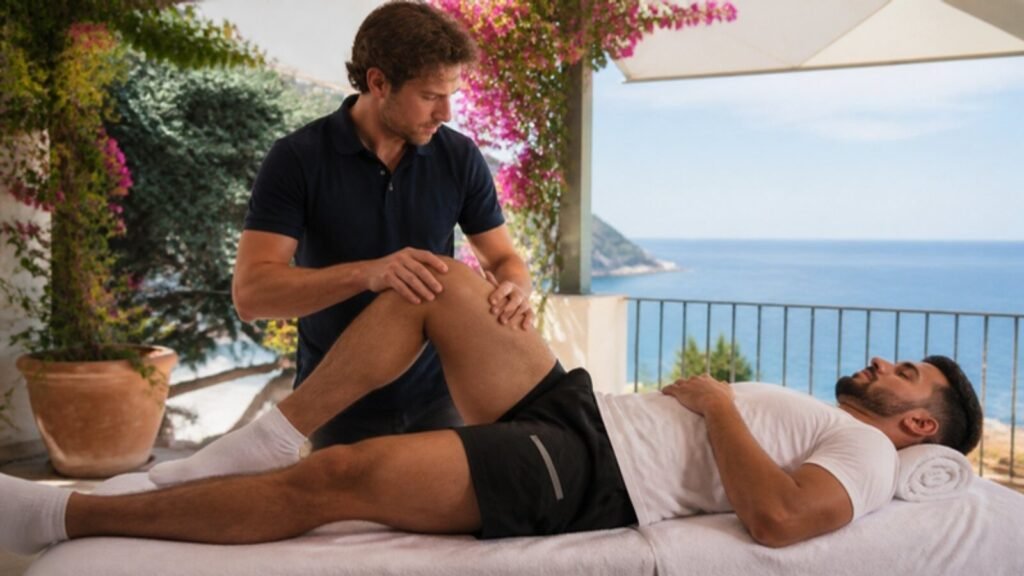
Physiotherapists & Osteopaths. Families look for musculoskeletal, neurological, post-operative and sports rehabilitation experience, and for clinicians who can design a programme and keep it going while the household travels.
Private & Concierge Physicians. Experience in general and family medicine, internal medicine, emergency medicine and anaesthesia translates well, because the role combines continuity of care with calm judgement when something unexpected happens away from a hospital.
Realistic salary bands
As market references, gross:
- Private & Concierge Physicians: £218,000 a year gross, with free accommodation and medical insurance covered (professional indemnity insurance is not included).
- Physiotherapists & Osteopaths: from £60,000 a year gross, depending on experience.
- Private & Maternity Nurses: from €5,000 a month.
The salary is agreed directly between the family and the clinician; each clinician should take advice from their own tax adviser on whether the income is taxable in their circumstances.
All roles are permanent, with annual leave. Accommodation in the family’s residence is fully free. Medical insurance is covered; professional indemnity insurance is not included. Flights and travel are always paid for by the family. To compare your current position with a Gulf package, use our home salary vs GCC gross package calculator, which includes Croatia in its selector, in euros. You may also find our notes on cost of living and your net position and wealth preservation useful.
The honest trade-offs
- Availability. Being available around the clock and working a six-day week are normal in this setting.
- Living where you work. You live in the family’s residence. Privacy is respected, but the line between work and home is thinner than in Zagreb, Split or Rijeka.
- Time off on the family’s timetable. Leave is taken when the family’s plans allow, not always when you would choose.
- Professional isolation. There are no colleagues down the corridor. You need to stay current on your own initiative.
- Distance from home. Birthdays, holidays and family events in Croatia will sometimes be missed.
For a fuller picture of daily life, see our article on live-in, single-status appointments.
Who it suits and who it does not
It suits clinicians who are settled in their clinical identity, enjoy depth of care with one patient, are comfortable with autonomy and travel, and are free to relocate alone. It does not suit those who need a fixed weekly routine, want to bring a partner or children, or depend on a large team for professional energy.
Picture a physiotherapist trained in Zagreb, with eight years of neurological rehabilitation, half of it in an HZZO-contracted hospital and half in private practice. Single, fluent in English and up to date with CPD through the Hrvatska komora fizioterapeuta, this clinician has always preferred seeing one patient’s progress over months rather than minutes. A family needs a programme that continues between Riyadh, the south of France and a summer at sea. That is the kind of profile that fits. This is a hypothetical profile.
How the introduction works
Medical Staff Talent introduces and verifies clinicians. The engagement is contracted directly between the family and the clinician, and all local arrangements (visa, licensed entity, coordination with local clinics) remain with the family’s own office and advisers.
A family’s office sends us a brief. We match it against clinicians who have applied, speak with you in confidence, and verify your registration, references and clinical history. We then introduce a small number of clinicians, the family holds video interviews, and the family makes the offer. We are not the employer and we are not a party to the contract. Your CV is never sent to a family without your agreement.
How to apply
Send your CV through our website form. Fluent English is required for every role. For a broader overview, read our guide for European-trained clinicians.
Prefer to read in Croatian? See our page in Croatian for nurses or for physiotherapists.
Frequently asked questions
Can I keep my HZZO post while I work for a family?
Possibly. Under the Croatian Labour Act an employer may approve unpaid leave at the worker’s request, and during that leave the rights and obligations of the employment relationship are suspended. It is the employer’s decision, so discuss it with your employer before you accept an offer.
Do I keep my Croatian chamber registration while abroad?
That depends on the steps you take. Doctors, nurses and physiotherapists in Croatia renew their licences in cycles that require CPD points and paid membership, and an expired licence can be harder to restore. Ask your chamber before you leave which option suits a period abroad.
Can my partner or children come with me?
No. Every role is live-in and single-status. You live in the family’s residence and travel with the family.
How much will I be paid?
As market references, gross: Private and Concierge Physicians £218,000 a year gross with free accommodation and medical insurance covered (professional indemnity insurance is not included); Physiotherapists and Osteopaths from £60,000 a year gross, depending on experience; Private and Maternity Nurses from €5,000 a month. The salary is agreed directly between the family and the clinician.
How much will I travel?
Often. Families spend summers in Europe and may travel by private jet or yacht. You travel with them, and the family arranges and pays the visas for international travel. Travel is part of the work.
Is Medical Staff Talent my employer?
No. Medical Staff Talent introduces and verifies clinicians. The engagement is contracted directly between the family and the clinician, and all local arrangements remain with the family’s own office and advisers.
Apply in confidence
If a permanent, live-in appointment with one private family in Saudi Arabia, the UAE or Qatar fits the next stage of your career, send your CV through our website form. Everything you share is treated in confidence, and on request I can send you personally our guide “Private Household Appointments: A Guide for Western-Trained Clinicians”.
Sources: Hrvatski zavod za zdravstveno osiguranje (HZZO); Narodne novine, Zakon o radu; Hrvatska liječnička komora; Hrvatska komora medicinskih sestara; Hrvatska komora fizioterapeuta; Porezna uprava; Hrvatski zavod za mirovinsko osiguranje (HZMO).