By David Vilchez, Founder & CEO, Medical Staff Talent
A nurse in Lisbon, a physiotherapist in Kraków, a general practitioner in Thessaloniki and an osteopath in Lyon rarely think of themselves as part of the same market. Private families in Saudi Arabia, the UAE and Qatar do. When a family’s office asks us for a clinician, it asks for training, judgement and discretion. Where that training took place matters only in one sense: it must have been in the UK or in Europe.
This guide is written for nurses, physiotherapists, osteopaths and doctors trained anywhere in Europe: every EU member state, plus Andorra, Iceland, Norway and Switzerland. It explains what a live-in appointment with a private family actually involves, what families require, what the packages look like, and which questions belong to your own country’s rules before you resign. Each of the countries we cover also has its own guide, collected under European country guides.
Medical Staff Talent in one line: Exclusively sourcing UK & European-trained Private & Concierge Physicians, Physiotherapists & Osteopaths, and Private & Maternity Nurses for Private Families across the GCC.
Why European-trained clinicians are asked for by name
Families who commission a private clinician are buying something they cannot inspect directly: years of supervised training inside a regulated system, a habit of documentation, and the confidence to act alone within a defined scope of practice. A European qualification, held with a registration that can be verified at source, gives a family’s office something concrete to check. Many principals have also been treated in European clinics and know the standard they expect.
That is why our positioning names the UK and Europe together. A clinician trained in Madrid, Milan or Munich is considered on the same footing as one trained in Manchester, with the same verification and the same conditions.
A private family is not a Gulf hospital
Most clinicians who write to us picture a hospital: a department, a rota, a larger salary, the same job in a warmer climate. The appointments we introduce are different in kind. They are permanent, live-in roles with one private family, and the change is less about geography than about the shape of clinical work.
- One household instead of a ward or a list. Your patients may be a principal, a newborn, an elderly parent or a small number of family members. Fewer patients means deeper work, not less of it.
- Clinical autonomy. You are frequently the only clinician in the residence. Escalation routes are agreed in advance rather than assumed.
- Documentation that travels. There is no institutional record following the patient. Your notes are the continuity of care when the family moves between residences or countries.
- A household team. Your colleagues are a household manager or chief of staff, security, drivers and domestic staff, not a multidisciplinary ward team.
- Travel as part of the role. Summers in Europe, the private jet, the yacht. The family arranges and pays the visas for international travel. Travel is work, not a holiday.
- Strict discretion. Every appointment carries an NDA covering the family, the residence and your movements, including social media.
We have set this out in more depth in what live-in and single-status really involve.
What every family requires, whichever country you trained in
- Start within about six weeks. Families commission a clinician when a need arises: a birth, a discharge home after surgery, a change in an elder’s health. Notice periods and leave rules differ across Europe; check yours before you apply.
- Total flexibility. The family’s diary sets the pattern, and it can change at short notice.
- Relocate alone and travel with the family at any time. Every role is live-in and single-status. A partner or children do not relocate with you.
Fluent English is required on every appointment. Arabic is valued but never a substitute for clinical standing.
The three service lines
Private & Maternity Nurses
Private nursing is always arranged in pairs: two nurses alternating shifts of 8 or 12 hours, so the patient has continuous care and each nurse has protected rest. Both work under a strict NDA. Experience in neonatal care, midwifery, critical care, theatres and recovery, geriatrics or community nursing translates well. See Private & Maternity Nurses and why private nursing is arranged in pairs.
Physiotherapists & Osteopaths
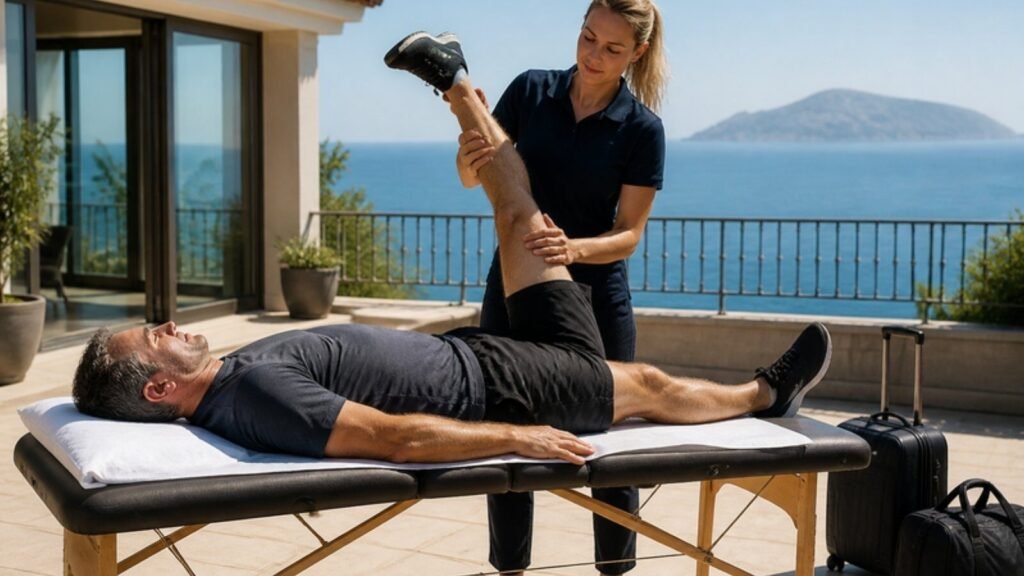
Families appoint physiotherapists and osteopaths for musculoskeletal care, recovery after surgery, neurological rehabilitation, sports performance and longevity work, often in a treatment room or gym inside the residence and continuing wherever the family travels. Osteopathy is regulated very differently across Europe; what matters to a family is verifiable training and a clear scope of practice. See Physiotherapists and Osteopaths.
Private & Concierge Physicians
A private physician is the family’s first point of contact for health: preventive and longevity medicine, acute assessment, chronic disease management and coordination with specialists at home and abroad. Family medicine, internal medicine, emergency medicine and anaesthesia backgrounds are common. See Private & Concierge Physicians.
Realistic salary bands
The figures below are market references for the appointments we introduce, not offers. They are gross, and negotiable between the family and the clinician.
- Private & Concierge Physicians: £218,000 a year gross, with free accommodation and medical insurance covered (professional indemnity insurance is not included).
- Physiotherapists & Osteopaths: from £60,000 a year gross, depending on experience.
- Private & Maternity Nurses: from €5,000 a month.
The salary is agreed directly between the family and the clinician; each clinician should take advice from their own tax adviser on whether the income is taxable in their circumstances.
These are permanent roles with annual leave, and accommodation in the residence is fully free. Medical insurance is covered; professional indemnity insurance is not included. Flights and travel are always paid for by the family. To compare an offer with what you keep today, use our UK & European vs GCC gross package calculator: it covers the UK and 31 European countries, in your own currency.
Leaving well: the questions that belong to your own country
Most of what changes when you join a private family is the same everywhere in Europe. Four things are not, and they are worth settling before you resign rather than after you land.
1. Your place in the public system
Many European public employers offer some form of unpaid leave or leave of absence, but the conditions vary widely: some reserve your post, some only give you a route back through future vacancies, and many grant it at the employer’s discretion. Ask your human resources department, in writing, what applies to you.
2. Your professional registration
Families expect an active registration in the country where you trained, verifiable at source. Some professional bodies let you suspend registration while you practise abroad; others expect you to keep paying and to keep up continuing professional development; a few require retraining if you have been away from practice in that country for several years. Check with your own regulator before you go.
3. Your tax residence
There are no EU-wide rules on personal tax residence. As Your Europe explains, each country sets its own test, usually combining days spent in the country (often more than 183) with where your home and your personal and economic ties are. Some countries go further and keep their nationals tax resident for several years after a move to a jurisdiction on a national list. Portugal, for example, applies such a rule, and its current list includes the UAE and Qatar. Italy presumes that citizens who move to a listed state remain resident unless they prove otherwise, and its list includes the UAE. Spain applies a similar rule, but none of the three Gulf states is on its current list. Your country guide sets out what we could verify; your own tax adviser should confirm your position before you move.
For context, the UAE, Saudi Arabia and Qatar do not levy personal income tax on employment income, according to PwC’s Worldwide Tax Summaries. Saudi Arabia charges VAT at 15% and the UAE at 5%, which matters for your spending rather than your salary. What applies to you depends on your tax residence and circumstances.
4. Your state pension and social security
The EU social security coordination rules apply across the EU, Iceland, Liechtenstein, Norway and Switzerland. They do not extend to the Gulf: according to the European Commission, outside that area benefits are only exported when national legislation or a bilateral agreement provides for it. Several European countries offer voluntary contributions to protect a state pension while you live abroad. Ask your national pension or social security body what is available and what it costs.
And your currency
The Saudi riyal, the UAE dirham and the Qatari riyal are pegged to the US dollar. If your commitments at home are in euros, kroner, złoty, forint, lei, koruna or Swiss francs, your Gulf salary will move against them as the dollar does.
The honest trade-offs
- Availability. 24/7 availability and a six-day week are normal in the Gulf. Nurses in pairs have structured shifts; physicians and therapists are often on call while in the residence.
- Living where you work. You have a private suite, but you are never quite off the premises.
- Time off on the family’s timetable. Leave is real, but it is arranged around the family’s movements.
- Professional isolation. No colleague down the corridor at three in the morning. You will need your own network and the discipline to keep learning.
- Distance from home. Single-status living means months away from partners, children and friends.
Who it suits
Picture a senior intensive care nurse from Valencia who wants to give one patient her full attention and is comfortable spending a summer on the Côte d’Azur doing it, or a neurological physiotherapist from Rotterdam who already builds long programmes for a handful of patients. These are hypothetical profiles, but they describe the people this work tends to suit: experienced, self-directed, calm under ambiguity and genuinely interested in one patient over time. It tends not to suit clinicians who need a fixed rota, who draw their energy from a large team, or whose commitments make relocating alone impractical.
How the introduction works
Medical Staff Talent introduces and verifies clinicians. The engagement is contracted directly between the family and the clinician, and all local arrangements (visa, licensed entity, coordination with local clinics) remain with the family’s own office and advisers.
A family or its office shares a brief with us. We look for clinicians who match it, speak with them in confidence, verify registration, references and clinical history at source, and introduce a small number to the family. Interviews are usually by video. The family makes the offer, and you agree terms with the family directly. We are not your employer and we are not a party to your contract. Your CV is never sent to a family without your agreement.
For those who want to read more first, I send the clinician guide Private Household Appointments: A Guide for UK & European-Trained Clinicians personally on request.
How to apply
Send your CV through our website form, with your current registration, clinical background, notice period and a short note on why a private family appointment suits you now. We read every application personally. If you prefer to read about the roles in your own language first, we have pages in Spanish, Italian, Portuguese, Polish, Greek, Romanian, German, French, Dutch, Croatian, Czech and Hungarian, linked from our Nurses and Physiotherapists pages.
Frequently asked questions
Which European countries do you recruit from?
We consider clinicians trained in the UK and anywhere in Europe: every EU member state, plus Andorra, Iceland, Norway and Switzerland. What matters is where you trained and that your registration can be verified at source.
Do I need to speak Arabic?
No. Fluent English is required on every appointment. Arabic is valued by many families but is never a substitute for clinical training and experience.
Can my partner or children relocate with me?
No. Every role is live-in and single-status. Families require clinicians who relocate alone and travel with the family at any time.
How much do private family appointments pay?
As market references: doctors £218,000 a year gross with free accommodation and medical insurance covered (professional indemnity insurance is not included); physiotherapists and osteopaths from £60,000 a year gross, depending on experience; nursing from €5,000 a month. Salaries are agreed directly between the family and the clinician.
Will I still be tax resident in my home country?
It depends on your country’s rules and your circumstances. Some countries keep nationals resident for several years after a move to a jurisdiction on a national list. Take advice from your own tax adviser before you move.
Is Medical Staff Talent my employer?
No. Medical Staff Talent introduces and verifies clinicians. The engagement is contracted directly between the family and the clinician, and all local arrangements remain with the family’s own office and advisers.
Apply in confidence
If you are a European-trained nurse, physiotherapist, osteopath or doctor who can start within six weeks, offers full flexibility, and is ready to relocate alone and travel with a family, we would like to hear from you. Applications are handled in strict confidence. Send us your CV.