By David Vilchez, Founder & CEO, Medical Staff Talent
→ Sports Physiotherapist (Manual & Movement Therapy) — Private Family, Dubai
A CV can say “soft tissue release, joint mobilisation, movement analysis”. A video call can show that you think clearly and speak calmly. Neither can show what your hands are like. That is why some private families in Saudi Arabia, the United Arab Emirates and Qatar ask a sports physiotherapist or osteopath for one more step before they decide: a short practical interview, in which the clinician assesses and works with a real person while someone from the family’s office looks on.
This article explains what a physiotherapist practical interview with a private family usually involves, what the family is really observing and how to prepare for it. It is written for Western-Trained physiotherapists and osteopaths, that is, clinicians trained in the UK, Europe, Australia, New Zealand, the United States or Canada, with a sports and manual therapy profile. Not every family asks for a practical session, and the format varies. Where we describe a situation, it is a hypothetical example, not an account of a real family, candidate or placement. For the earlier stages, read the first conversation with a private family.
Why some families ask for a practical interview
The role is hands-on, daily and personal. The clinician lives with the family, travels with them and treats the same few people for years. A family that is about to make a permanent appointment wants to know more than whether the qualifications are in order, which is something we verify before any introduction. It wants to know how a session with this person feels.
A practical interview answers questions that no document can: is the handling confident and comfortable, does the clinician explain what they are doing, do they notice things, and do they leave the person feeling better and more at ease? It is a short, one-off demonstration, not a trial period. The roles themselves are permanent.
What a practical session usually includes
There is no fixed script, but a practical session tends to follow the shape of a good first appointment, compressed into a short time:
- A brief conversation. A few well-chosen questions about activity, sport, travel, past injuries and what the person would like to change.
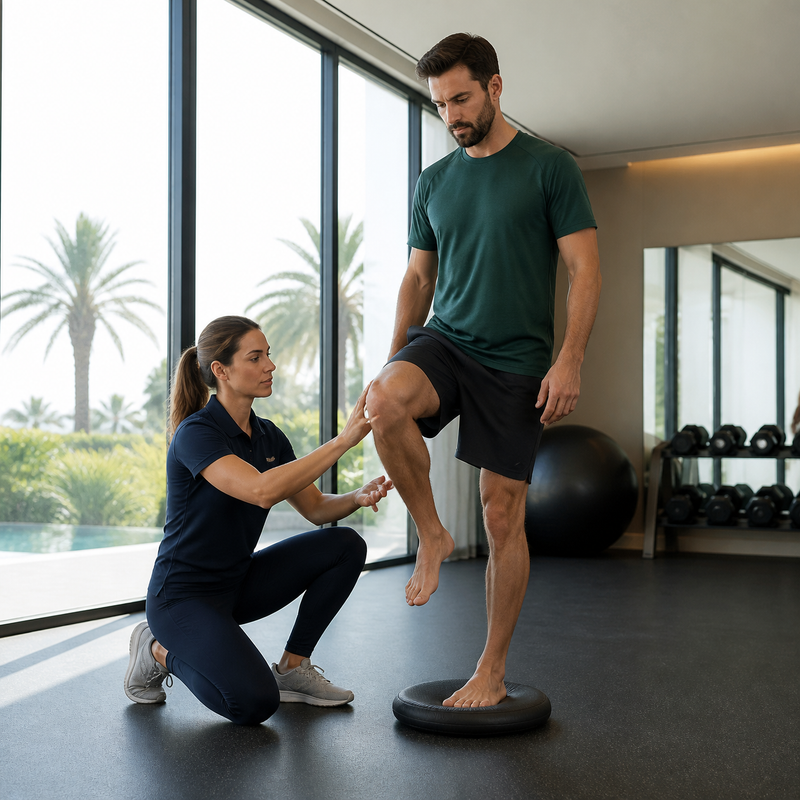
- Movement analysis and assessment. A quick look at posture, gait and a handful of functional movements, followed by targeted joint and muscle testing. This is where your biomechanical reasoning shows.
- Hands-on work. Soft tissue release, assisted stretching and joint mobilisation, chosen for what you found rather than from habit.
- Active work. One or two active mobility or corrective exercise drills, with attention to neuromuscular control, breathing and core control, or proprioception and balance, so that the change made on the table is used in movement.
- A short summary. What you found, what you did, what you would do over the next few weeks and what would make you involve the family’s physician.
Strength and conditioning usually plays a smaller part. Families ask first for manual skill, movement control and injury prevention. Our guide to sports physiotherapist jobs with private families in the Gulf describes the full clinical scope.
What the family is really observing
The person watching is rarely a clinician. It may be a chief of staff, a house manager or, sometimes, the family’s physician. They are not marking your technique against a textbook. They are watching for:
- Consent and comfort. Do you explain before you touch, ask permission, check pressure and respect privacy and modesty?
- Calm, confident handling. Do your hands feel sure, and do you position the person carefully?
- Clear reasoning. Can you say in two or three plain sentences why you chose each technique?
- Judgement. Do you stay within your training and say so when something belongs with a doctor?
- Time-keeping. Do you finish within the time agreed, without rushing the last five minutes?
- Presence. Are you punctual, neatly presented, quiet in your manner and discreet about previous clients?
How to prepare
Ask the practical questions in advance
Before the day, ask the family’s office how long you will have, who you will be working with, whether there is a treatment table or a mat, and what you should wear. Where and how a practical session takes place is decided by the family’s office and its advisers, who are responsible for all local arrangements. It may be wherever the family happens to be, including in Europe when the family is travelling.
Plan a structure you can adapt
Decide roughly how you will divide the time between conversation, assessment, hands-on treatment, active work and summary. Then be ready to change it. If the person mentions a stiff neck after a flight, that is the session, whatever you had planned.
Choose depth over variety
You do not need to show every technique you know. Two or three things done precisely, on the area that matters, say far more about you than a tour of your whole repertoire.
Practise explaining in plain words
Rehearse describing soft tissue release, a joint mobilisation or a breathing drill to someone who is not a clinician. Short sentences, no jargon, no long lectures. If English is not your first language, practise the phrases you use during treatment: “Is this pressure comfortable?”, “Breathe out slowly”, “Tell me if anything changes”.
Bring very little
Clean, professional clothing you can move in, short nails, no strong fragrance and, if the office agrees, a small kit such as a strap or a massage ball. The family is assessing you, not your equipment.
A hypothetical practical session
Picture a physiotherapist trained in the Czech Republic, with eight years in sport, several of them with a professional volleyball club. After a good video call, the family’s office invites the clinician to a practical session while the family is in Europe. A member of the household team, who sits and flies a great deal and complains of a tight hip and lower back, has agreed to be the person on the table. The house manager observes.
The clinician asks a few questions, watches the person walk, squat and rotate, and tests hip range and trunk control. They explain what they see in one sentence, ask permission and begin: soft tissue release around the hip, gentle joint mobilisation, then assisted stretching with contract-relax. They check comfort throughout. In the last ten minutes they teach two active mobility drills with slow breathing, re-test the squat so the person can feel the difference, and close with a short summary: what they found, what they would do in the first weeks, and what would make them speak to the family’s physician.
Nothing in that session is spectacular. It is careful, clear and finished on time, which is exactly what a family hopes to see. This is a hypothetical example, not a description of a real session.
Common mistakes to avoid
- Treating without assessing. Going straight to your favourite technique suggests a routine, not a clinician.
- Too much force. A practical interview is not the moment to prove how deep you can work.
- Talking through the whole session. Explain briefly, then let the person relax.
- Naming former clients or clubs’ players. Describe settings, never people. Discretion is being assessed from the first minute.
- Promising results. Say what you would expect and how you would measure it, not what you guarantee.
- Running over time. A principal’s diary will not wait, and the observer knows it.
If you come from elite sport, or you are an osteopath
Experience with elite athletes, professional teams or high-profile clients is a major advantage, and a practical session is where it shows naturally: quick assessment, efficient hands and calm under observation. The adjustment is one of pace. A principal is not a player on a match day, and the session should feel unhurried. Our article for club and national-team physiotherapists moving to a private family looks at that change in detail.
Osteopaths with a manual and sports therapy profile are assessed in the same way. Show your structural assessment, your hands-on work and, just as importantly, the active mobility and movement control that make the result last. See osteopath jobs with private families in the Gulf for the profile families ask for.
Where the practical interview sits in the process
Everything starts with your CV, sent through our confidential form and read personally. If your experience fits a brief, we speak with you, verify your qualification, registration and references, and introduce you only with your agreement. A first conversation with the family’s office follows, and in some cases a practical session. A clear CV makes each of those steps easier; what private families look for in a sports physiotherapist, and how to show it in your CV explains how to describe your hands-on skills on paper.
Medical Staff Talent introduces and verifies clinicians and advises on the licensing and relocation route. The engagement is contracted directly between the family and the clinician, and all local arrangements (visa, licensed entity, coordination with local clinics) remain with the family’s own office and advisers.
Requirements and conditions of the role
- A physiotherapy or osteopathy degree from the UK, Europe, Australia, New Zealand, the United States or Canada, with current registration in the country of training. What counts is where you trained, not your nationality.
- Strong manual therapy, movement control and injury prevention skills; experience with elite athletes, professional teams or high-profile clients is a major advantage.
- Availability to start within about six weeks and total flexibility.
- Willingness to live with the family and travel with them continuously across several countries. The role is live-in and single-status: you relocate alone, and partners or children do not relocate with you.
- Fluent English and complete discretion.
The package:
- Salary from £60,000 a year gross, depending on experience.
- Free private accommodation.
- Flights and travel paid by the family.
- Medical insurance covered. Professional indemnity insurance is not included.
- A permanent position with annual leave.
The salary is agreed directly between the family and the clinician; each clinician should take advice from their own tax adviser on whether the income is taxable in their circumstances.
Frequently asked questions
Does every private family ask for a practical interview?
No. Some families decide after one or two conversations; others ask for a short practical session first. The format varies from family to family.
How long does a practical session last?
It depends on the family. Ask the family’s office in advance and plan a short, focused session rather than a full course of treatment.
Who will I work with during the session?
The family’s office decides. It may be a member of the household team or someone else the office chooses, with a representative of the office observing.
What should I show?
A brief assessment, two or three hands-on techniques chosen for what you find, one or two active drills and a clear summary. Depth, comfort and clear reasoning matter more than variety.
Can osteopaths apply?
Yes. Osteopaths with a manual and sports therapy profile, trained in the UK, Europe, Australia, New Zealand, the United States or Canada and registered in the country of training, are considered on the same basis as physiotherapists.
What is the salary?
From £60,000 a year gross, depending on experience, with free private accommodation, flights and travel paid and medical insurance covered. Professional indemnity insurance is not included.
Is the role permanent?
Yes. It is a permanent, live-in position with annual leave, and you travel continuously with the family across several countries.
Send your CV in confidence
If you are a sports physiotherapist or osteopath whose best work is done with your hands, and a permanent role travelling with one private family appeals to you, send your CV in confidence. Every CV is read personally.
Send your CV in confidence