By David Vilchez, Founder & CEO, Medical Staff Talent
→ Sports Physiotherapist (Manual & Movement Therapy) — Private Family, Dubai
Many of the physiotherapists who write to us have spent years inside a football club, a rugby or basketball squad, a cycling team or a national federation. They know the rhythm of a season, the medical room on match day and the long bus journeys between fixtures. At some point they begin to wonder whether that experience could lead somewhere quieter, more personal and more international. One answer is a permanent, live-in role with one private family in Saudi Arabia, the UAE or Qatar.
This article looks at that career change in practical terms: which skills from team sport transfer directly, what changes from one day to the next, and how to present a club or national-team background when you apply. It is written for physiotherapists trained in the UK or anywhere in Europe. Where we describe a situation, it is a hypothetical example, not an account of a real person or placement.
Medical Staff Talent in one line: “Exclusively sourcing UK & European-trained Private & Concierge Physicians, Physiotherapists & Osteopaths, and Private & Maternity Nurses for Private Families across the GCC.”
Why team physiotherapists are well placed for private family roles
A private family that wants a sports physiotherapist is usually looking for three things at once: high-level hands-on skill, sound judgement under pressure and complete discretion. Team sport develops all three. A club or national-team physiotherapist is used to assessing quickly, treating efficiently, working to a timetable set by someone else and keeping sensitive information inside the group.
The family will not judge you on the badge on your old training kit. They will judge you on whether you can keep active adults moving well, look after an older relative with patience, support children who train seriously, and do all of this while travelling. Team sport is excellent preparation for that mix, provided you understand what changes. For an overview of the role itself, start with our guide to sports physiotherapist jobs with private families in the Gulf.
Skills that transfer directly from club and national-team work
Rapid assessment and clear clinical reasoning
Pitch-side and training-ground assessment teaches you to reach a working view quickly, decide what can be managed now and recognise what needs a doctor. In a household, the same reasoning applies when a principal tweaks a calf on the padel court or an older relative feels unsteady after a flight. Anything outside your scope goes to the family’s doctor; everything within it is handled calmly and promptly.
Hands-on treatment and recovery work
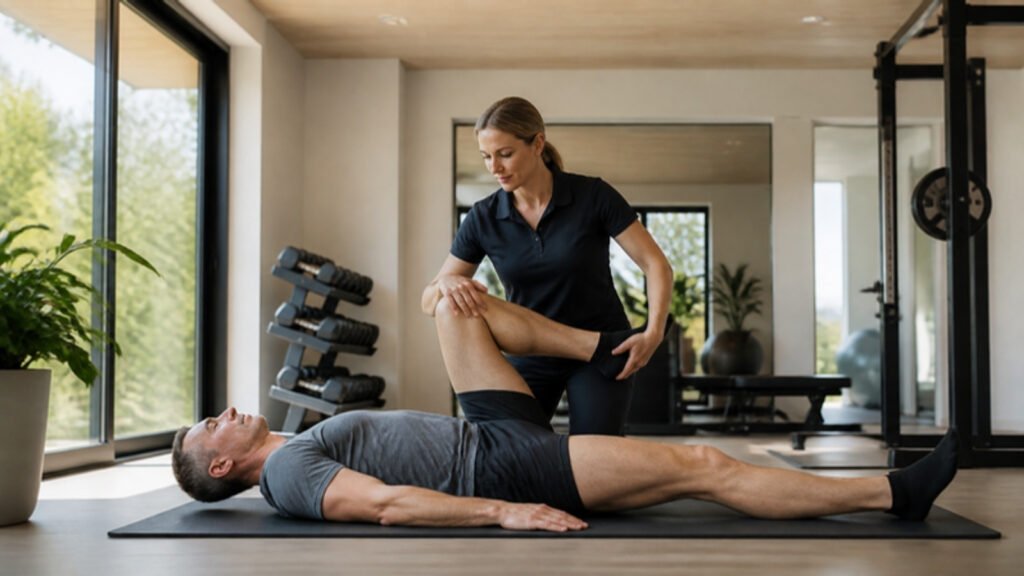
Soft tissue release, joint mobilisation, assisted stretching and post-session recovery are daily tasks in team sport, and they are among the services private families value most. Our article on the hands-on skills private families ask for describes this side of the role in more detail.
Load management and injury prevention
Team physiotherapists think in weeks and seasons, not single sessions. You are used to balancing training load, travel and recovery, spotting early warning signs and adjusting a programme before a niggle becomes an injury. With a family, the “fixture list” is their sporting and travel calendar: a skiing trip, a run of tennis lessons, a summer of sailing.
Return-to-activity planning
Graded rehabilitation with clear criteria for each stage is second nature in professional sport. The same structure works for a principal returning to golf after a back episode, provided it is explained in plain language and agreed with the family’s medical advisers.
Life on the road
If you have packed a treatment couch onto a team coach, set up a recovery room in a hotel or treated players on a long-haul flight, you already understand much of the logistics of a travelling role. Families travel continuously, and their physiotherapist travels with them.
Confidentiality
Dressing rooms run on trust. Physiotherapists in professional sport learn early that injury news, medical details and private conversations stay inside the group. That habit is essential in a private household, where every role is covered by a confidentiality agreement.
What changes day to day
| Aspect | Club or national team | Private family |
|---|---|---|
| Who you treat | A squad of athletes of similar age and goals | A small household with very different needs, from active adults to older relatives and children |
| Main goal | Availability and performance for selection | Comfort, mobility, injury prevention and long-term wellbeing |
| Team around you | Doctor, head of performance, strength and conditioning coaches, analysts | Often the only clinician present; liaison with the family’s doctor, trainer or coach |
| Calendar | Fixtures, training blocks and an off-season | The family’s calendar, with continuous travel and no fixed season |
| Decisions | Shared with the medical department and coaching staff | Agreed with the person you treat, within the plan set by the family’s medical advisers |
| Equipment | Club facilities, gym and technology | A portable set-up adapted to residences, hotels and yachts |
| Communication | Technical language with colleagues | Plain, discreet explanations to people who are not clinicians |
Adjustments that make the transition work
From a squad to a household
In a team, everyone shares broadly the same goal. In a household, you may move within one morning from hip mobility work with a principal to gait practice with an older relative and a playful coordination session with a teenager. Range matters as much as depth. Our article on balance and proprioception training across generations shows how one skill set adapts to very different people.
From a medical department to working on your own
Most team physiotherapists work within a structure: a head of medicine, a club doctor, a performance lead. In a private family you are often the only clinician in the residence. That brings clinical autonomy, and with it the responsibility to document carefully, know the limits of your scope and refer early to the family’s doctor.
From performance targets to wellbeing goals
The question is rarely “will they be fit for Saturday?” More often it is “can they play padel without pain this week?” or “can they manage the stairs at the summer house?” The tools are familiar; the definition of success is broader and more personal.
From the gym to the portable clinic
A household does not come with a club’s facilities. The physiotherapists who do well build effective programmes around simple, portable equipment and whatever space each residence, hotel or yacht offers.
From the technical briefing to the plain explanation
In sport, you explain your findings to a coach or a doctor. In a household, you explain them to the person you are treating, in clear language, at a moment that suits them, and without sharing anything beyond what is needed.
A hypothetical transition
Picture a physiotherapist with several seasons at a professional football club and some time with a national youth squad. Their first weeks with a family in Doha look very different from match week. Mornings begin with a mobility and soft tissue session for the principal, who plays tennis several times a week. Later, an older family member does a short walking and balance routine in the garden. In the afternoon, there is a recovery session after the principal’s match and a quick conversation with the family’s tennis coach about the following week. A month later, the family travels to Europe and the programme travels with them.
What carries over from the club is the structure: clear assessment, sensible progression, attention to load and recovery, and absolute discretion. What is new is the setting, the range of people and the pace, which is steadier and more personal. Our guide to your first 90 days in a live-in physiotherapist role describes how an appointment usually begins.
Is the change right for you? Questions to ask yourself
- Am I comfortable as the only clinician on site? You will need to make sound decisions within your scope and refer early to the family’s doctor.
- Do I enjoy working with a wide range of people? A household mixes athletes, older adults and children.
- Can I live with the family and travel continuously? Every role is live-in and single-status, with continuous travel across several countries.
- Am I ready to step away from the matchday atmosphere? The satisfaction comes from continuity of care rather than results on a scoreboard.
- Is discretion second nature to me? Nothing about the family is ever shared, on social media or anywhere else.
How to present a club or national-team background
Families cannot watch you on the touchline, so your CV has to show them what you do. The strongest applications from team physiotherapists usually:
- Describe the work, not just the club. Set out the hands-on, rehabilitation, load management and injury prevention work you did each week.
- Show breadth. Mention any work with older adults, private clients or mixed caseloads alongside your team experience.
- Show travel experience. Tournaments, away fixtures and training camps show that you can work well on the move.
- Stay discreet. Describe the level of sport and your responsibilities without disclosing confidential information about athletes.
Our article on elite-sport physiotherapists in private family roles explains how experience with athletes is weighed, and our piece on what private families look for in a sports physiotherapist covers how to show those skills in your CV. If most of your experience is in a hospital setting, read our guide to moving from hospital MSK outpatients to a private family role.
What families look for
- A physiotherapy qualification obtained in the UK or Europe, with current registration in the country of training. What counts is where you trained, not your nationality.
- A strong sports and manual therapy background: soft tissue release, assisted stretching, active mobility and joint mobilisation, neuromuscular and movement control, corrective exercise, movement analysis and biomechanical assessment, injury prevention, breathing and core control, proprioception and balance.
- Experience with elite athletes, professional teams or high-profile clients is a strong advantage.
- Availability to start within about six weeks and complete flexibility.
- Readiness to live with the family and travel continuously with them across several countries. Every role is live-in and single-status: partners and children do not relocate with you.
What the role offers
- A permanent, live-in appointment with the family, with annual leave.
- From £60,000 a year gross, depending on experience.
- Free private accommodation in the residence.
- Flights and travel always paid for by the family.
- Medical insurance covered. Professional indemnity insurance is not included.
The salary is agreed directly between the family and the clinician; each clinician should take advice from their own tax adviser on whether the income is taxable in their circumstances.
How the introduction works
Medical Staff Talent introduces and verifies clinicians. The engagement is contracted directly between the family and the clinician, and all local arrangements (visa, licensed entity, coordination with local clinics) remain with the family’s own office and advisers.
You can read more about the profession on our physiotherapists page and see the current role on our sports physiotherapist vacancy.
Frequently asked questions
Do I need experience with a professional club or national team to apply?
No, but it is a strong advantage. Experience with elite athletes, professional teams or high-profile clients is valued. A strong sports and manual therapy background is the essential requirement.
Will I miss the multidisciplinary team?
You will work more independently than in a club, but not in isolation. You liaise with the family’s doctor and, where relevant, with their personal trainer or coach, and you refer anything outside your scope to the family’s doctor.
Is the role seasonal like a sports contract?
No. It is a permanent, live-in appointment with annual leave, and the family travels continuously throughout the year.
Can I apply if I trained in Europe but hold a different nationality?
Yes. What counts is where you trained, not your nationality. You need a physiotherapy qualification obtained in the UK or Europe and current registration in the country of training.
Can my partner or children come with me?
No. Every role is live-in and single-status, so partners and children do not relocate with you.
How do I apply?
Send your CV in English through our confidential online form. Please do not send it as an email attachment.
Apply in confidence
If you are a UK or European-trained physiotherapist with club, national-team or elite-sport experience, can start within about six weeks and are ready to relocate alone and travel with a family, we would like to hear from you. Send us your CV in confidence.