By David Vilchez, Founder & CEO, Medical Staff Talent
→ Sports Physiotherapist (Manual & Movement Therapy) — Private Family, Dubai
In a clinic, a club or a hospital, your notes sit inside a system. There is a template on the screen, a colleague who will read them tomorrow, an auditor who checks them once a year and an administrator who knows where last spring’s records are kept. Most physiotherapists rarely think about that system until it is gone.
In a permanent, live-in role with a private family, it is gone. You may be the only clinician who sees the principal every day. Your notes may be the only continuous record of how a shoulder recovered, how a back responded to load or what was said before a family member chose to ski against advice. They travel with you between residences and countries. And the people who might one day need to read them, from a visiting surgeon to the family’s own doctor, will not have been in the room.
This article is written for Western-Trained sports and manual therapy physiotherapists considering that kind of role in Saudi Arabia, the United Arab Emirates or Qatar. It sets out how to keep clinical notes that are clear, useful and discreet when no institution is keeping them for you. It is practical guidance, not legal advice: the standards that apply to your records are those of your own professional body, and anything specific about data protection should be checked with them and with the family’s office. Where we describe a situation, it is a hypothetical example.
Why notes matter more, not less, when you work alone
It is tempting to think that one patient means lighter paperwork. In practice, the opposite is true. Good notes do four jobs in a private household, and each of them becomes more important without a team around you.
- They are your memory. Over months with the same few people, small changes blur together. Notes show you whether a programme is really working.
- They are your colleague. When there is no one down the corridor, writing your reasoning down is how you test it. We look at peer support in more depth in our guide to working as the only clinician in the house.
- They are your handover. If you are on annual leave, if a specialist is called in or if the principal has surgery abroad, someone else needs to understand the story quickly.
- They are your record of what you advised. Families make their own choices. A clear note of what you recommended, what was understood and what was decided protects everyone.
What a good note contains
You do not need a new method. The structure you were trained in still works. What changes is that every note must make sense to a reader who knows nothing about the household.
- Subjective: what the person reports, in their own words where it helps. Sleep, travel, sport and stress often matter as much as symptoms.
- Objective: what you found. Range, strength, specific tests, and the outcome measures you have chosen to track over time.
- Assessment: your working hypothesis, and why. This is the part most often skipped, and the part a visiting clinician most needs.
- Plan: what you did, what you advised, what comes next and when you will review it.
Add two things that a hospital system would normally record for you: who was present, and what consent was given for each treatment. In a residence, sessions can happen in a gym, a bedroom, a hotel suite or on a jet. Recording the setting is a small habit that answers questions later.
Outcome measures a family can understand
Notes are not only for clinicians. Over time, the family’s office will want to know whether the care is working. Choose a few measures that you can repeat consistently and explain in plain words: a pain score, a functional task that matters to the person, a range of movement, a time or distance in their chosen sport. If a principal wears a sleep or recovery tracker, our guide to using wearable data well explains how to bring it into your notes without letting it replace your clinical judgement.
For longer problems, such as the back that flares every busy season, a simple chart of a few measures over months can be more persuasive than any explanation. Our article on persistent pain in a private family shows why that longer view matters.
Confidentiality in a household
Discretion is part of every role with a private family. Notes are where it is tested most.
- Agree early who may see the records. Usually the patient, the family’s own doctor and, where the patient agrees, the specialists involved in their care. House staff, drivers and security do not need clinical detail, even when they ask kindly.
- Keep clinical notes separate from household logistics. A diary of session times can be shared with the house manager. The content of those sessions should not.
- Write as if the patient will read it. Sometimes they will. Keep notes factual, respectful and free of opinion about the family’s private life.
- Never use personal messaging or social media for clinical content. Agree a secure method with the family’s office for anything that has to be sent.
Most families will have their own expectations, often set out in a confidentiality agreement signed with your contract. Read it carefully, and if anything in it seems to conflict with the record-keeping duties of your professional body, raise it with the family’s office before you start rather than after.
Paper, tablet or app?
There is no single right answer, but there are a few questions worth asking before you choose.
- Will it travel? You may work from three or four residences a year. A system that only works on one desktop will fail you.
- Is it secure if a device is lost? Passwords, encryption and a backup that does not depend on the device itself.
- Can you produce a clear summary quickly? A surgeon in London or a doctor in Riyadh will want two pages, not two hundred entries.
- Who owns it at the end? Agree with the family’s office what happens to the records when the role ends, consistent with the retention rules of your professional body.
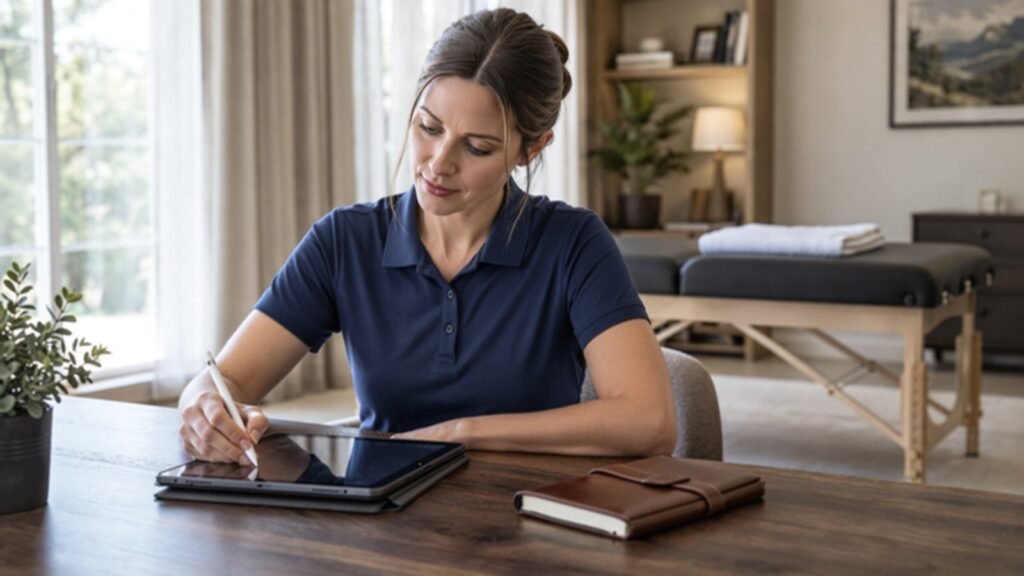
Many physiotherapists coming from their own private practice already use a clinical records app and simply continue with it. Others prefer a structured document on an encrypted tablet. What matters is that you choose deliberately and that the family’s office knows how the records are kept.
Notes as a handover tool
The moments when notes matter most are the moments when someone else takes over. Three are common in a private family.
Specialist care. When a principal has surgery abroad, your notes are often the only record of how they moved and what they could do before the operation. A short pre-operative summary, sent through the agreed channel, gives the surgical team a better baseline. Our guide to rehabilitation at home after surgery abroad describes that link in detail.
Head injuries and red flags. After a knock to the head, clear, timed notes of symptoms and decisions are essential, both for the family’s doctor and for any return to sport. We cover that process in our article on the physiotherapist’s role after a concussion.
Other professionals in the household. A personal trainer, a coach or the family’s doctor may all be part of the picture. Notes help you share the right information, and only the right information. Our guide to working alongside a family’s trainer, coach or doctor looks at that etiquette.
A hypothetical example
Picture a physiotherapist six months into a role with a family that divides its year between Riyadh, London and a summer house by the sea. The principal has had recurring shoulder pain after tennis. The physiotherapist has kept brief, consistent notes: a pain score and two strength measures each week, the training load, what was advised and what the principal chose to do.
When the principal decides to see a shoulder surgeon in London, the family’s office asks for “something the surgeon can read”. Within an hour, the physiotherapist sends a two-page summary through the agreed secure route: history, findings, the trend in each measure, what has helped and what has not. The surgeon decides that surgery is not needed yet and asks the physiotherapist to continue a modified programme. Nothing about the notes was elaborate. They were simply clear, consistent and ready.
Notes and your own career
Good record keeping is also good for you. Your professional body is likely to expect evidence of continuing practice and reflection for registration. Anonymised reflections from your notes, written without identifying the family, can support that. And when the time comes to move on, a record of the outcomes you achieved is part of the story you tell. We explore that in our article on career progression after a private family role.
The role, the terms and how we work
Medical Staff Talent introduces Western-Trained sports and manual therapy physiotherapists to private families in Saudi Arabia, the UAE and Qatar. What counts is where you trained (the UK, Europe, Australia, New Zealand, the United States or Canada), not your nationality. The roles are permanent and live-in, with annual leave; you relocate alone and travel with the family across several countries. The working pattern is six days a week with availability around the clock. You can see a current example in our sports physiotherapist role with a private family in Dubai, and more on our physiotherapists page.
The role is offered from £60,000 a year gross, depending on experience, with free private accommodation, flights and travel paid and medical insurance covered. Packages may be paid in GBP, EUR or the family’s local currency (AED, SAR or QAR). Professional indemnity insurance is not included. The salary is agreed directly between the family and the clinician; each clinician should take advice from their own tax adviser on whether the income is taxable in their circumstances.
Medical Staff Talent introduces and verifies clinicians. The engagement is contracted directly between the family and the clinician, and all local arrangements (visa, licensed entity, coordination with local clinics) remain with the family’s own office and advisers.
Frequently asked questions
Do I still need to keep notes if I only treat one family?
Yes. Your professional body’s record-keeping standards apply wherever you practise, and with one family your notes are often the only continuous clinical record. They are also your best tool for reviewing progress and handing over safely.
Who is allowed to see my clinical notes?
Usually the patient, the family’s own doctor and, with the patient’s agreement, specialists involved in their care. Agree this with the family’s office at the start. House staff and security do not need clinical detail.
Can I use my own app or software for records?
Often, yes, provided it is secure, works across the places you will be and can produce a clear summary. Tell the family’s office how records are kept and agree what happens to them when the role ends.
What should I do if a family member asks me not to write something down?
Listen to the concern, explain calmly why accurate records protect them as well as you, and keep your notes factual and respectful. If it remains an issue, discuss it with the family’s office and follow the standards of your professional body.
Will the family expect reports on progress?
Many will, usually through the family’s office. A short, regular summary in plain language, built from the outcome measures in your notes, is usually welcome and builds trust.
If you are a Western-Trained sports or manual therapy physiotherapist who takes pride in clear thinking and careful practice, send your CV in confidence. Every CV is read personally.
Send your CV in confidence