By David Vilchez, Founder & CEO, Medical Staff Talent
→ Sports Physiotherapist (Manual & Movement Therapy) — Private Family, Dubai
Ask an Austrian physiotherapist about their caseload and you will often hear about knees. Ligament reconstructions after a fall on the piste, ski tourers with overloaded hips, mountain runners with Achilles problems, and the long, careful rehabilitation that gets them back on the slopes the following winter. That alpine background turns out to be remarkably useful in an unexpected place: the households of private families in Saudi Arabia, the United Arab Emirates and Qatar, many of whom spend part of every winter skiing in the Alps.
This guide is for physiotherapists who trained in Austria and are curious about a permanent, live-in role with a private family. It covers what the work involves, why Austrian training is valued, what changes day to day and what the package looks like. For the general picture, start with our pillar guide to sports physiotherapist jobs with private families in the Gulf. If you prefer to read in German, our German-language page for physiotherapists covers the essentials.
The role in one paragraph
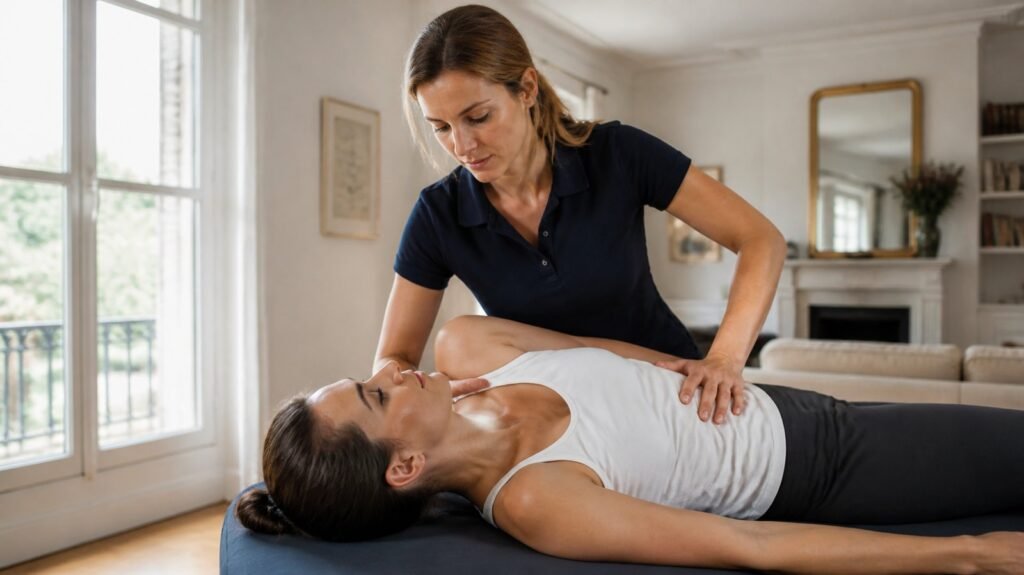
You work for one family rather than a clinic. Your patients are the people in the household: a principal who skis, plays tennis or golf and wants to stay pain-free, younger family members with sporting ambitions, perhaps an older parent recovering from surgery or at risk of falls. The work is manual and programme-based: soft tissue release, assisted stretching, joint mobilisation, neuromuscular and movement control, corrective exercise, breathing and core work, balance and proprioception. It is permanent, live-in and single-status. You relocate alone, live in private accommodation provided by the family and travel with them continuously across several countries, with annual leave.
Why Austrian training is valued
Physiotherapy in Austria is taught as a bachelor’s degree at universities of applied sciences, with substantial supervised clinical placements, and practitioners are listed in the national register of health professions. For a family office, a regulated title and a public register are exactly the reassurance they need. What counts is where you trained and that your registration there is current, not your nationality.
- Winter and mountain sports. Knee, shoulder and wrist injuries from skiing and snowboarding, return-to-slope programmes and pre-season conditioning are directly relevant to families who ski every year.
- Prevention culture. Many Austrian physiotherapists build strength and proprioception programmes before the season starts. Families value a clinician who prevents the injury rather than treats it.
- Thorough documentation. Clear, structured notes make it easy to work alongside the family’s doctor and personal trainer.
- Languages. German is useful with European staff and in Alpine resorts; fluent English remains essential.
A typical case (hypothetical)
Picture a physiotherapist who trained in Austria, worked six years in an outpatient practice near a ski region and spent several winters supporting a regional ski club. The family’s brief describes a principal with a reconstructed knee who wants to ski again safely, two teenagers who play tennis competitively and a grandmother whose walking has become hesitant. In autumn the physiotherapist runs a pre-season strength and proprioception programme for the principal in the residence gym. In January the work moves to a chalet in the Alps: short warm-ups before skiing, recovery sessions in the evening, a careful eye on fatigue. Back in the Gulf, the focus shifts to the teenagers’ tennis season and the grandmother’s balance work. Same clinician, same family, different setting every few weeks.
What changes day to day
The biggest change is time. Instead of a full appointment book, you have a handful of patients and the space to follow them closely. Sessions happen when the family is available, which can mean early mornings before travel and quiet afternoons. You agree a weekly plan with the household manager, keep your own rest protected and travel light: a portable couch, bands, a few weights, a balance board. You work without a department around you, so sound clinical judgement and knowing when to involve the family’s doctor matter more than ever.
The package
| Element | What families offer |
|---|---|
| Salary | From £60,000 a year gross, depending on experience |
| Accommodation | Private accommodation provided free of charge |
| Flights and travel | Paid by the family |
| Medical insurance | Covered |
| Professional indemnity insurance | Not included: arranged by the clinician |
| Contract | Permanent, live-in, single-status, with annual leave |
The salary is agreed directly between the family and the clinician; each clinician should take advice from their own tax adviser on whether the income is taxable in their circumstances.
Requirements
- A physiotherapy qualification obtained in the UK or in Europe, with current registration in the country where you trained. What counts is where you trained, not your nationality.
- Strong hands-on and exercise skills; experience with elite athletes, professional teams or high-profile clients is a major advantage.
- Availability to start within about six weeks and total flexibility.
- Willingness to live with the family and travel with them continuously across several countries, relocating alone.
- Fluent English and complete discretion.
Our role
Medical Staff Talent introduces and verifies clinicians. The engagement is contracted directly between the family and the clinician, and all local arrangements (visa, licensed entity, coordination with local clinics) remain with the family’s own office and advisers.
Further reading
Read balance and proprioception training, from elite athletes to older family members, our guide to your first 90 days in a live-in role and sports physiotherapists with elite athlete experience. The current opening is our sports physiotherapist job with a private family; more on how we work is on our physiotherapists page.
Frequently asked questions
Do I need Austrian nationality?
No. What counts is that you trained in Austria, the UK or elsewhere in Europe and hold current registration in that country.
Is ski injury experience relevant in the Gulf?
Yes. Many families spend part of the winter in the Alps, and knee, shoulder and wrist rehabilitation, pre-season conditioning and return-to-slope judgement are exactly what they ask for.
Do I need to speak Arabic?
No. Fluent English is required. German is a useful extra with European staff and in Alpine resorts.
What does the package include?
From £60,000 a year gross, depending on experience, free private accommodation, flights and travel paid and medical insurance covered. Professional indemnity insurance is not included.
Is it a seasonal role?
No. The role is permanent and live-in, with annual leave, and you travel with the family throughout the year.
Send your CV in confidence
If you trained in Austria and this sounds like the next step, send your CV in confidence. Every CV is read personally.
Send your CV in confidence